
Expertise note: This comparison draws on two decades of in-house die-casting and trailer-hardware production at our Ningbo factory (ISO 9001 and SAE J684 certified). It is engineering guidance, not a sales pitch.

GDC (gravity die casting) and PDC (pressure die casting) are the two mainstream permanent-mold processes for turning molten metal into precise components. Gravity die casting lets molten aluminum flow into the die under its own weight, while pressure die casting forces it in at high pressure for speed and fine detail. If you are weighing GDC vs PDC for a new part, the real difference comes down to one question: what pushes the metal into the mold? As a custom die casting manufacturer with two decades of in-house metal-forming experience, we see buyers confuse the two constantly. This guide compares how each process works, where it wins on cost and quality, and how to match the right one to your volume and geometry – without the sales fluff.
How GDC and PDC Die Casting Processes Work
Gravity Die Casting (GDC)
GDC needs no injection machine. A ladle pours molten aluminum into a steel die and gravity pulls it down; tilt-pour versions rotate the mold slowly to cut turbulence and trap fewer air pockets. Because the fill is calm, GDC parts show very low porosity and can later take T6 heat treatment to raise strength. It suits larger, simpler shapes – housings and brackets up to roughly 1000 mm on a side – where internal soundness matters more than surface polish. A custom manufacturer often picks GDC when tooling budget is tight and annual volumes sit in the low-to-medium range.
Pressure Die Casting (PDC)
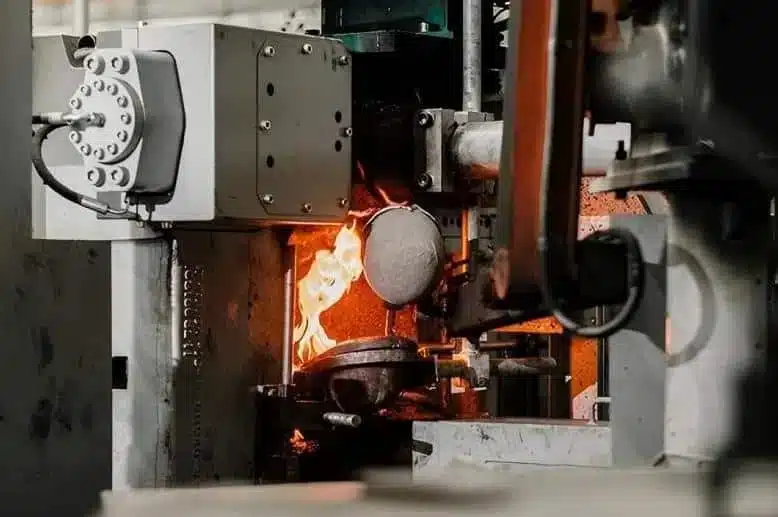
PDC uses a hydraulic plunger to inject metal at 2,000-20,000 psi (cold-chamber) in a fraction of a second. That pressure fills thin walls and fine detail gravity cannot reach, and automated cells run more than 400 shots per hour on small parts. Cycle time is just 30-90 seconds versus 2-8 minutes for GDC. The trade-off is porosity: trapped gas limits heat treatment, so most PDC parts ship as-cast. Keeping gate velocity inside NADCA’s 35-45 m/s window helps suppress defects. For high-volume, complex, small-to-medium parts, PDC is the cost-effective default. Our custom OEM/ODM manufacturing services tune alloy, gate, and die design to your drawing and volume.

GDC vs PDC: Key Differences in Speed, Cost and Quality
Speed, tooling cost, and surface quality separate the two methods sharply. The table below sums up the production gap and typical tooling investment a buyer should budget for.
| Factor | Gravity Die Casting (GDC) | Pressure Die Casting (PDC) |
| Filling force | Gravity only | 2,000-20,000 psi injection |
| Cycle time | 2-8 minutes | 30-90 seconds |
| Production rate | 20-60 cycles/hour | 400+ shots/hour (automated) |
| Tooling cost | $50,000-$180,000 | $150,000-$600,000 |
| Surface finish | Rougher, may need machining | Smooth as-cast |
| Best fit | Large, simple, low-porosity parts | Small, complex, high-volume parts |
Tooling for GDC runs about 50-65% lower than PDC, which is why a wholesale supplier quoting a large housing often steers toward gravity casting. PDC wins on tolerance and finish, so it fits visible or tightly-mated components. You see the same choice inside towing hardware: at FTrade, aluminum trailer coupler bodies and hitch ball mounts are formed by pressure die casting for tight tolerances and a smooth as-cast face our factory can ship with minimal machining. Both processes serve different needs, and many programs combine them rather than pick one.
How to Choose Between GDC and PDC Die Casting
Choose by annual volume, geometry, and what the part must do. Below about 5,000 units, GDC’s low tooling usually wins; above 50,000 units a year, PDC’s speed pays back its die. Pick GDC for large, thick-walled, safety-critical parts that need heat treatment and low porosity – engine brackets, suspension arms, heavy housings. Pick PDC for small, thin-walled, high-volume parts with complex internal cores – sensor housings, transmission cases, connectors. If a part is borderline, a short prototype run is the cheapest way to see which process fills cleanly. Always validate wall thickness, alloy, and tolerances against your own specification with a qualified supplier before committing to tooling.
Quick answers
Which process is faster?
PDC. Automated cells exceed 400 shots per hour, while GDC runs 20-60 cycles per hour because the metal takes longer to solidify and needs more handling.
Which gives the better surface finish?
PDC. Its high-pressure fill leaves a smoother as-cast surface than GDC, cutting secondary machining on visible or tightly-mated parts.