

Quick Answer
Hot chamber die casting keeps the injector submerged in the melt, so it runs low-melting alloys (zinc, magnesium) at about 15 shots per minute. Cold chamber die casting ladles metal from a separate furnace, so it can handle high-melting alloys (aluminum, copper, brass) but cycles more slowly because of the transfer step.
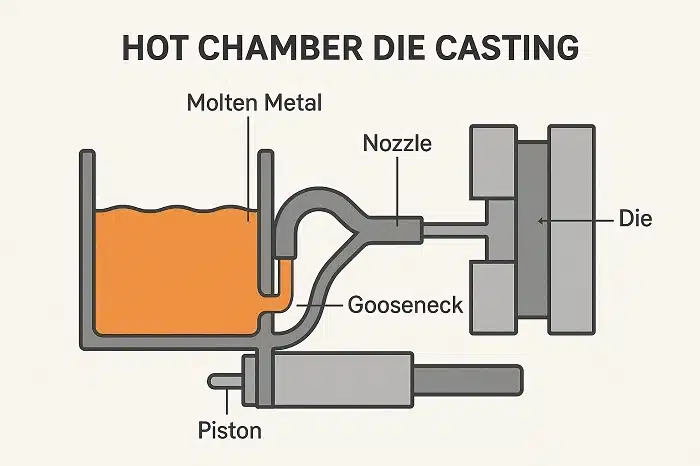
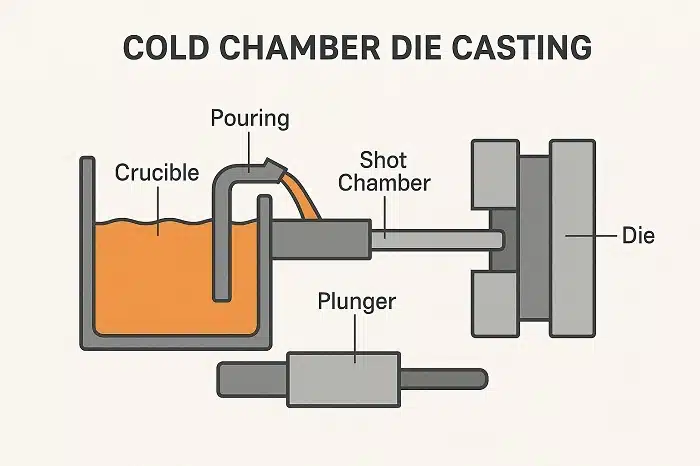
The main difference between hot and cold chamber die casting is how the molten metal reaches the die cavity. In the submerged-injector layout, the shot system sits inside the melt bath and feeds low-melting alloys like zinc through a gooseneck. In the separate-furnace layout, a ladle pours melt into an empty shot sleeve — the only safe way to run high-melting alloys such as aluminum and copper. See our full die casting capability chain for the upstream-to-downstream process map.
That one design choice cascades into every other trade-off — metal compatibility, cycle speed, part size, tooling cost, and finishing needs. The rest of this guide walks through each trade-off on our floor and ends with a short project-fit checklist.
Key Takeaways
- Hot chamber die casting uses low-melting alloys (zinc, magnesium) and runs the fastest cycle of any high-volume die casting process.
- Cold chamber die casting uses high-melting alloys (aluminum, copper, brass) and produces larger, denser structural parts.
- Pick by metal melting point first, then by volume and part size — the two decisions cascade together.
- Hot chamber wins on per-part cost for small, high-volume runs; cold chamber wins on strength and size for moderate volumes.
- A wrong match costs you in porosity, tool wear, or both — fix the metal first, then confirm with a flow study.
How Hot Chamber Die Casting Works
The Submerged Injection Process
On a hot-chamber machine the injection mechanism — gooseneck, plunger, nozzle — sits inside the holding furnace, under the melt. Because the metal is already at the nozzle, every cycle skips the ladling step. That is why hot-chamber die casting is the fastest die casting route in production today.
On our floor, the typical cycle for Zamak 3 sensor housings runs 8 to 12 seconds per shot, with a die-open window under 2 seconds for extraction. That is what makes the submerged route so cost-effective for small parts at volume.
A hot-chamber cycle follows six repeatable steps:
- The injection assembly sits in the holding furnace, submerged in the melt.
- A gooseneck connects the furnace to the die cavity.
- The plunger retracts and opens a port so molten metal fills the cylinder.
- The plunger descends, closes the port, and pushes the melt through the gooseneck into the die cavity.
- The casting solidifies inside the die; the die opens and the part is extracted.
- The cycle restarts immediately — no ladling, no waiting.
Submerging the gooseneck also cuts melt oxidation, because the metal stays under the surface between shots. That is why zinc parts come out of a hot-chamber machine with such a clean surface finish and so few porosity defects.
Suitable Materials and Applications
Hot-chamber die casting is limited to alloys that melt below about 480 °C. Zamak 3 is the workhorse for general hardware; Zamak 5 is used where higher tensile strength is needed. Magnesium alloys fill the lightweight niche for portable electronics. Tin and lead alloys remain niche applications (specialty solders, balance weights).
Aluminum and copper are out of reach — they would attack the steel gooseneck within hours. For those metals you must move to a separate-furnace layout (see the next section).
How Cold Chamber Die Casting Works

Why a Separate Furnace
Cold-chamber die casting keeps the injection system dry and pulls melt from a furnace next to the machine. A ladle — hand-operated on small cells, robot-operated on automated cells — transfers a precise shot weight into the empty sleeve. The plunger then drives the metal into the die at high pressure.
On our cold-chamber cells we run ADC12 and A380 aluminum at 660–680 °C with injection pressures between 70 and 90 MPa for thin-wall structural parts. That window matches the casting envelope described in the NADCA Product Specification Standards, which we use as our default acceptance reference for porosity and dimensional tolerance
Process Steps
A cold-chamber cycle adds one upstream step:
• Melt is held in a separate furnace at the alloy’s working temperature.
• A ladle doses a measured shot weight into the empty injection sleeve.
• The plunger seals the sleeve and drives the metal into the die cavity.
• The casting solidifies under continued pressure; the die opens and the part is extracted.
• The shot sleeve is cleaned, lubricated, and recharged for the next cycle.
The transfer step is the slowest part of the cycle — about 3 seconds for a robotic ladle versus 0.3 seconds for a submerged gooseneck. That single delta is what makes cold-chamber die casting slower than the hot-chamber route.
Cold-chamber die casting is the only safe route for high-melting alloys — primarily aluminum, plus copper and brass for specialty applications. Our aluminum die casting line covers ADC12, A380, and A383 grades with section thicknesses from 1.5 mm to 6 mm and shot weights up to about 8 kg per cycle. Aluminum is also where the cold-chamber route earns its keep — it delivers the density and strength that engine brackets, transmission housings, and pump bodies demand.
Materials and Common Uses
Aluminum die casting leads the cold-chamber segment. ADC12 and A380 are the two alloys we run most — both have good fluidity and accept thin walls down to about 1.5 mm. Copper and brass are reserved for specialty parts where conductivity or corrosion resistance matters (see Copper Development Association data sheets for the relevant alloy families).
Typical applications: automotive engine brackets, transmission housings, brake-system components, aerospace support shells, pump and valve bodies, EV battery enclosures, and lighting heat sinks. The pattern is clear — anything that needs strength, size, or thermal stability over raw cycle speed.
Key Differences: Hot-Chamber vs. Cold-Chamber Die Casting
Material Compatibility and Cycle Speed
Material compatibility drives every other trade-off. Read this table top to bottom and the rest of the decision falls into place.
| Decision Factor | Hot Chamber | Cold Chamber |
| Primary materials | Zinc (Zamak 3/5/7), magnesium, tin, lead | Aluminum (ADC12, A380), copper, brass |
| Melting point | Below ~480 °C | Above ~480 °C (typically 580–680 °C for Al) |
| Cycle speed | Up to ~15 shots per minute | Slower due to ladling (typically 3–6 shots per minute) |
| Part size | Small, thin-wall, intricate | Medium to large, structural, high-strength |
| Best-fit application | Electronics housings, sensor brackets, fasteners | Engine brackets, transmission housings, EV battery enclosures |
A buyer who needs thousands of small zinc parts at the lowest unit cost will pick hot-chamber die casting. A buyer who needs large, strong aluminum structural parts will accept the slower cold-chamber cycle because no other route matches the strength-to-weight ratio.
The trade-off table also explains why automotive die casting is dominated by the cold-chamber route — most underbody and powertrain parts are aluminum and large enough to need the structural envelope the ladling layout provides. Lighting, telecom, and electronics still pull a hot-chamber zinc share for small fasteners and brackets; medical devices sit in both camps depending on the alloy and the sterilization requirement.
Part Size, Cost, and Applications
Part size and cost come straight from the metal choice and cycle speed. Hot-chamber die casting fits small, complex parts. Zinc die casting makes thin walls and fine detail with little finishing work. The fast cycle keeps unit cost low for high-volume runs. A manufacturer often picks this route for electronics housings, sensor brackets, and small automotive components.
Cold-chamber die casting fits larger, stronger parts. Aluminum die casting leads this category. Engine blocks, transmission housings, and structural brackets need the strength and density that cold-chamber machines give. The slower cycle and separate furnace raise the unit cost. Tooling for larger parts also costs more. A supplier must weigh those costs against the part’s performance needs.
Key differences at a glance:
- Material compatibility: hot-chamber die casting uses zinc, tin, and lead alloys; cold-chamber die casting uses aluminum, magnesium, and copper.
- Cycle speed: hot-chamber die casting is faster because the injector stays submerged; cold-chamber die casting is slower because of ladling.
- Part size: hot-chamber die casting makes small parts; cold-chamber die casting makes large parts.
- Cost: hot-chamber die casting offers lower unit cost at high volume; cold-chamber die casting carries higher tooling and material costs.
- Applications: hot-chamber die casting serves electronics and small auto parts; cold-chamber die casting serves automotive and industrial equipment.
These trade-offs guide the choice between the two chamber die casting methods. A buyer who needs small zinc parts at high volume will favor hot-chamber die casting. A buyer who needs large aluminum parts will accept the slower cold-chamber die casting route. The next section explains how to match each process to a specific project.
Choosing the Right Chamber Die Casting Process
Matching Process to Project Requirements
The metal’s melting point is the main thing to think about when picking a chamber die casting method. Hot chamber die casting only works with alloys that melt at low temperatures, like zinc and magnesium. Cold chamber die casting handles metals that melt at high temperatures, such as aluminum, brass, and copper. A manufacturer cannot swap one process for the other when the alloy needs certain heat conditions.
Production volume shapes the decision next. Hot chamber die casting is great for fast, mass production of small parts. The submerged injection system allows quick cycling without any hand transfer steps. Cold chamber die casting fits moderate volume runs or projects where slower speed is okay. Larger, complex, or structural parts usually need the cold chamber method because they require higher injection pressure and denser castings.
Part complexity and size also matter. Hot chamber die casting is best at smaller, less complex parts with better surface finish and looks. Cold chamber die casting makes larger parts with higher strength and tighter tolerances. A buyer who needs small zinc components at high volume will find hot chamber die casting more efficient. A buyer who needs large aluminum structural parts will accept the slower cold chamber die casting route.
Key Factors: Material, Volume, and Budget
Budget considerations tie directly to tooling and material costs. Hot chamber die casting often has lower initial equipment costs because its structure is simpler. However, maintenance costs run higher over time because key components stay exposed to molten metal and wear out faster. Cold chamber die casting involves higher equipment and tooling costs upfront. Maintenance costs stay lower during normal operation because components face less direct molten metal contact.
| Decision Factor | Hot Chamber Die Casting | Cold Chamber Die Casting |
|---|---|---|
| Material requirements | Zinc or magnesium | Aluminum, brass, or copper |
| Production volume | High-speed, mass production | Moderate volume or slower speed |
| Part size | Smaller, less complex parts | Larger, structural parts |
| Initial cost | Lower setup cost | Higher setup cost |
| Maintenance | Higher over time | Lower during operation |
Production volume affects total manufacturing cost and cost per part. Higher quantities spread fixed expenses such as tooling and setup over more units. A die costing $50,000 adds $50 per part if only 1,000 units are made, but only $0.50 per part if 100,000 units are produced. Die casting becomes more valuable when part designs are stable and production volumes are high enough to justify the upfront tooling investment.
For businesses seeking a reliable partner, MORELUX stands out as a precision die-casting manufacturer based in Malaysia. The company offers one-stop solutions for aluminum, zinc, and copper alloys. MORELUX brings expertise in tooling design, CNC machining, and finishing services. The manufacturer serves industries such as automotive, medical, and electronics with high-quality metal components. Their tooling design uses advanced CAD and flow simulation to ensure efficient, cost-effective molds. This approach helps buyers achieve optimal part quality and manufacturing efficiency.
Hot chamber die casting works well for metals that melt at low temperatures, like zinc. It also runs very fast. Cold chamber die casting handles metals that melt at high temperatures, like aluminum. It is best for larger, stronger parts. The metal’s melting point is the first thing to choose by. Then production volume and cost matter next. Zinc die casting and aluminum die casting each need the correct machine. A wrong match hurts part quality and raises total cost. A manufacturer must think about tooling, machining, and finishing together. MORELUX is an experienced manufacturer that helps buyers pick the right process. Their team helps with tooling design, machining, and finishing for reliable results. This partnership protects part quality and manufacturing efficiency for every die casting project.
FAQ
Which metals work with each chamber die casting method?
Hot chamber die casting works with zinc, tin, and lead alloys. These metals melt at low temperatures. Cold chamber die casting works with aluminum, magnesium, and copper. These metals melt at high temperatures. A manufacturer cannot use aluminum in a hot chamber machine because the melted metal would harm the injection system.
Why is hot chamber die casting faster than cold chamber die casting?
The injection mechanism stays under the melted metal during hot chamber die casting. This design lets the metal flow right into the die. Cold chamber die casting needs a ladle to move metal from a separate furnace into the shot chamber. That extra step adds time to every cycle.
What types of defects appear in each process?
Hot chamber die casting makes fewer porosity defects because the submerged system cuts down on oxidation. Zinc die casting gives great surface finish with very few defects. Cold chamber die casting may show more porosity because the ladling step brings in air. Aluminum die casting needs higher injection pressure to reduce internal voids.
How does tooling cost compare between the two methods?
Hot chamber die casting uses simpler tooling and lower starting equipment costs. However, maintenance costs run higher over time because parts stay exposed to melted metal. Cold chamber die casting needs higher upfront tooling investment. Maintenance costs stay lower during operation because the injector faces less direct heat.
Can a factory switch between hot and cold chamber methods?
No. A factory cannot run both processes on the same machine. Each method needs different equipment, tooling, and safety systems. A supplier must pick the correct process based on the metal’s melting point. Switching would require a complete equipment change and new die setup.