
Casting shapes far more of the modern car than most drivers realize. If you have ever wondered what automobile parts are made by casting, the straightforward answer is: a large share of the metal components under the hood, behind the dash, and along the chassis are produced this way. The process forces molten aluminum, zinc, or copper into a steel mold at high pressure, forming strong, thin-walled, repeatable parts at scale. Lightweight cast parts also drive better fuel economy and longer EV range, so casting content keeps growing in both zones. A precision die casting manufacturer typically runs this process for OEMs and Tier-1 suppliers. For a part-by-part breakdown of how castings are applied in vehicles, dedicated automotive die-casting resources map engine, transmission, structural, and electronic components across multiple alloys. This guide walks through the main part families, the materials behind them, and the engineering trade-offs to weigh.
Engine and Transmission Parts Produced by Die Casting
Engine components
Aluminum die casting dominates the engine bay. Engine blocks, cylinder heads, and pistons are cast in aluminum because the metal is light, conducts heat well, and resists corrosion. In production, aluminum is typically cast at around 650 degC using cold-chamber high-pressure die casting. Common alloys include AA 380 – roughly 9% silicon and 3.5% copper – which balances strength and castability, and AA 390, a high-silicon grade built for wear resistance in cylinder bores. A cast aluminum block is also markedly lighter than a machined billet while keeping the rigidity the combustion cycle needs. Per NADCA’s casting standards, high-pressure die casting injects metal at roughly 10,000-20,000 psi (about 70-140 MPa), which is what enables the thin walls and tight tolerances cited above. For the alloy-selection and tolerance detail behind these parts, the aluminum die casting overview lays out the common grades and their trade-offs.
Transmission parts
Transmission cases and housings must hold tight tolerances under continuous load. Die casting delivers that precision and a smooth surface finish in a single shot, cutting downstream machining and assembly steps. A well-cast housing also damps vibration better than a welded stamping, helping keep gear noise low.
The table below maps the most common cast automobile parts to the alloy and process that fit them:
| Part family | Typical alloy | Process | Design note |
| Engine block / cylinder head | Aluminum A380 / AA 390 | Cold-chamber HPDC | Near-net shape; light, heat-resistant |
| Transmission case / housing | Aluminum A380 / A360 | Cold-chamber HPDC | Tight tolerance, less machining |
| Suspension arm / bracket | Aluminum / Zinc | HPDC | Weight down, stiffness kept |
| Gear / sprocket / connector | Zinc (Zamak 3) | Hot-chamber HPDC | Plus/minus 0.001 in, thin walls |
| Sensor / airbag / lidar housing | Aluminum / Zinc | HPDC | Precise fit, EMI shielding |
| Fuel / brake / steering part | Aluminum / Zinc | HPDC | Corrosion-resistant, traceable |
Structural, Suspension, and Body Parts Made by Casting
Suspension and structural components
Suspension arms, brackets, frames, and strut mounts are natural casting candidates. Moving from stamped or forged assemblies to aluminum or zinc castings drops vehicle weight while keeping structural integrity, which directly improves fuel economy and handling. For small, complex clips and connectors, zinc die casting is the practical choice: its low 419.5 degC melt and high fluidity fill thin walls and hold plus/minus 0.001 in repeatability. In high-volume runs of small parts, hot-chamber zinc die casting can exceed 2,000 units per hour – a rate tied to the metal’s low melting point and fast fill, not a claim that applies to all castings. The zinc die casting process page details how that cycle time and tolerance are achieved.o to zinc. Our zinc die casting service covers brackets, gears, and connector housings at wholesale volume.

Exterior and interior body parts
Door handles, mirror brackets, steering-wheel frames, dashboard trims, and HVAC components are all made by casting, blending appearance with structural strength. HVAC impellers and vent frames benefit from the same one-shot accuracy, merging form and function in a repeatable step.
Electronic Housings, Braking Parts, and How to Spec a Casting
Electronic and sensor housings
Today’s vehicles are computers on wheels, and casting protects the electronics. Housings for sensors, airbags, lidar, telematics, and motor covers demand a precise fit and shielding. Lidar and ADAS brackets in particular rely on cast aluminum for stiffness at low mass. Die casting forms these shells accurately so sensitive electronics survive heat, vibration, and dust.
Fuel, steering, and braking systems
Lightweight, corrosion-resistant castings also appear in fuel-intake parts and in power-steering and braking components, where safety is non-negotiable and full traceability matters.
Casting temperature by metal (degC) – a lower melt means faster cycles and less energy:
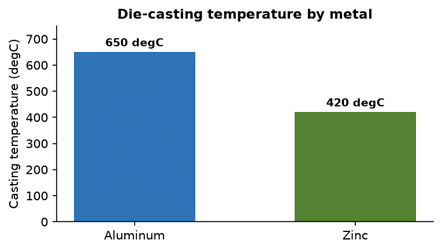
Figure 1. Typical die-casting temperature – aluminum ~650 degC vs zinc ~420 degC.

How to choose the right process
Whether a part should be die cast – and in which alloy – comes down to a few engineering questions: how complex is the geometry, what is the annual volume, and what tolerance and surface finish are required? Aluminum suits larger structural and thermal parts; zinc suits small, thin-walled, high-precision parts; magnesium is lighter still but used less often. For safety-critical components, validate the supplier’s quality system (IATF 16949:2016 for automotive, plus ISO 9001:2015) and its in-house controls such as X-ray, CMM, and spectrometry. A short prototype run before full production is the cheapest way to catch a design that fills poorly in the die.
Quick answers
Are engine blocks really made by casting?
Yes. Most modern engine blocks and cylinder heads are aluminum die cast for weight savings and heat management.
Which metal is best for small auto parts?
Zinc. Its low melt and high fluidity allow thin walls and plus/minus 0.001 in repeatability, ideal for gears, connectors, and clips.