

Zinc die casting is widely used because it produces parts with high strength, durability, and excellent dimensional accuracy. Zinc alloys, such as Zamak 5, flow easily during the casting process, allowing manufacturers to create thin walls and complex shapes with excellent accuracy. This makes zinc die casting suitable for industries such as automotive, electronics, and aerospace that require reliable and highly detailed components. Compared with materials such as aluminum (A380) and plastic (PA66 30% GF), zinc alloys offer high tensile strength of about 330 MPa and can achieve extremely thin wall thicknesses of around 0.15 mm. In addition, zinc die casting molds can last for more than 1,000,000 production cycles, which helps reduce manufacturing costs in high-volume production.
Key Takeaways
- Zinc die casting produces strong yet relatively lightweight components. These parts are great for cars and electronics.
- The process provides excellent precision, producing parts with tight tolerances and detailed geometries. This means less extra work is needed.
- Zinc alloys melt at lower heat. This saves energy and helps tools last longer than with aluminum or magnesium.
- Zinc die cast parts do not rust or wear out easily. They work well in tough places and last a long time.
- Using zinc die casting can cut costs but still keep good quality. This makes it a smart pick for companies.
What Is Zinc Alloy?
Zinc alloys are important in die casting because they move easily and fill molds with hard shapes. Most zinc alloys melt between 380 and 420°C. This melting point keeps the alloy liquid so it can reach every part of the mold. Zinc die casting uses this to make parts with thin walls and small details.
Zinc alloys flow easily into small mold cavities. They can make parts with very close measurements and do not shrink much. Magnesium alloys also fill thin molds well, but zinc alloys can make even smaller details.
Many parts are made as exact as ±0.02 mm. This is very helpful for thin wall parts. Zinc die castings keep these close measurements for a long time, even when it is warm.
| Dimension Range | Standard Commercial Tolerance |
|---|---|
| Up to 25mm | ±0.1mm |
| 25mm to 50mm | ±0.15mm |
| 50mm to 150mm | ±0.2mm |
| 150mm to 300mm | ±0.3mm |
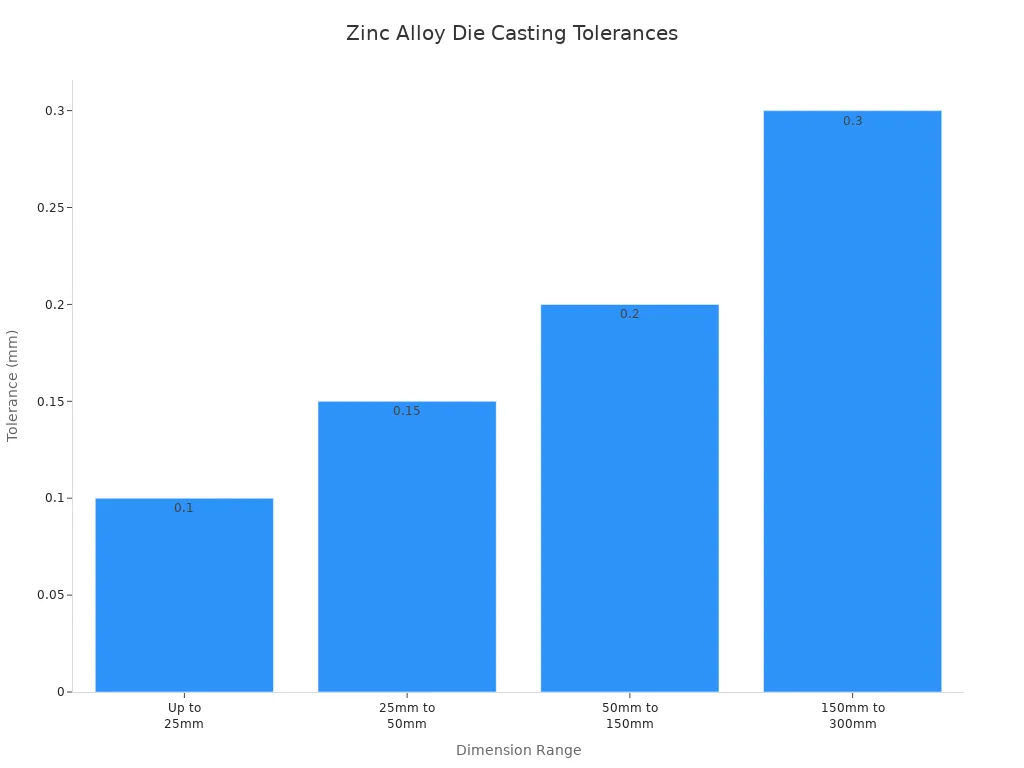
Zinc die casting also means less extra work is needed after making parts. Zamak melts at a lower temperature, so hot chamber die casting can be used. This way uses less energy and helps machines do more work. Machines doing more work means people do less, parts are made faster, and there is less waste. These things help companies save money and make parts more exact.
- Zinc alloys help lower costs when making parts.
- The hot chamber way uses less energy than aluminum’s cold chamber way.
- Using machines in zinc die casting means less work for people and less extra work.
Zinc alloys let people make parts with thin walls, close measurements, and hard shapes. Companies use zinc die casting to make exact parts that do not need much fixing. As a result, manufacturers can achieve consistent quality while maintaining high production efficiency.
Strength and durability of zinc die casting

Mechanical Strength
Zinc die casting is well known for its high mechanical strength. Engineers pick zinc alloys because they are strong but not heavy. Zinc alloys are much stronger than aluminum. They are about two and a half times stronger. This means zinc parts can take more force without getting heavier.
- Zinc alloys provide excellent durability and thermal conductivity compared with many alternative materials.
- Car makers use zinc die casting for brackets and supports. These parts help cars stay safe and stiff.
- Zinc’s strength and ability to bend keep parts from breaking under stress. Making parts with care also makes them lighter, so cars use less fuel.
Zinc alloys have good mechanical properties. This is why they work well in tough jobs. The table below shows how different zinc alloys compare:
| Property | Alloy 2 | Alloy 3 | Alloy 5 | Alloy 7 |
|---|---|---|---|---|
| Ultimate tensile strength (MPa) | 359 | 283 | 328 | 283 |
| Yield stress, 0.2% offset (MPa) | 221 | 221 | 228 | 221 |
| Elongation in 50 | 7% | 10% | 7% | 13% |
| Hardness, Brinell 500 | 100 | 82 | 91 | 80 |
| Shear strength (MPa) | 317 | 214 | 262 | 214 |
| Compressive strength, 0.1% offset (MPa) | 641 | 414 | 600 | 414 |
| Impact strength (J) | 47 | 58 | 65 | 58 |
| Fatigue strength, 5×10^8 cycles (MPa) | 58.6 | 47.6 | 56.5 | 46.9 |
| Young’s modulus (MPa) | 85.5 | 85.5 | 85.5 | 85.5 |
Impact resistance is also important. The table below shows how zinc alloys do:
| Alloy | Impact Strength |
|---|---|
| Zamak 3 | Moderate |
| Zamak 5 | Slightly lower |
| ZA-8 | Higher than Zamak 3 |
Zinc die casting helps molds and tools last longer. The process uses a lower melting point. This means molds do not wear out fast. The table below shows how long tools last for zinc and aluminum:
| Material | Tool Life (Shots) | Notes |
|---|---|---|
| Zinc Die Casting | Over 1,000,000 | Lower melting point and less abrasive, leading to reduced mold damage. |
| Aluminum Die Casting | 100,000 | More abrasive, resulting in shorter mold life. |
Manufacturers use zinc die casting for parts that need to last. The process makes strong and exact parts for cars, electronics, and machines.
Wear and Corrosion Resistance
Zinc die cast components offer strong resistance to wear and corrosion. This makes it good for parts that get wet, touch chemicals, or face hot and cold. Zinc alloys keep their shape and strength for many years.
- Zinc alloys combine strength, moderate weight, and strong corrosion resistance. These things make it good for cars.
- The process lets companies make many parts at once and not need much fixing. This keeps parts the right size and looking nice, which is important for cars.
- Zinc die casting is used for small gearbox parts, like cases and gears. These parts need to be made just right and last a long time.
How well zinc die castings fight rust depends on where they are used. The chart below shows how zinc alloys do in different places:
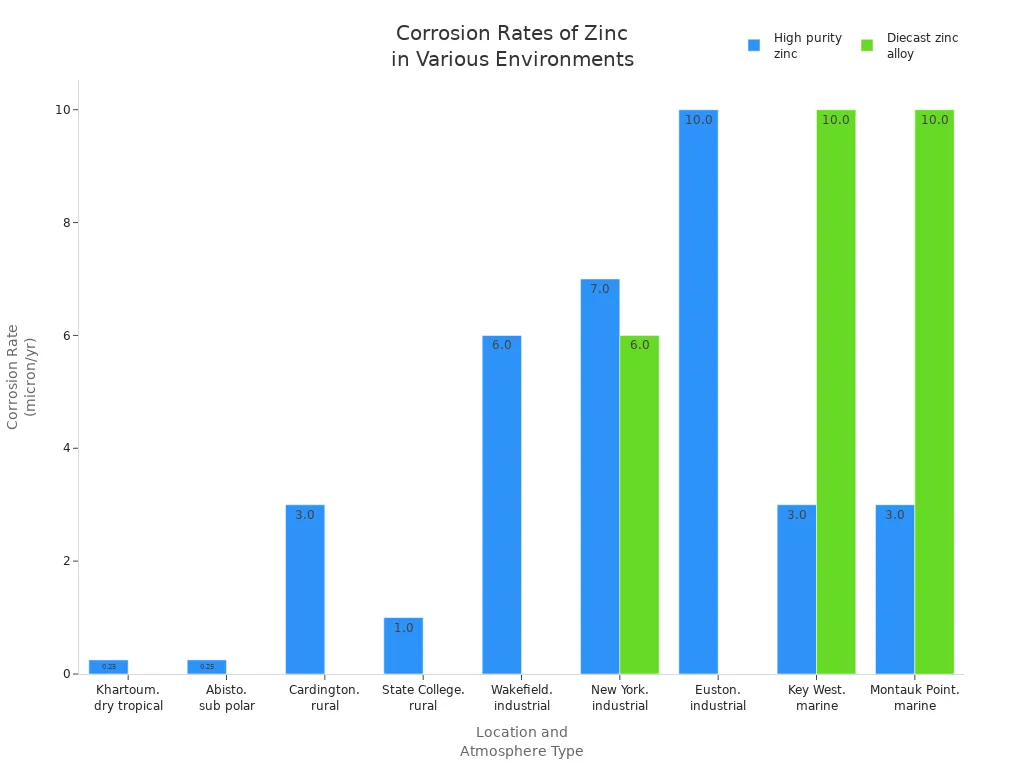
Zinc die casting parts work well even in hard places. Many electric car makers use zinc die cast cases for sensors and control boxes. These cases keep the electronics safe and make building easier. Zinc’s toughness makes sure parts keep working, even in bad weather.
Zinc die casting gives companies trust in their parts. The parts do not rust, wear out, or break easily. This makes zinc die casting a great choice for hard jobs.
Cost efficiency of zinc die casting
Low Melting Point
Zinc alloys have a significantly lower melting point than many commonly used casting metals. Most zinc alloys for die casting melt between 380 and 390 °C (716–734 °F). Because of this, machines use less energy to melt zinc. Factories can save money on power and fuel. The process is also faster since zinc heats up and cools down quickly.
| Property | Typical Value (Zamak 3) | Significance |
|---|---|---|
| Melting Point Range | 380–390 °C (716–734 °F) | Enables low-energy melting and short cycle times |
Zinc’s low melting point lets factories use hot chamber die casting. This way is quicker and uses less energy than the cold chamber process for aluminum. Companies can make more parts in less time. The molds also last longer because the process is gentle.
Tool Life and Maintenance
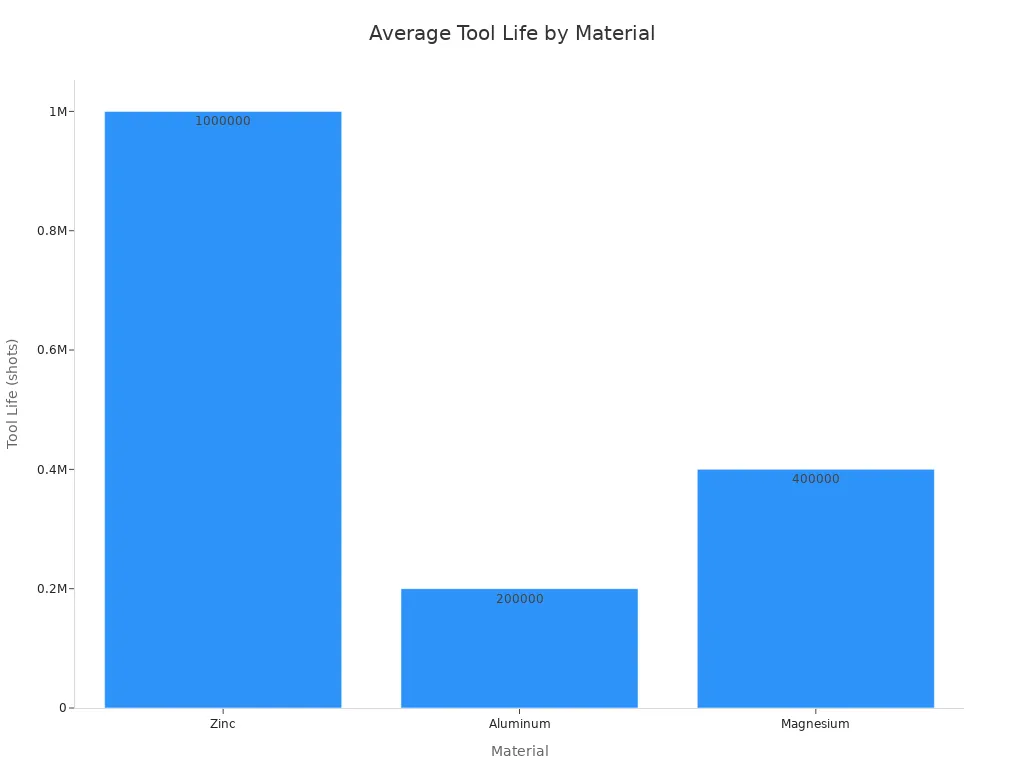
Zinc die casting tools last longer than tools for aluminum or magnesium. The lower temperature puts less stress on the molds. Factories do not have to change tools as often. This saves money on repairs and keeps work going smoothly.
| Material | Average Tool Life (shots) | Maintenance Interval |
|---|---|---|
| Zinc | 1,000,000 | Lower maintenance costs |
| Aluminum | 200,000 | Regular maintenance required |
| Magnesium | 400,000 | Frequent replacement needed |
Zinc die casting is great for making lots of detailed parts. The process makes pieces with close measurements and smooth surfaces. Many factories pick zinc because it lets them make many parts with less stopping. Zinc alloys are strong and fight rust, so finished parts need less fixing later.
Tip: Using zinc die casting helps companies save money, use less energy, and keep machines working longer.
Applications of zinc die casting
Complex Designs
Zinc die casting is great for making parts with hard shapes and small details. Engineers can produce parts with ultra-thin walls and tight dimensional tolerances. They can also add tiny features that are hard to make with other metals. This way of making parts works fast and gives the same results every time for small and medium pieces.
| Feature | Zinc Die Casting | Other Metals (e.g., Aluminum) |
|---|---|---|
| Design Complexity | High complexity with tight tolerances | Moderate complexity |
| Wall Thickness | Ultra-thin walls (0.6–3.0 mm) | Thicker walls typically required |
| Production Efficiency | High production efficiency | Varies, generally lower |
| Dimensional Accuracy | High dimensional repeatability | Moderate to high |
| Suitable Applications | Small to medium precision components | Broader applications, less precision |
Zinc die casting works well with many ways to finish parts. Plating makes parts look better and keeps them from rusting. Powder coating puts a strong layer on big surfaces. Polishing takes away tool marks and makes parts shiny and smooth. These finishing steps help every part pass tough quality checks.
Note: It is important to clean parts before finishing. Clean parts stop bubbles and peeling, which can hurt the final product.
Many businesses use zinc die casting to get strong and exact parts. Car companies use it for engine parts, brackets, and boxes for electronics. Electronics and telecom companies pick zinc die casting for connector cases, LED light covers, and antenna brackets. Medical device makers use it for tool covers and test equipment. Other areas like home goods, green energy, and factory machines also use zinc die casting because it can do many jobs.
MORELUX makes top-quality zinc die casting parts for these jobs. The company’s skill helps every part stay strong, exact, and look good.
Zinc Die Casting vs Other Metals
Zinc vs Aluminum
Zinc die casting is better than aluminum in many ways. Zinc molds last a lot longer than aluminum molds. A zinc mold can be used about 1,000,000 times. An aluminum mold is used only about 100,000 times. This means factories do not need to change zinc molds as much. They save both money and time.
Zinc die casting can make more detailed shapes. The process keeps parts very exact, up to 0.05 mm or less. This helps because there is less extra work needed after. Zinc flows well into thin and tiny spaces in molds. This makes it easy to make parts with close measurements.
Making parts with zinc costs less than with aluminum. Zinc melts at a lower temperature, so it uses less energy. The table below shows how the costs are different:
| Cost Factors | Aluminum Die Casting | Zinc Die Casting |
|---|---|---|
| Raw Materials | $2-4 | $2-3 |
| Tooling Life | 100,000-500,000 shots | 500,000-1,000,000 shots |
| Cycle Time | 30-60 seconds | 15-30 seconds |
| Secondary Processing | Moderate | Low |
| Per Part Cost | $0.75-3.00 | $0.50-2.00 |
Zinc die casting is a good choice for making lots of parts. Zinc molds are cheaper and last longer. Zinc parts also need less fixing, so the total cost is lower.
Zinc vs Magnesium
Zinc die casting makes parts that are always the right size. Zinc parts stay the same, even when making thousands of them. Magnesium can make light parts, but zinc is better for strong and exact parts.
Zinc alloys move easily and fill thin and hard shapes. This helps factories make parts with walls as thin as 0.8 mm. Zinc parts often do not need much extra work after casting. This saves both time and money.
| Advantage | Description |
|---|---|
| Tight Tolerances | Zinc die casting provides extremely tight tolerances, essential for precise fitment and functionality. |
| Consistency | Maintains accuracy across thousands of identical parts, ensuring consistency and reducing secondary machining. |
The best thing about custom zinc die casting is its high accuracy. Each part is made the same size, so there is less extra work needed after.
Factories pick zinc for parts that must be strong, exact, and not cost too much. Zinc alloys do not wear out or rust easily, so they are good for tough jobs. Zinc also makes a smooth surface, which is great for painting or plating.
Zinc die casting stands out because it combines multiple manufacturing advantages. Companies pick it for these reasons:
- It costs less to make parts.
- The parts are strong and last a long time.
- The size and shape of parts are very exact.
These advantages make zinc die casting a reliable manufacturing solution for many industries. The table below lists the main good points:
| Advantage | Description |
|---|---|
| High Precision | Makes parts with close sizes and tiny details |
| Strength and Durability | Parts do not wear out and work well in tough places |
| Versatility | Used for cars, medicine, and home products |
MORELUX helps companies do well with smart zinc die casting methods.
FAQ
What makes zinc alloys ideal for die casting?
Zinc alloys move into molds very easily. They can fill tiny spaces and shapes. Engineers use zinc to make thin walls and hard designs. Factories pick zinc to make parts fast and exact.
How long do zinc die casting molds last?
Zinc die casting molds can be used over 1,000,000 times.
This helps factories save money and stop work less often.
Can zinc die cast parts resist corrosion?
Zinc die cast parts do not rust easily. They work well in wet or rough places. Many companies use zinc for parts that must stay strong and not rust.
Which industries use zinc die casting?
- Automotive
- Electronics
- Telecommunications
- Medical devices
These jobs need parts that are strong and exact. Zinc die casting gives them what they need.
What finishing options are available for zinc die cast parts?
| Finishing Method | Benefit |
|---|---|
| Plating | Makes parts look better |
| Powder coating | Gives more protection |
| Polishing | Makes parts smooth |
Factories pick how to finish parts based on what they will do.