
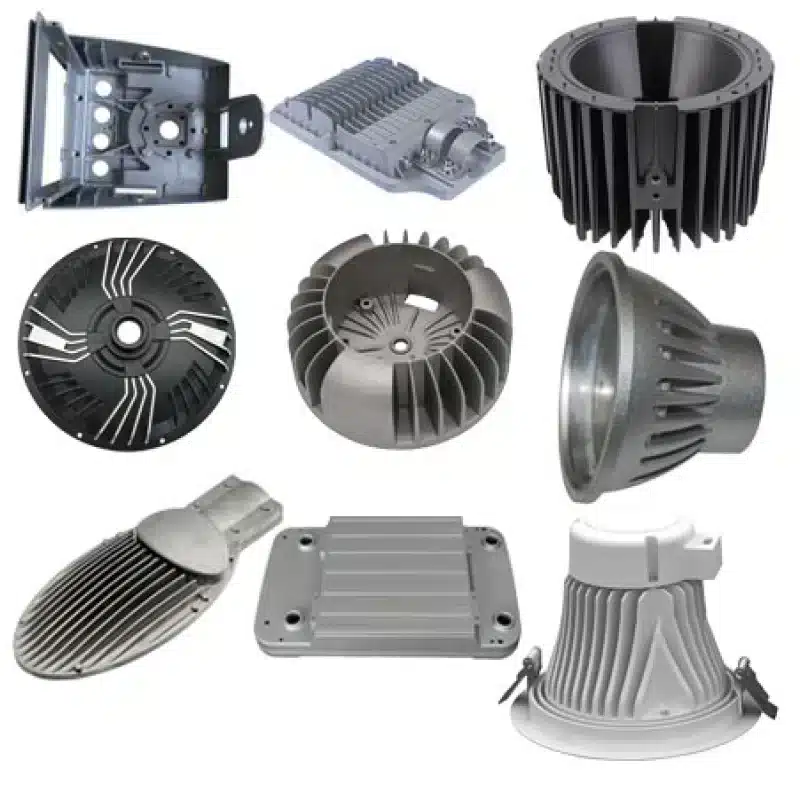
Many industries use specialty aluminum alloys for die casting to manufacture high-strength parts. The most commonly used alloys include A380, A360, A413, ADC12, B390, and ADC10. Each alloy has its unique properties, such as high strength, rust resistance, or good pressure resistance. Choosing the right aluminum alloy is crucial for both product performance and cost. MORELUX is a trusted die casting solutions company with extensive experience in aluminum die casting for the automotive, electronics, and medical device industries.
Key Takeaways
- A380 is the most commonly used aluminum alloy in die casting. It is strong, lightweight, and versatile.
- Choosing the right aluminum alloy is crucial. If you require corrosion resistance, A360 is a good choice. B390 is more wear-resistant. This helps ensure good product performance and durability.
- Aluminum die casting alloys are reusable, making them environmentally friendly. Furthermore, it helps reduce waste and save energy.
- MORELUX selects the best aluminum alloys for each project, a strategy that has proven highly effective in the automotive and electronics industries.
- Understanding the unique characteristics of each alloy helps engineers make informed choices. This not only leads to superior designs but also saves costs during production.
Aluminum Used for Die Casting Alloys

A variety of special aluminum alloys are used in die casting. Each alloy has unique properties, making it suitable for different products and industries. MORELUX selects the best aluminum alloys for each project, producing high-quality components for automotive, electronics, and medical devices.
A380 Alloy Overview
A380 is the most commonly used aluminum alloy in die casting. It contains approximately 8.5% silicon and 3.5% copper. Silicon helps improve the metal’s fluidity and reduce shrinkage. Copper enhances the alloy’s strength and hardness. A380 is strong, lightweight, and resistant to wear.
| Element | Percentage |
|---|---|
| Silicon | 7.5-9.5% |
| Copper | 3-4% |
| Iron | Small amount |
| Manganese | Small amount |
| Other elements | Small amounts |
| Property | Value |
|---|---|
| Tensile Strength (Ultimate) | 324 MPa |
| Yield Strength (0.2% offset) | 160 MPa |
| Elongation (in 50mm) | 3.5% |
| Shear Strength | 190 MPa |
| Hardness | 80 Brinell |
| Impact Strength | 4 J |
A380 aluminum used for die casting is found in many things:
- Car housings and transmission cases
- Electronic boxes and LED lights
- Engine parts, brackets, and telecom gear
- Hand tools, office machines, and outdoor lights
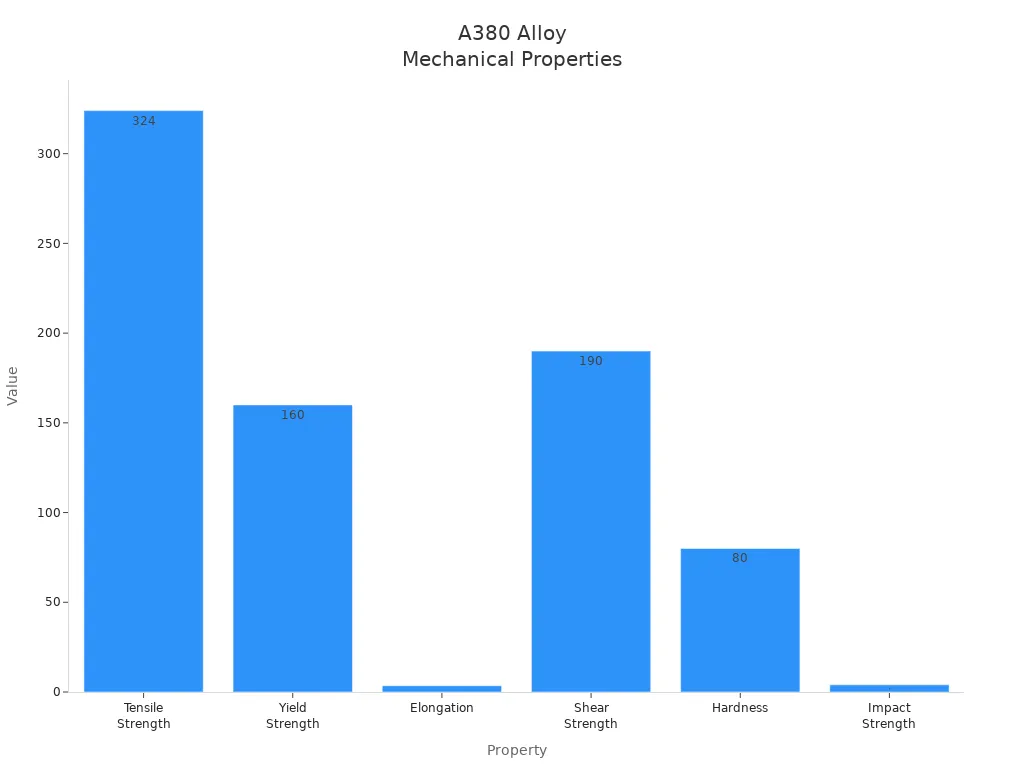
MORELUX likes to use A380 because it works well for many jobs and is very reliable.
A360 Aluminum Alloy Overview
A360 is another important aluminum alloy used in die casting. Compared to A380, it has a higher silicon content (9.0-10.0%) and a lower copper content. This makes A360 more fluid and more resistant to corrosion. It maintains its strength even at high temperatures and will not break when bent.
A360 aluminum alloys are used in:
- Car parts like oil pans and motor covers
- Marine equipment like outboard motors
- Hydraulic cylinders and pressure-tight parts
- LED lamp covers and 5G boxes
A360 is a great pick for parts that need to fight rust, especially in water or outside.
Overview of A413 Alloy
The unique features of A413 alloy are its ease of casting, high strength, and light weight. It also has good thermal conductivity and is resistant to cracking at high temperatures. These properties make it ideal for manufacturing complex-shaped parts that need to withstand high temperatures.
| Property | Description |
|---|---|
| Strength-to-Weight Ratio | High, suitable for strong but light parts |
| Castability | Excellent, good for intricate components |
| Thermal Conductivity | Superior, helps with heat management |
| Hot Cracking Resistance | High, improves durability during casting |
| Fluidity | Superior, allows for complex geometric shapes |
A413 aluminum alloy, used in die casting, is commonly found in the automotive and electronics industries. These parts require specific shapes and must possess excellent thermal control properties.
ADC12 and ADC10 Alloys
ADC12 and ADC10 are commonly used aluminum alloys in Asia and globally. They differ in composition and processing properties.
| Criteria | ADC10 | ADC12 |
|---|---|---|
| Composition | More silicon and iron | More copper |
| Tensile Strength | Around 310 MPa | Around 290 MPa |
| Yield Strength | About 140 MPa | About 130 MPa |
| Hardness (Brinell) | About 85 HB | About 80 HB |
| Elongation | Around 3% | Around 2.5% |
| Castability | Good, less fluid in complex molds | Better, preferred for intricate casting |
| Corrosion Resistance | Decent | Better |
| Thermal Conductivity | Slightly better | Lower |
| Applications | Automotive, electrical, engineering | Electronics, high-precision automotive |
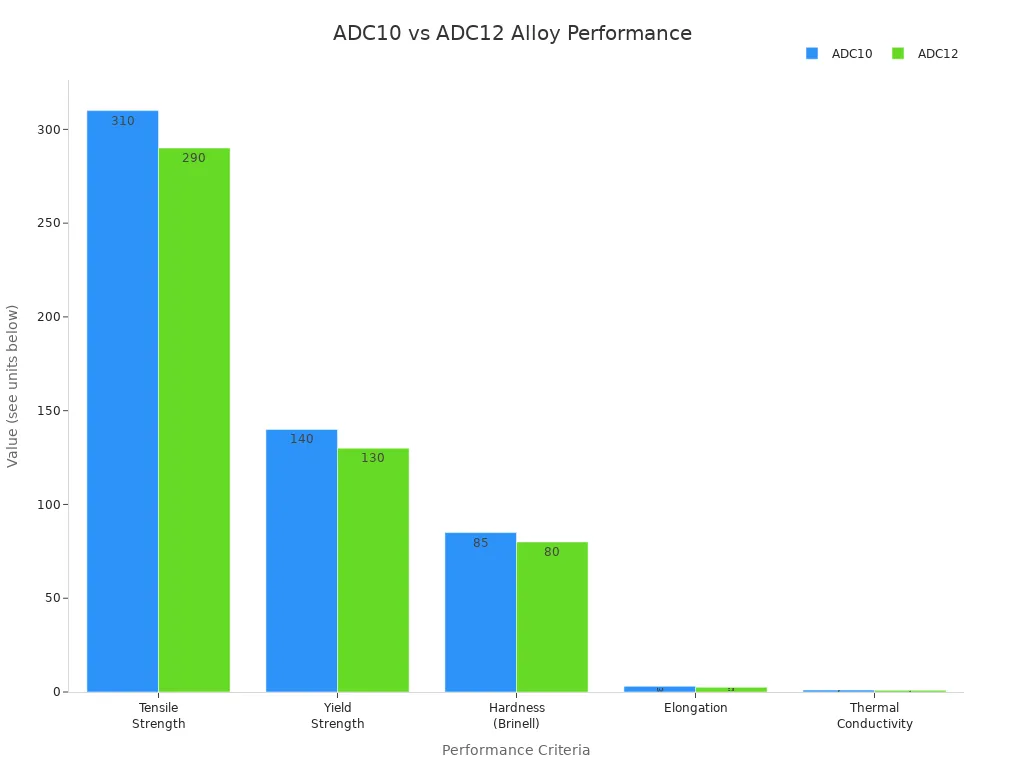
MORELUX uses ADC12 to manufacture parts requiring precise shapes and strong corrosion resistance. ADC10 is suitable for automotive and electronic parts requiring good heat dissipation.
B390 Alloy and Other Grades
B390 is a special aluminum alloy used for die casting, particularly suitable for parts requiring wear resistance. Its silicon content is 16% to 18%, significantly higher than other alloys. This gives B390 extremely high wear resistance and good heat dissipation, but its bending deformation resistance is relatively poor.
| Characteristic | B390 Aluminum Alloy | Other Die Casting Grades |
|---|---|---|
| Silicon Content | 16% – 18% | Lower than B390 |
| Wear Resistance | Very High | Varies |
| Ductility | Lowest | Higher in some grades |
| Thermal Conductivity | High | Varies |
B390 aluminum used for die casting is used in:
- Engine blocks and cylinder liners
- Brake parts and pulleys
- Pumps and pistons
MORELUX picks B390 for parts that rub a lot or get very hot. Other grades with less silicon are picked for different needs.
Note: The MORELUX team helps customers pick the right aluminum alloys for every job. Their skill makes sure every die casting project is high quality and works well.
Key Properties of Aluminum Die Casting
Mechanical Strength
Mechanical strength refers to the amount of force a material can withstand. Die-cast aluminum alloys have very high strength. These excellent properties help extend the service life of parts and keep them safe under harsh operating conditions. The following table lists the main mechanical properties:
| Property | Description |
|---|---|
| Tensile Strength | Shows the highest pulling force the material can take. This helps parts hold heavy loads. |
| Yield Strength | Marks when the material starts to bend or change shape. This is important for strong designs. |
| Elongation | Tells how much the material can stretch before it breaks. This helps with safety and impact. |
| Hardness | Measures how well the material resists scratches and dents. This helps parts last longer. |
Automotive components like engine hoods require high strength to ensure vehicle safety and proper functioning. Medical devices also need robust and durable materials to protect patients and ensure the devices function correctly.
Corrosion Resistance
Corrosion resistance refers to a material’s ability to resist rust and corrosion from water or chemicals. Aluminum alloys have better corrosion resistance than many metals, making them ideal for outdoor products and electronics.
| Metal Type | Corrosion Resistance | Notable Alloys |
|---|---|---|
| Aluminum Alloys | Superior | A380, A356 |
| Other Metals | Varies | N/A |
Aluminum alloys are widely used in electronic products and medical devices. Aluminum alloys are resistant to rust, which helps extend the product’s lifespan and keep it looking new.
Casting and Machinability
Casting refers to the ease with which metal can be filled into a mold. Machinability refers to the ease with which a part can be cut or shaped. Different aluminum alloys have different casting and machinability properties. The table below compares several common aluminum alloys:
| Alloy | Approx. Melting Range (ºF) | Resistance to Hot Cracking | Die-Filling Capacity | Anti-Soldering to the Die | Machining |
|---|---|---|---|---|---|
| 360 | 1035-1105 | 1 | 3 | 2 | 3 |
| 380 | 1000-1100 | 2 | 2 | 1 | 3 |
| 413 | 1065-1080 | 1 | 1 | 1 | 4 |
| 390 | 945-1200 | 3 | 1 | 3 | 5 |
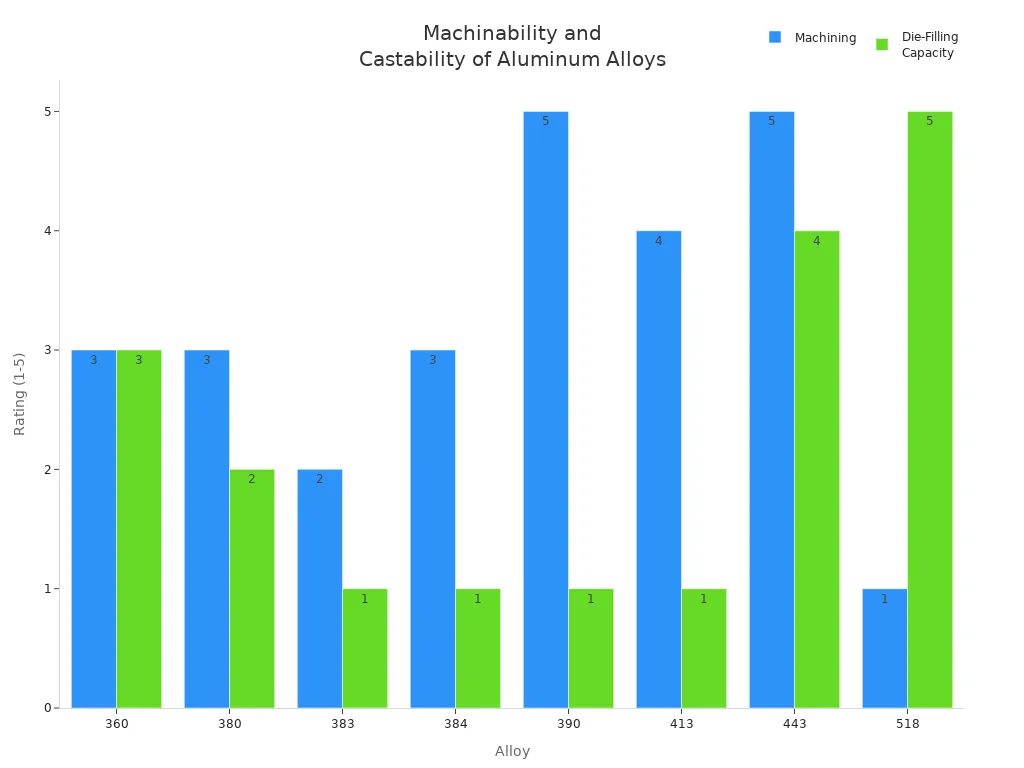
Car and electronics companies need alloys that fill molds well. They also need alloys that are easy to shape. This helps make tricky parts with smooth surfaces.
Thermal Conductivity
Thermal conductivity means how well a material moves heat. Aluminum alloys for die casting move heat better than most metals. This helps keep electronics cool. It also makes car parts safer.
| Alloy | Thermal Conductivity | Applications |
|---|---|---|
| A413 | High | Heat sinks, hydraulic parts, engine covers, electronics, autos |
| ADC12 | Superior fluidity | Electronics cases, telecom parts, LED lighting heat sinks |
Good thermal conductivity stops electronics and cars from getting too hot. This keeps devices safe and working well.
Comparing Die Casting Alloys
Performance Differences
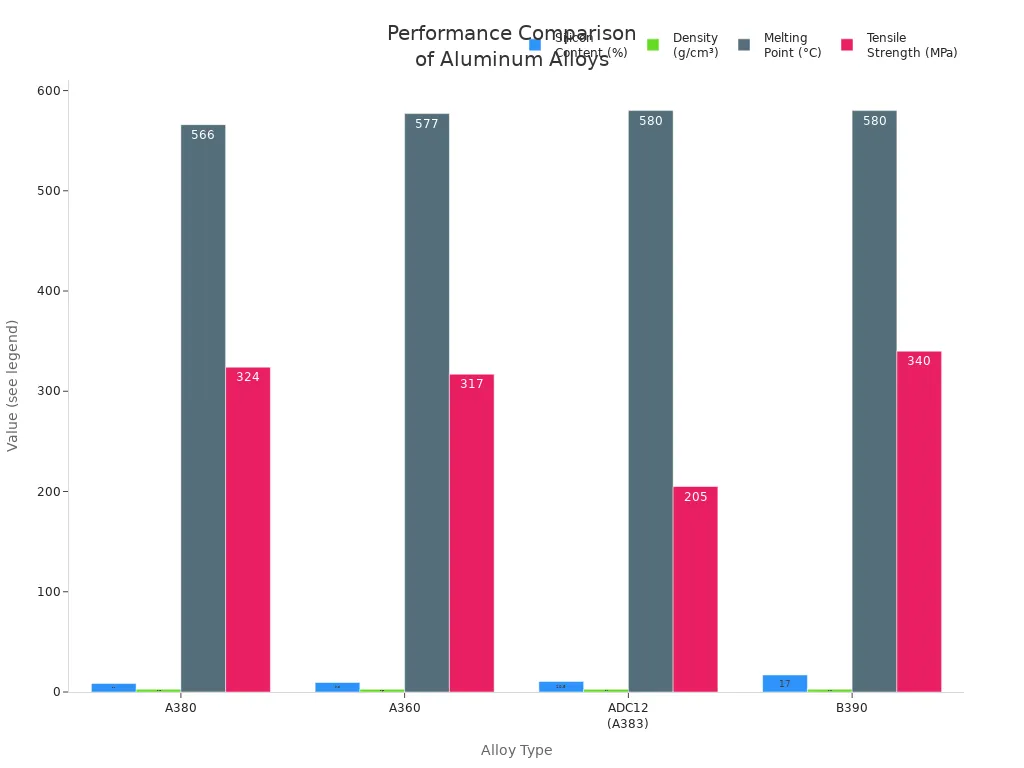
Aluminum alloys have different strengths in die casting. The table below shows how popular alloys compare:
| Attribute | A380 | A360 | ADC12 (A383) | B390 |
|---|---|---|---|---|
| Silicon Content | 7.5-9.5% | 9.0-10.0% | 9.5-11.5% | 16-18% |
| Density | 2.71 g/cm³ | 2.63 g/cm³ | 2.7 g/cm³ | 2.74-2.8 g/cm³ |
| Melting Point | 566°C | 577°C | 580°C | 580°C |
| Tensile Strength | 324 MPa | 317 MPa | 180-230 MPa | 320-360 MPa |
| Key Advantage | Versatile | Corrosion resistance | Die-filling | Wear resistance |
| Main Use | Automotive, tools | Marine, hydraulics | Electronics, cars | Engine parts |
A380 is strong and can be used for many things. A360 protects better against rust. ADC12 flows well and fills tricky shapes. B390 is very hard and does not wear out fast.
Cost and Production Factors
Demand for alloys influences their price and supply. Automakers now require lighter materials, meaning increased use of aluminum alloys. The US die-casting market is also expanding with the rise of electric vehicles. Manufacturers will choose alloys that offer good performance at a reasonable price. A380 and ADC12 alloys are widely used in high-volume production due to their ease of use and low cost.
Tip: Picking the best alloy can save money and make better parts.
Application Suitability
Each alloy works best for certain jobs. The table below shows where each alloy is used:
| Alloy Type | Industry Application | Key Characteristics |
|---|---|---|
| A380 | Automotive | Lightweight, versatile |
| ADC12 | Automotive, electronics | Good for complex shapes |
| A360 | Industrial, marine | High corrosion resistance |
| A413 | Hydraulic, intricate components | Handles high pressure |
| B390 | Engine parts, pumps | Superior wear resistance |
Car companies use A380 for engine covers and brackets. Electronics makers use ADC12 for detailed cases. Marine and industrial companies use A360 because it fights rust. B390 is used in engines and pumps that need to last a long time.
Note: MORELUX helps customers pick the best alloy for their project. This makes sure every die casting job turns out great.
Choosing the Best Aluminum for High-Pressure Die-Casting

Project Requirements
Every project is different and has its own needs. Engineers think about strength, weight, and shape before picking an aluminum alloy. Some parts need to be light but also strong. Other parts must handle heat or fit into tricky molds. The table below shows how each alloy does in important areas:
| Alloy Type | Strength-to-Weight Ratio | Corrosion Resistance | Thermal Conductivity | Machinability |
|---|---|---|---|---|
| A413 | Excellent | Good | Balanced | High |
| A360 | High | Excellent | Good | Moderate |
A413 is ideal for components requiring both strength and lightweight design. A360 is best suited for components exposed to water or chemicals. MORELUX is dedicated to helping customers select the right aluminum alloy for each project. Their team utilizes intelligent design tools to ensure every component functions perfectly.
Environmental and Industry Factors
The environment and regulations of different industries are key factors in selecting aluminum alloys. For example, industries such as automotive manufacturers require alloys that meet stringent regulations. The table below lists commonly used alloys and their certifications:
| Alloy | Corrosion Resistance | Industry Standards |
|---|---|---|
| A360 | Strong | ASTM, EN, JIS |
| ADC12 | Excellent fluidity | CE, RoHS |
| A413 | Strong | ASTM, EN, JIS |
| A380 | Sufficient | ASTM, EN, JIS |
- Cars need alloys that are strong, light, and can take heat.
- Electronics need good heat control and smooth surfaces.
- Planes need the best quality and long-lasting parts.
Aluminum die casting is environmentally friendly because aluminum can be reused. Using recycled metal saves energy and reduces waste. MORELUX maintains strict quality control to ensure compliance with all industry and environmental regulations.
Production Volume and Cost Considerations
The number of parts affects the cost of aluminum die casting. Producing a large number of parts at once reduces the cost per part. Mass production of simple-shaped parts is also less expensive. The price of aluminum die casting alloys fluctuates depending on customer demand. Higher-performance alloys are more expensive, but special-purpose parts require even higher-performance alloys.
- The price of aluminum die casting alloys goes up and down with supply and demand.
- Making many parts at once lowers the cost for each one.
- Good design and careful work help make less waste.
MORELUX checks every part before, during, and after making it. This makes sure every part is high quality for high-pressure die-casting projects.
Tip: Work with experts like MORELUX to pick the best aluminum die casting alloy for your project. Their custom help and quality checks make every project do well.
Aluminum die casting uses alloys such as A360, B390, and A380. Each alloy is good for different jobs. The table below shows what makes each alloy special:
| Alloy Type | Key Characteristics | Common Applications |
|---|---|---|
| A360 | Keeps pressure well, fights rust | Used for strong parts |
| B390 | Very hard, does not wear out fast | Used in engines |
| A380 | Works for many things, strong, easy to shape | Used in lots of products |
Picking the right alloy makes every project work well. Today, companies want new alloys, more machines, and to help the planet. MORELUX helps customers find the best die-casting alloy for their needs.
FAQ
What is the most commonly used aluminum alloy in die casting?
A380 is the most commonly used alloy. Many companies choose it because of its high strength, light weight, and ease of molding. A380 is ideal for automotive, electronics, and other components.
Why do engineers choose ADC12 for electronics?
Engineers like ADC12 because it fills complex molds very well. It is rust-resistant and produces a smooth surface finish. These properties make it ideal for electronic casings and small parts.
How does MORELUX ensure die casting quality?
MORELUX uses specialized tools to inspect each part. Their team monitors every step from start to finish to ensure that every part is manufactured to a high standard.
Can aluminum die casting alloys be recycled?
Yes, aluminum alloys can be recycled multiple times. Recycling reduces energy consumption and waste generation. Many companies use recycled aluminum to protect the environment.
Which industries use high-pressure aluminum die casting?
Automotive, electronics, telecommunications, and medical companies all use high-pressure aluminum die casting. They need sturdy, lightweight, and appropriately sized parts.