

A360 is the strongest die-cast aluminum for most applications. B390 has extremely high hardness and good wear resistance, making it ideal for components with high friction. Choosing the right alloy is crucial to the performance and lifespan of the component. Engineers consider the alloy’s strength, heat resistance, and rust resistance, as well as cost. MORELUX has extensive experience in high-pressure aluminum die casting.
- Mechanical Properties
- Thermal Properties
- Corrosion Resistance
- Cost Considerations
| Performance Metric | Description |
|---|---|
| Mechanical Properties | How strong and tough the alloy is under different loads. |
| Thermal Characteristics | How well it handles and moves heat in hot places. |
| Corrosion Resistance | How well it stands up to things that can cause rust or damage over time. |
Key Takeaways
- A360 is the strongest die-cast aluminum for most applications. It is rust-resistant and can withstand high pressure, making it ideal for automotive and marine applications.
- B390 has extremely high hardness and is not easily worn. It is suitable for friction components such as engine blocks and brake pads.
- Choosing the right alloy is crucial. You need to consider strength, rust resistance, and price. This will help you achieve optimal project results.
- MORELUX is an expert in high-pressure die casting. They help customers select the aluminum alloy best suited to their needs. This ensures long service life and compliance with industry standards for parts.
- Other high-strength alloys, such as ZL114A and 7068, are also worth considering. These alloys are lightweight and strong, suitable for many engineering applications.
Die Cast Aluminum Alloys

Common Aluminum Alloys for Die Casting
Many industries use aluminum alloys for die casting. These alloys are lightweight, strong, and rust-resistant. Companies choose different alloys depending on the application.
- A380 is easy to cast and reasonably priced. Its strength is sufficient for many applications.
- A360 can withstand higher pressures and offers better sealing performance. It is suitable for high-temperature or rust-prone environments.
- ADC12 (equivalent to A383) has good flowability and is not easily deformed. It is suitable for parts with complex shapes.
- Al-Si11Cu3 is tough and resistant to wear. It is widely used by automotive and engineering companies.
- B390 is best suited for parts with high friction. It is used in engines and compressors.
MORELUX has extensive experience in aluminum die casting. They use these alloys to manufacture parts for automobiles, electronics, and medical devices.
Strength and Mechanical Properties
The strength of aluminum alloys is crucial. This includes their tensile strength, hardness, and tensile strength before bending. Each alloy has its unique applications.
| Alloy | Tensile Strength (MPa) | Yield Strength (0.2%) (MPa) |
|---|---|---|
| A360 | 317 | 170 |
| B390 | 317 | 250 |
Both A360 and B390 are very strong. B390 can withstand greater forces without bending. Hardness is also important. B390 contains a high amount of silicon, making it very hard and resistant to wear. This makes it ideal for parts that rub against each other.
Other high-strength alloys, such as ZL114A, ZL115, ZL116, and 7068, also offer toughness and lightweight properties. These alloys are used when high strength and lightweight components are required.
A360 vs. B390: Key Differences
A360 and B390 are two of the strongest die-cast aluminum alloys. Due to their respective properties, their applications differ.
| Property | A360 | B390 |
|---|---|---|
| Hardness, Brinell | 75 | Very High |
| Tensile Strength, Ultimate (MPa) | 317 | 317 |
| Yield Strength (MPa) | 170 | 250 |
| Wear Resistance | Good | Excellent |
- A360 aluminum alloy is high in strength, slightly flexible, and rust-resistant. It is commonly used in automotive parts, such as gearbox housings and engine mounts. It is also used in lightweight components in aircraft and electronics.B390 aluminum alloy is extremely hard and resistant to wear. Automakers use it for engine blocks and brake components. Due to its higher silicon content, it is less flexible than A360, but is ideal for parts with high friction.
Tip: When choosing an aluminum alloy, consider your specific needs. B390 is suitable for easily worn parts. A360 is suitable for parts requiring high strength and rust resistance.
MORELUX uses intelligent die-casting technology to select the best alloy for each project. Their team helps customers choose based on the actual application of the part. This ensures that each part operates efficiently and is durable.
Die Cast Aluminum Alloy Properties and Applications

A360 Alloy: Strength and Corrosion Resistance
A360 is a high-strength aluminum alloy that is rust-resistant. Engineers choose A360 alloy when parts need to maintain strength in harsh environments. This alloy performs excellently in humid or saline environments and can also be used in environments with corrosive chemicals. A360 has a lower copper content and a higher silicon and magnesium content, making it more rust-resistant than A380 and ADC12.
- A360 is ideal for marine, automotive, and medical equipment applications.
- Its rust resistance is 45% higher than A380.
- A360 is lighter in weight while maintaining strength.
| Property | O/Annealed | Key Temper (e.g., T6) | Notes |
|---|---|---|---|
| Tensile Strength | 120 – 180 MPa | 250 – 360 MPa | Values change with thickness and mix |
A360 is used to manufacture gearbox housings and engine mounts, as well as electronic device housings. MORELUX uses A360 to manufacture robust, durable, and rust-resistant parts.
B390 Alloy: Hardness and Wear Resistance
B390 is a special aluminum alloy. It has extremely high hardness and excellent wear resistance. Manufacturers use B390 when creating parts that need to withstand friction and maintain their shape. B390 has a hardness of 120 HB, significantly higher than A380’s 80 HB. This higher hardness helps extend the lifespan of parts.
- B390 extends the lifespan of parts, reducing maintenance needs.
- It maintains the strength of castings and prevents wear.
- B390 has the ideal strength-to-weight ratio required in automobiles and machinery.
B390 is used to manufacture engine cylinders and pistons, as well as pulleys and mechanical parts. The electronics and consumer goods industries also use B390 to manufacture high-strength parts.
B390’s hardness helps car engine parts last longer. Engineers use B390 for parts that move a lot and face stress.
MORELUX manufactures B390 parts using intelligent die-casting technology. They manufacture components for automobiles, electronics, and heavy machinery. Their expertise ensures that every part meets stringent standards.
Other Strong Alloys: ZL114A, ZL115, ZL116, 7068
Several other aluminum alloys are also very strong. ZL114A, ZL115, and ZL116 are tough and strong. These alloys are suitable for lightweight yet high-strength parts. Alloy 7068 is lightweight and high-strength, and is one of the strongest aluminum alloys.
- ZL114A, ZL115, and ZL116 are used in aircraft and automotive manufacturing.
- 7068 is used in high-strength engineering applications.
- These alloys help reduce part weight while maintaining its strength.
MORELUX selects the best alloy based on the specific needs of each project. Their team carefully analyzes the needs and strength requirements of the parts. They use high-pressure die casting and precision machining processes to ensure that each part fits perfectly. MORELUX always finds the best alloy and design solution for every project.
Engineers trust MORELUX to give them alloys that meet industry rules. Their skills in die casting and picking alloys help clients get good results.
Pros and Cons of Strong Die Cast Aluminum Alloys
Advantages of A360 and B390
Both A360 and B390 are high-strength aluminum alloys. Engineers use A360 to manufacture parts that require toughness, durability, and impact resistance. B390 is suitable for parts that are less prone to wear or deformation. These alloys enable stronger automotive and aircraft parts while maintaining lightweight construction.
| Alloy | Advantages |
|---|---|
| A360 | Strong, not very bendy, handles hits well |
| B390 | Great at not wearing out, keeps its shape, very hard |
A360 contains silicon, copper, and magnesium. These elements contribute to its higher strength and longer service life. B390 is less prone to cracking at high temperatures and experiences less wear. This makes it ideal for manufacturing brake and engine components. Both alloys extend the service life of die-cast aluminum parts and improve their performance.
Limitations and Challenges
High-strength die-cast aluminum alloys also present some challenges. B390 has a high silicon content, making it difficult to machine and accelerating tool wear. A360 is difficult to cast and requires surface treatment to prevent scratches. Both can crack or cause other problems if cooled too quickly.
| Challenge/Limitations | Description |
|---|---|
| Machinability | Hard to cut, wears tools out |
| Resistance to Hot Cracking | A360 only does okay |
| Wear on Tooling and Dies | B390 makes tools wear out faster |
| Cost | A360 costs more than steel |
| Surface Finish Requirements | Needs a finish, can scratch easily |
| Casting Difficulty | A360 is hard to cast |
Manufacturers must pay close attention to cooling and time control. Inferior aluminum can cause problems. Cutting and repairing parts after casting requires more time and money.
Choosing the Right Alloy
Choosing the right aluminum alloy depends on your specific needs. Engineers will consider the thickness, strength requirements, and any special requirements of the part. For load-bearing parts, strength and rust resistance are crucial. For parts with complex shapes, the alloy’s flowability and machinability are also critical. Automotive parts require alloys that offer high strength and long service life.
MORELUX helps clients select the best die-cast aluminum for their projects. Their team considers the part’s function, origin, and cost. They offer customized services to ensure that every part meets specifications and is durable.
Die Cast Aluminum Comparison Table
Alloy Strength and Application Summary
Choosing the right aluminum alloy helps engineers manufacture parts that are strong yet lightweight. The table below shows the differences in strength, weight, and application areas among various alloys.
| Alloy | Density (g/cm³) | Tensile Strength (MPa) | Elongation (%) | Key Properties | Typical Applications |
|---|---|---|---|---|---|
| A380 | 2.72 | 310 | 3.5 | Good balance of strength and cost | Automotive housings, brackets |
| A360 | 2.68 | 320 | 4.0 | High corrosion resistance, ductility | Marine, telecom parts |
| B390 | 2.74 | 340 | 1.0 | High wear resistance, hardness | Engine blocks, pump bodies |
| ADC12 | 2.75 | 305 | 3.0 | Stable, easy to cast, cost-effective | Electronics housings, appliance parts |
| AlSi10Mg | 2.67 | 330 | 5.0 | High strength-to-weight ratio | Aerospace, structural components |
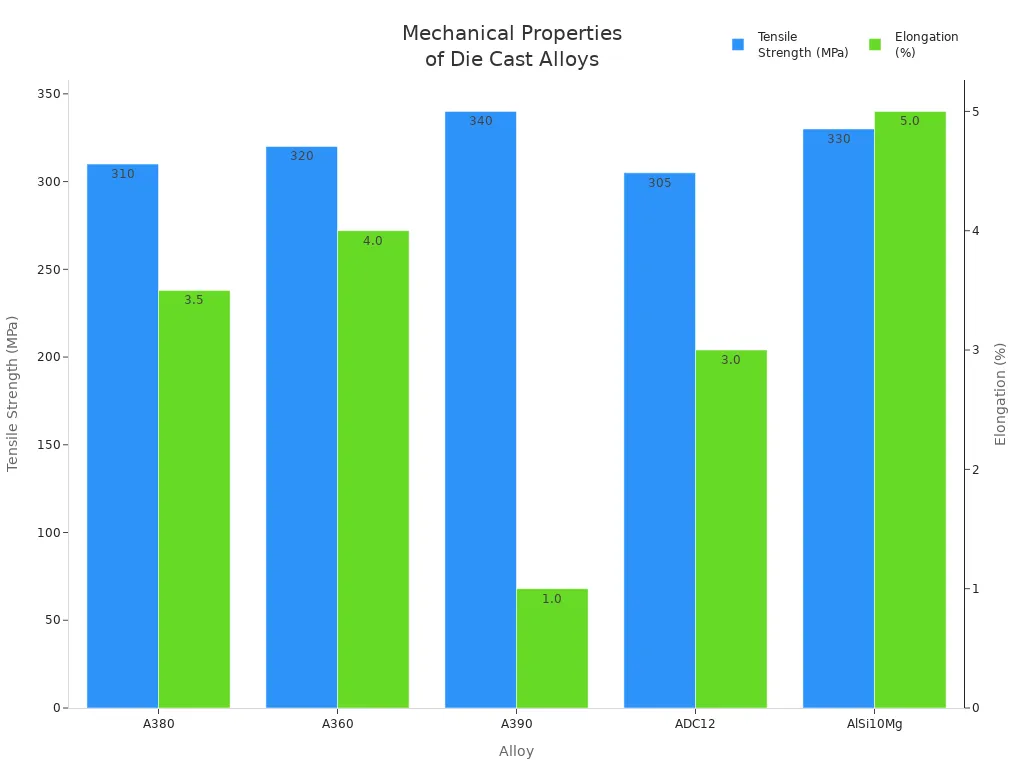
Note: The strength and ductility of each alloy shown in the chart are different. The higher the tensile strength of an alloy, the greater the force it can withstand before fracture. Elongation indicates the degree to which an alloy can be stretched before fracture.
A360 and B390 are commonly used for parts requiring durability and low wear resistance. A360 is rust-resistant, making it suitable for humid environments. B390 is best suited for parts subject to friction, such as engine blocks. AlSi10Mg, due to its high strength and light weight, is frequently used in aircraft manufacturing.
Many companies use aluminum die casting to create thin, complex shapes. They aim to produce lighter parts to save fuel and protect the environment. Therefore, engineers choose alloys with a high strength-to-weight ratio. These alloys are used in automotive parts, aircraft parts, and electronics.
Industry professionals choose between A360 and B390 depending on the application. They consider the alloy’s properties and intended use. A360 is rust-resistant and has good bending properties, making it ideal for automotive controller housings and oil pans. B390 has extremely high hardness and is resistant to wear. It is best suited for engine blocks and parts with high friction.
| Alloy | Corrosion Resistance | Wear Resistance | Ductility | Applications |
|---|---|---|---|---|
| A360 | Excellent | Moderate | Good | Automotive controller housings, oil pans |
| B390 | Moderate | Outstanding | Lowest | Engine blocks, high-wear applications |
The aluminum die-casting market is expanding. There is a demand for lighter materials and new casting methods. Businesses are starting to use aluminum instead of iron and steel. This contributes to market growth. The composition of an alloy affects its environmental impact. Engineers must consider the composition ratio when selecting the right alloy.
MORELUX gives smart advice and custom help for every project. Their team helps clients pick alloys that follow rules and help the environment.
- A360 is suitable for parts that cannot rust and need to withstand pressure.
- B390 is ideal for parts that require robustness, durability, and a long service life.
FAQ
Why is A360 the strongest die-cast aluminum alloy?
A360 is strong and rust-resistant. Engineers choose it to manufacture parts that need to operate for extended periods in harsh environments. The silicon and magnesium in A360 give it both strength and lightweight properties.
Why do manufacturers use B390 to make engine parts?
B390 is extremely hard and resistant to wear. Automakers use it for engine blocks and pistons. These parts experience friction and high temperatures, so B390 helps extend their lifespan.
How does MORELUX help customers choose the right alloy?
MORELUX analyzes the specific requirements of each project. Their team selects the best alloy based on strength, rust resistance, and application. Customers receive advice tailored to their projects.
Can die-cast aluminum alloys be used in medical devices?
Yes. Engineers use aluminum alloys to manufacture medical devices because they are rust-resistant and lightweight. These alloys help create safe and robust parts for hospitals and clinics.
Which industries benefit most from high-strength die-cast alloys?
High-strength die-cast alloys are used in the automotive, aircraft, electronics, and medical industries. These alloys help to create lightweight, durable, and high-performance parts.