

A360 is the strongest die-cast aluminum alloy used in many industries. This alloy has excellent tensile strength and yield strength. The table below compares the properties of A360 and A380:
| Property | A360 (MPa) | A380 (MPa) |
|---|---|---|
| Tensile Strength, Ultimate | 317 | 324 |
| Tensile Strength, Yield | 165 | 159 |
Strength refers to the maximum force that aluminum can withstand before breaking or bending. A360 aluminum alloy also has good ductility and excellent corrosion resistance. This makes it the strongest aluminum material for die casting. With technological advancements and the demand for lighter materials, many industries require high-strength die-cast aluminum alloys.
Key Takeaways
- A360 is the strongest die-cast aluminum alloy. It has very high tensile strength and yield strength. This makes it ideal for high-intensity operations.
- Understanding tensile strength, yield strength, and impact strength helps engineers select the appropriate aluminum material. Each strength is crucial for different operations.
- A360 is rust-resistant, making it ideal for outdoor and harsh environments. A380 is cheaper but has a shorter lifespan than A360.
- Choosing the right aluminum grade is crucial. A360 offers the highest strength and best rust resistance. If you want to save costs and are using it for simple applications, A380 is more suitable.
- New die-casting technologies are improving the performance of aluminum alloys. These new alloys are lighter, stronger, and suitable for a wide range of industries.
Strength in Die Cast Aluminum

Die Cast Aluminum Types of Strength
Aluminum casting uses several methods to measure the strength of the material. Each strength provides engineers with important information about the metal’s properties.
- Tensile strength is the maximum tensile force that aluminum can withstand before breaking. This characteristic helps determine whether a part will break under heavy loads.
- Yield strength is the critical point at which aluminum begins to bend and cannot return to its original shape. The 0.2% offset method is a common method for determining this point. This means the metal has been stretched to the point where it cannot spring back.
- Impact strength measures the ability of aluminum to absorb energy without cracking when subjected to a sudden impact or shock. This is crucial for components that may be subjected to impacts or drops.
These strength tests follow rigorous rules. Standards such as ASTM E8 and ISO 6892 specify the shape of the test specimen, the tensile speed, and the test temperature. These steps ensure the fairness and comparability of test results.
Why Die Cast Aluminum Strength Matters
Strength plays a vital role in aluminum casting. Many industries choose aluminum because it is lightweight and strong. A high strength-to-weight ratio means components are both robust and easy to move.
Automotive companies use aluminum casting to manufacture engine parts and wheels. These parts must be able to withstand pressure and high temperatures without failing. Electronics manufacturers need robust yet lightweight housings to protect their equipment without adding too much weight. Medical devices often use aluminum casting to manufacture tools and housings that must remain strong and resist damage.
When selecting alloys for aluminum casting, engineers consider their tensile strength, yield strength, and impact strength. These properties help them determine whether a part can perform its function. Higher strength aluminum casting alloys enable the manufacture of safer cars, higher-performance electronics, and more reliable medical devices.
Strongest Die Cast Aluminum Alloys
A360 Alloy Profile
A360 is the strongest die-cast aluminum alloy in the factory. Engineers chose this alloy because of its exceptional toughness. Data shows that A360 has a Brinell hardness of 75 and an elastic modulus of 72 GPa. This alloy can be stretched by 1.6% to 5.0% before fracture, thus exhibiting good ductility. Its fatigue strength ranges from 82 to 150 MPa, making it ideal for parts subjected to repetitive stresses.
| Property | Value |
|---|---|
| Brinell Hardness | 75 |
| Elastic (Young’s) Modulus | 72 GPa |
| Elongation at Break | 1.6 to 5.0 % |
| Fatigue Strength | 82 to 150 MPa |
| Poisson’s Ratio | 0.33 |
| Shear Modulus | 27 GPa |
| Shear Strength | 180 MPa |
| Tensile Strength: Ultimate | 180 to 320 MPa |
| Tensile Strength: Yield | 170 to 260 MPa |
A360 has high tensile and yield strength, making it ideal for high-strength applications. Heat treatment can increase the strength of A360 by up to 25%. Heat treatment also helps it resist heat and maintain its shape, thus extending the service life of parts. Many companies use A360 to manufacture outdoor lighting fixtures, automotive parts, and other products requiring rust resistance and durability.
Note: A360 has a lower silicon content, making it easier to cut. This means longer tool life and faster parts manufacturing.
Comparison with A380 and Other Grades
A360 has higher strength and better rust resistance than other die-cast aluminum alloys. A380 is the most widely used because it is inexpensive and easy to manufacture. However, A380’s strength and rust resistance are not as good as A360.
| Property | A360 Value | A380 Value |
|---|---|---|
| Tensile Strength | 317 MPa | N/A |
| Yield Strength | 170 MPa | N/A |
| Shear Strength | 180 MPa | N/A |
| Hardness | 75 Brinell | N/A |
| Elongation | 3.5% | N/A |
| Corrosion Rate | 0.124 mm/year | 0.153 mm/year |
| Melting Point | 680°C | 590°C |
| Thermal Conductivity | 113 W/m·K | 96 W/m·K |
A360 rusts more slowly than A380, resulting in a longer service life in harsh weather. A360 has a special anti-rust coating, while A380 does not. A360 has a lower silicon content, making it easier to cut and reducing tool wear. A380 has a higher silicon content, leading to faster tool wear.
A413 is another die-cast aluminum alloy. A413 is used to make radiators because of its good thermal conductivity and light weight. It is strong, but its rust resistance is not as good as A360.
| Alloy Type | Common Applications | Properties |
|---|---|---|
| A360 | Outdoor lighting, automotive | Corrosion resistance |
| A380 | General die casting parts | Most common, least expensive |
| A413 | Heatsink parts | High strength, lightweight, heat transfer |
New die-casting technologies have produced aluminum alloys with superior performance. These new alloys use magnesium and copper, resulting in higher strength and a longer service life. High-pressure die casting technology now uses lighter and stronger materials, resulting in lighter automotive parts and lower fuel consumption.
MORELUX specializes in manufacturing high-strength die-cast aluminum parts. The company uses innovative processes to produce components for automobiles, electronics, and medical devices. The MORELUX team has a deep understanding of how to select and use various alloys for optimal results.
Tip: Choose the appropriate aluminum alloy based on the intended use of the part. A360 aluminum alloy is high in strength and has good rust resistance. A380 aluminum alloy is economical and suitable for general parts. A413 aluminum alloy is suitable for parts requiring rapid heat dissipation.
Die Cast Aluminum Grades for Casting
Common Grades Overview
Different grades are used in aluminum casting. Each grade has its unique metal composition. These compositions determine the strength and toughness of the metal. The most commonly used grades are A360, A380, and A413. These grades are widely used in parts manufacturing across numerous industries.
The table below lists the composition of each grade. It also shows their strength and hardness:
| Alloy | Silicon (%) | Iron (%) | Copper (%) | Manganese (%) | Magnesium (%) | Nickel (%) | Zinc (%) | Tin (%) | Ultimate Tensile Strength (ksi) | Yield Strength (ksi) | Elongation (%) | Hardness (HB) |
|---|---|---|---|---|---|---|---|---|---|---|---|---|
| A360 | 9.0-10.0 | 1.3 | 0.6 | 0.35 | 0.40-0.6 | 0.50 | 0.50 | 0.15 | 46 | 24 | 3.5 | 75 |
| A380 | 7.5-9.5 | 1.3 | 3.0-4.0 | 0.50 | 0.10 | 0.50 | 3.0 | 0.35 | 47 | 23 | 3.5 | 80 |
| A413 | 11.0-13.0 | 1.3 | 1.0 | 0.35 | 0.10 | 0.50 | 0.50 | 0.15 | 40.5 | 19 | 2.5 | 120 |
A360 Durable and rust-resistant, A380 aluminum is the most widely used due to its low cost and good performance. A413 aluminum is chosen for its ease of casting and good thermal conductivity.
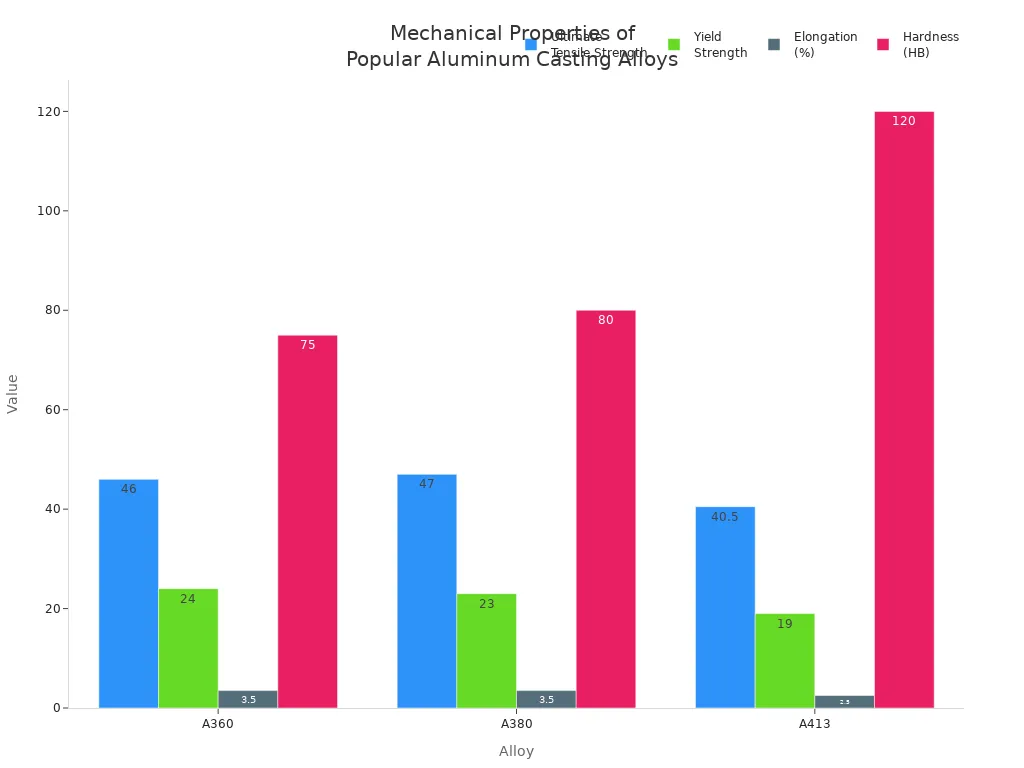
Other grades such as A390, A356, and A319 are also commonly used. Each grade has its specific application. For example, A390 is used to manufacture engine blocks, while A356 is suitable for manufacturing suspension components.
Selecting the Right Grade
Choosing the right aluminum grade is crucial. The grade affects the strength and lifespan of the part, as well as its cost. Engineers will examine the metal’s toughness and ease of casting, and consider the intended use of the part.
| Factor | Description |
|---|---|
| Mechanical Properties | The mechanical properties of each alloy vary, affecting its strength and durability. |
| Castability | The ease of casting an alloy affects production efficiency. |
| Application Characteristics | Requirements will vary depending on the intended use of the die-cast product. |
Manufacturers also consider cost factors. Each casting method has its own price. The more parts there are, the more difficult and expensive the casting process becomes. Comprehensive cost accounting helps businesses make informed choices.
- A360 is best suited for parts requiring high strength and rust resistance, such as engine housings.
- A380 is suitable for most casting operations because it is easy to use and has a lower cost.
- A413 is suitable for parts requiring good heat dissipation, such as pump housings.
Tip: Always choose aluminum profiles appropriate for the specific application. Higher strength aluminum profiles are better suited for harsh environments. Easy-to-cast aluminum profiles can save time and money.
MORELUX experts help customers select the best aluminum profiles. They consider the functional requirements of the parts and the budget to ensure optimal quality for every component.
Die Cast Aluminum Applications and Trade-Offs
Die Cast Aluminum Industry Uses
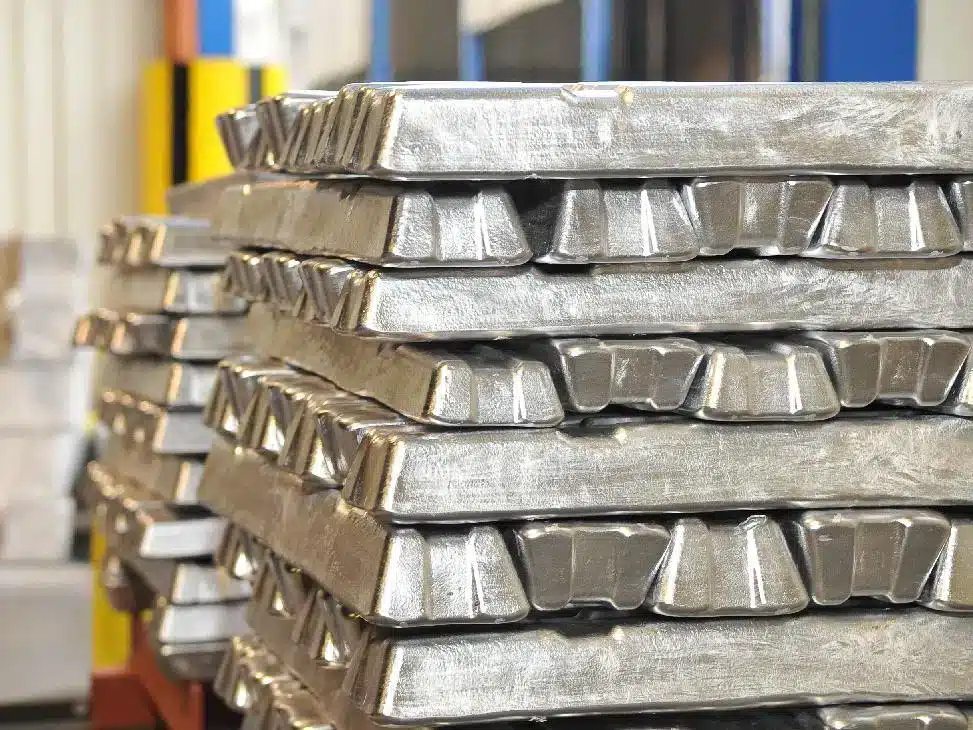
Many industries use aluminum castings to create robust yet lightweight parts. Automotive companies use die casting to manufacture engine hoods, gearbox housings, and sensor mounts. These parts must be strong, durable, and resistant to rust. Electronics manufacturers use aluminum castings to create power supply housings and shielding. Aluminum has good thermal conductivity, which helps dissipate heat in electronic devices. Medical device companies use die casting to manufacture valves and fluid control components. These components need to be kept clean and function properly in safe environments.
The table below shows how different industries use the highest strength die-cast aluminum alloys:
| Industry Sector | Description |
|---|---|
| Automotive | Uses A360 for strength and rust resistance in tough jobs. |
| Lighting | Picks A360 for moving heat and making many shapes in lights. |
| Electronics | Chooses A360 for cases because it flows well and handles heat. |
Other sectors, such as telecommunications and renewable energy, also use aluminum castings. Telecommunications companies use die casting to manufacture RF housings and antennas. Renewable energy projects use aluminum to manufacture solar inverter housings and wind turbine gears. Lighting companies use die casting to manufacture LED heat sinks.
Die Cast Aluminum Limitations and Considerations
Choosing the strongest die-cast aluminum alloy means making choices. The table below compares the strength, price, machinability, and rust resistance of different alloys:
| Alloy | Strength | Cost | Machinability | Corrosion Resistance |
|---|---|---|---|---|
| A380 | Medium | Low | Easy | Low |
| A360 | High | Medium | Medium | High |
| A383 | Medium | Low | Very Easy | Medium |
Engineers will examine the thickness of parts based on the alloy’s flowability. They will consider the load-bearing capacity of each part. Machinability and cost are also important considerations. Parts made from the A360 alloy are durable, rust-resistant, and therefore require less maintenance.
In the aluminum casting industry, environmental protection is paramount. Life cycle assessments can help companies understand the impact of their alloy choices on the natural environment. Some alloys, such as A380 and A356, will have different environmental impacts depending on their composition and manufacturing methods.
MORELUX meticulously manufactures die-cast aluminum parts for the automotive, electronics, and medical device industries. Their team ensures every project functions flawlessly and lasts a long time.
A360 is the strongest die-cast aluminum alloy in the factory. The table below lists its key advantages:
| Advantage | Description |
|---|---|
| Great strength and ductility | Works well when it gets very hot |
| Strong corrosion resistance | Stays good in tough places |
| Good dimensional stability | Helps make parts that need to be exact |
Engineers consider the forces the part will withstand, the application location, precision requirements, part quantity, surface treatment requirements, and budget when selecting an alloy. MORELUX helps companies choose the right alloy for each project.
FAQ
What makes A360 the strongest die-cast aluminum alloy?
A360’s advantages lie in its high tensile and yield strength. This aluminum alloy also has good corrosion resistance. Many industries choose it to manufacture parts that require durability and to maintain strength under pressure.
How do engineers choose the right aluminum grade for casting?
Engineers consider the intended use of the part. They examine strength, ease of casting, and cost. Each grade of aluminum has different properties and is suitable for different applications.
Why do industries prefer aluminum casting for its high strength-to-weight ratio?
Aluminum casting can produce lightweight yet strong parts. A high strength-to-weight ratio helps in the manufacture of vehicles, electronics, and tools that are easy to move yet robust and durable.
What are the main differences between A360 and A380 aluminum alloys?
A360 has better corrosion resistance and higher strength. A380 is less expensive and easier to cast. The choice of alloy depends on the intended use and operating environment of the part.
Can aluminum alloys be used in medical devices?
Yes, aluminum alloys are ideal for use in medical devices. They are rust-resistant, easy to clean, and can be machined into precision parts. The highest strength aluminum-based materials help ensure the safety and reliability of medical devices.