
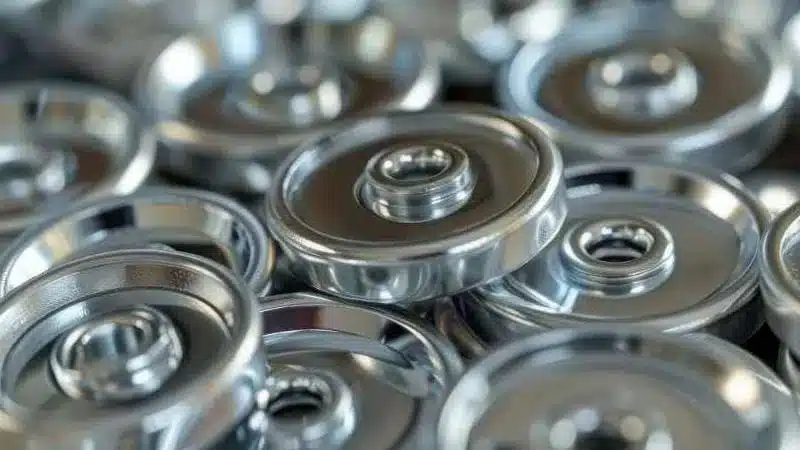
The die-casting process is designed to manufacture high-precision metal components, enabling rapid production while ensuring consistent product quality. This process allows companies to easily mass-produce parts with complex geometries. Die-casting plays a vital role in modern manufacturing; industry data indicates that it is more efficient and reliable than other manufacturing methods.
Key Takeaways
- Die casting enables the rapid production of precision metal parts, making it highly suitable for mass production.
- Die casting helps save time and reduce costs by minimizing the need for additional processing steps and ensuring consistent specifications across parts.
- Companies in sectors such as automotive and electronics utilize die casting technology to manufacture robust yet lightweight parts, thereby enhancing product performance.
Purpose of die cast in manufacturing

Why Use the Die-Casting Process?
Manufacturers use the die-casting process to produce metal components with precise dimensions and high consistency. The primary goal is to rapidly manufacture complex metal parts while minimizing material waste. This process employs molds to shape molten metal—heated to high temperatures—into precise forms. Companies such as MORELUX in Malaysia are able to provide customized solutions that adhere to rigorous quality standards.
The die-casting process offers numerous distinct advantages:
- It makes parts with exact sizes, so designs can be detailed.
- The mold shapes each part, so every piece is just like the first.
- Many parts can be made before the mold needs fixing.
- This method is good for making lots of parts quickly.
Some advantages of die casting are:
- The parts are strong and last a long time.
- The surfaces are smooth and need little extra work.
- One part can do many jobs, so fewer pieces need to be put together.
The table below shows the main jobs of die casting in today’s factories:
| Function | Description |
|---|---|
| High Efficiency and Speed | Makes parts quickly, good for making many at once. |
| Excellent Dimensional Accuracy | Parts are very exact, even with tricky shapes. |
| Cost-Effectiveness | Cheaper for big orders, even if the mold costs a lot at first. |
| Strong and Durable Parts | Makes tough parts that last in hard places. |
| Applications in Industries | Needed for cars, electronics, planes, and defense equipment. |
Manufacturers choose the die-casting process because, compared to other methods, it produces parts with intricate details and superior dimensional accuracy. The use of molds enables thin-walled designs while ensuring structural strength. Compared to plastic parts, aluminum alloy die-castings offer greater strength and durability. They feature smooth surfaces that are easily painted or coated. Since a single mold can produce thousands of identical parts, the process offers a high degree of consistency and repeatability.
Advantages of Mass Production
The die-casting process is ideally suited for the high-volume production of components. Its advantages are particularly evident when manufacturing large quantities of parts with consistent quality. Molds enable rapid production—sometimes taking as little as 30 to 60 seconds per part. This high production speed facilitates mass manufacturing and effectively saves time.
The process also reduces the cost of manufacturing complex metal parts. Although the initial investment in molds is high, the cost per unit decreases as production volume rises. This allows companies to obtain high-quality parts at a low cost—parts that often surpass the quality of those produced via other manufacturing methods.
Key advantages of high-volume production include:
- Not much extra work is needed after casting, so time and money are saved.
- All parts look and measure the same.
- Machines can run all the time, so less time is wasted and costs go down.
The table below shows how die casting changes costs when making many parts:
| Factor | Impact on Costs |
|---|---|
| Tooling Complexity | Harder parts need more detailed molds, which cost more and take longer. |
| Production Volume | Making more parts spreads out the cost, so each part is cheaper. |
| Design Considerations | Simple shapes make molds faster to build and waste less material. |
| Machine Utilization | Running machines all the time means less waiting and lower costs for each part. |
MORELUX uses advanced methods to make sure every part is the same and works well. Their special molds and checks help meet world standards. Car and electronics companies use die casting for battery cases, engine parts, and frames. These industries need light, strong parts to help things work better and last longer.
Die casting process explained
Working Principle of the Die-Casting Process
The die-casting process uses a mold to shape molten metal. Before use, the mold is cleaned and preheated, and a worker sprays it with lubricant to prevent the metal from sticking. The mold is tightly closed before the metal is injected.
The steps of the die-casting process are as follows:
- Mold creation: Engineers use machines to build the mold. They add channels for metal and cooling.
- Mold preparation: The mold is cleaned, heated, and sprayed with lubricant.
- Metal injection: Hot metal is pushed into the mold with high pressure. It fills every space.
- Cooling: The metal cools down inside the mold and forms the part.
- Casting removal: Pins push the finished part out of the mold.
- Finishing: Workers take off extra material. They may grind or machine the part.
Materials and techniques used
Manufacturers employ various alloys in the die-casting process, with aluminum, zinc, and magnesium alloys being the most common. Aluminum alloys are both lightweight and strong; zinc alloys offer good ductility and corrosion resistance; magnesium alloys are lightweight and ideal for complex shapes; and copper alloys are used when high electrical conductivity is required.
| Alloy | Properties |
|---|---|
| Aluminum | Light, strong, does not rust, makes thin and exact shapes |
| Zinc | Strong, bendy, does not rust, melts easily, good for making many parts |
| Magnesium | Light, strong, makes tricky shapes, keeps exact sizes |
| Copper | Carries electricity and heat well, used in electronics |
High-pressure die-casting technology enables the production of superior-quality components, preventing the formation of micro-porosity while ensuring a smooth surface finish. Precision mold-making techniques guarantee exceptional dimensional accuracy and fit.
MORELUX employs advanced technology and rigorous inspection protocols to ensure component precision. The resulting die-cast parts are robust and reliable, finding widespread application in sectors such as automotive manufacturing, electronics, and medical devices.
Common applications of die casting

Industries Relying on Die Casting
Many industries utilize the die-casting process to manufacture robust metal components. The automotive sector is the largest application area for this technology; automakers use die casting to produce engine blocks and transmissions, as well as lightweight parts that help improve fuel efficiency and reduce emissions. Electronics companies rely on die casting to produce small, heat-resistant components and precision housings, while telecommunications firms use die-cast parts to create durable casings and connectors. Medical device manufacturers choose die casting to produce components that are both corrosion-resistant and highly safe. Furthermore, the strength and design flexibility offered by die casting have significantly enhanced the performance of products such as kitchenware and power tools.
By enabling the production of robust, lightweight, and structurally complex components, die casting plays a vital role in modern manufacturing.
Limitations and Considerations
While the die-casting process offers numerous advantages, it also has certain limitations. Selecting the appropriate metal is crucial. Metals with good fluidity—such as aluminum, zinc, and magnesium—are best suited for die casting, whereas others (like brass) require strict control over heating temperatures. Excessively thin walls can make it difficult for the molten metal to fully fill the mold, while excessively thick walls result in wasted material and slower production speeds.
| Material | Limitation |
|---|---|
| Aluminum | Shrinks a lot when it cools, which can change the size. |
| Brass | Needs careful heat control, which makes things harder. |
| General | Only metals that flow well can be used, so not all parts can be made. |
Manufacturers fix these problems by making better molds, picking the best metals, and cooling parts the right way. Quality rules, like IATF 16949 for cars, help stop mistakes and keep parts the same. Using metals like aluminum and zinc is better for the planet because they can be recycled and make less waste.
Die-casting plays a vital role in modern manufacturing. The use of new materials and process improvements has enhanced component quality, while the application of computer technology and a focus on environmental protection help save time and energy. Furthermore, rigorous inspection of every component ensures product consistency.
| Design Tip | Benefit |
|---|---|
| Alloy selection | Makes sure parts are strong |
| Wall thickness | Helps fill the mold right |
FAQ
What is die casting?
Die casting produces metal parts by forcing molten metal into a mold under high pressure. Engineers use this process to create strong, precision-fit parts. Many industries require such components.
What materials are used in die casting?
Manufacturers use alloys such as aluminum, zinc, and magnesium. Parts made from these metals are lightweight and durable; they also offer resistance to rust and damage.
What is the difference between injection molding and die casting?
Injection molding uses plastic, whereas die casting uses metal. Die-cast parts are stronger than plastic parts. While both processes utilize molds, the materials and applications differ.