
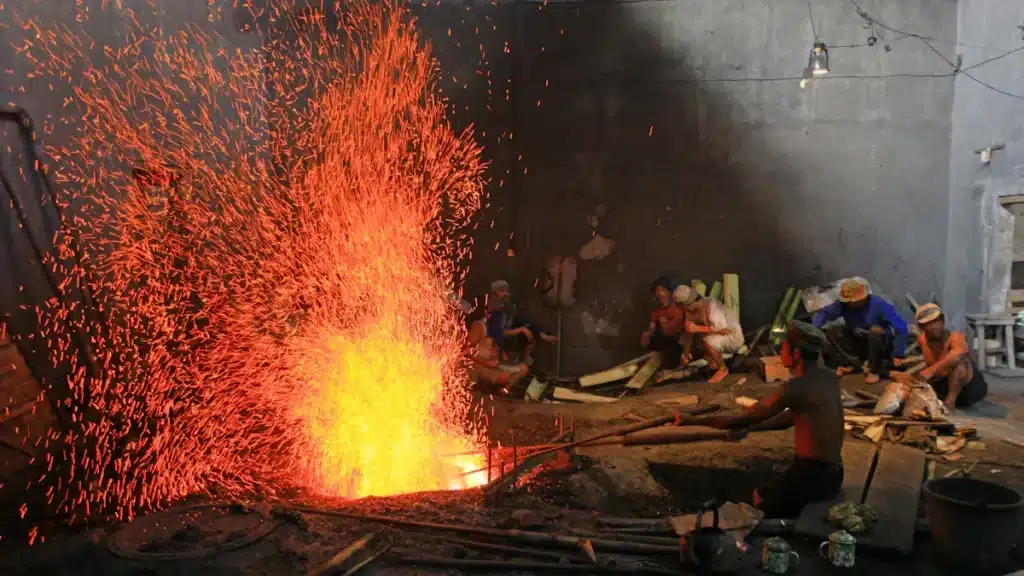
Extrusion casting uses molten metal, which is then hardened under pressure. Forging, on the other hand, shapes solid metal by hammering or pressing. These two methods are quite different, and both affect the strength, shape, and cost of the parts. Designers and manufacturers need to understand these differences and choose the best method for their specific needs. In North America, the forging industry is growing rapidly. New machines that combine 3D printing, casting, and forging technologies are helping to improve production efficiency in the automotive die-casting and aircraft industries die-casting.
| Year | Market Size (USD Billion) | CAGR (%) |
|---|---|---|
| 2025 | 131.65 | N/A |
| 2026 | 143.70 | 9.22 |
| 2032 | 244.19 | N/A |
Key Takeaways
- Squeeze casting combines casting and forging techniques to manufacture high-strength metal parts. It helps reduce potential problems during the part manufacturing process. This method is particularly suitable for complex-shaped parts and can achieve smooth surfaces.
- Forging, on the other hand, shapes solid metal by applying pressure. This allows the grains to align properly, thus increasing the strength of the part. Forged parts have a longer lifespan. Forging is best suited for simple-shaped parts that need to withstand high stress.
- Costs may differ. For complex-shaped parts, squeeze casting is generally cheaper. If you need to manufacture a large quantity of simple parts, forging may be less expensive.
- Choosing the right process depends on your project requirements. You should consider the complexity of the part’s shape, the required strength, and the quantity. Experts can help you choose the best process.
- Both processes have their advantages. Squeeze casting is ideal for manufacturing parts with intricate shapes. Forging provides optimal strength and toughness for high-intensity work.
Squeeze Casting Process
How Squeeze Casting Works
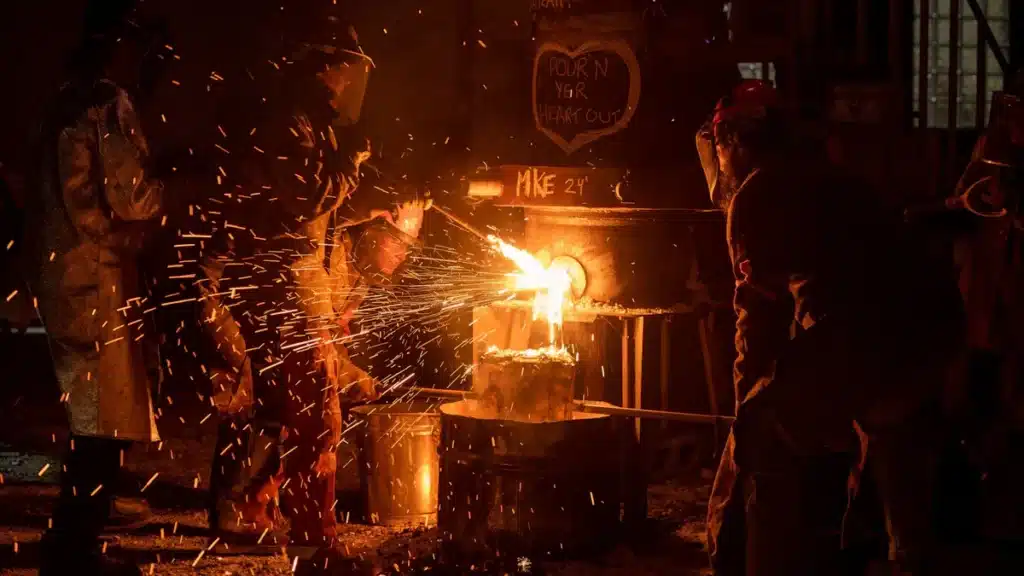
Squeeze casting combines casting and forging processes to manufacture high-strength metal parts. First, workers pour molten metal into a hot mold. Then, they use punches to press the metal into each part of the mold. Pressure is maintained throughout the cooling process. This helps the metal cool in a controlled manner. Workers monitor temperature and pressure at each step. This process produces parts with fewer problems and higher strength.
Steps in the squeeze casting process:
- Pour molten metal into a hot mold.
- Use a punch to press the metal firmly to prevent shrinkage.
- Continue to apply pressure during metal solidification to aid cooling.
- Slowly cool the metal to achieve a fine microstructure.
- Monitor temperature and pressure throughout the process.
Squeeze Casting Features
Squeeze casting offers numerous advantages. High pressure reduces bubbles and shrinkage, resulting in stronger and more durable metal parts. It also reduces the probability of problems such as hot cracking and voids. The table below lists some key characteristics:
| Feature | Squeeze Casting Benefit |
|---|---|
| Porosity | Very low (1.0-1.5%) |
| Shrinkage | Greatly minimized |
| Gas entrapment | Reduced |
| Fracture properties | Improved |
| Defects (hot tears, cavities) | Significantly reduced |
MORELUX employs new die casting technologies that conform to these principles. Their solutions help manufacture metal parts with smooth surfaces and robust internal structures.
Squeeze Casting Applications
Squeeze casting is used in many fields to manufacture critical metal parts. Automakers use squeeze casting to manufacture crash beams, engine blocks, pistons, wheels, and steering brackets. Shipyards use it to make propellers. The aerospace industry uses this process to manufacture critical aircraft components. Defense companies use squeeze casting to produce iron mortar shells. These examples demonstrate how this process creates robust and reliable metal parts for a wide range of applications.
Forging Process

How Forging Works
Forging uses powerful mechanical forces to shape solid metal. Workers first take a lump of metal, typically heating it to soften it. Then, they use tools such as hammers or presses to shape it. This process presses the metal into a new shape without melting it. The steps in the forging process are typically as follows:
- Create CAD drawings of the part.
- Upset the metal to increase its thickness.
- Unfold the metal using a blanking process.
- Edge the metal to control its flow.
- Bend the metal into the desired shape.
- Punch holes as needed.
- If joining parts is required, welding is performed via forging.
- Excess metal is removed.
- The surface is flattened and secured.
- Spinning is then performed to achieve the final shape.
The forging process utilizes compressive stresses higher than the flow stresses of the metal. Depending on the part, this force may act quickly or slowly. Heating the metal helps to make it easier to shape and improves the final properties.
Forging Features
Forging alters the internal structure of metals. When metal is bent or stretched, the internal grains conform to the shape. This grain arrangement makes parts stronger and tougher. Forging also helps improve the crack resistance and wear resistance of metals. Special techniques, such as dynamic recrystallization, can make the grains even finer, giving parts higher strength and a longer service life. The table below lists some key characteristics:
| Feature | Benefit |
|---|---|
| Grain alignment | Higher strength and toughness |
| Fine grain structure | Better fatigue resistance |
| Improved ductility | Easier to machine and shape |
| Fewer defects | More reliable metal parts |
Forging Applications
Parts manufactured using the forging process are suitable for harsh working environments. In the automotive industry, forging is used to manufacture engine parts such as crankshafts, connecting rods, and pistons. It is also used to manufacture robust suspension parts such as control arms and steering knuckles. In the aerospace industry, forging is used to manufacture turbine disks, blades, rotors, and landing gear. These components must withstand high stress and high temperatures. Forged metal parts are also used in commercial jet aircraft, military aircraft, and spacecraft. They are used to manufacture bulkheads, wing roots, and engine mounts. Forging gives these components the necessary strength and durability, ensuring their safe and long-lasting use.
Squeeze Casting vs Forging
Strength and Durability
Strength and durability are paramount when choosing a manufacturing method for metal components. Squeeze casting and forging differ in these two aspects. Forging can produce components with extremely high internal strength. During forging, the grains in the metal are aligned in a uniform manner. This makes the component stronger in a variety of conditions, including tension, compression, and torsion. Forged components can withstand heavy loads and torsion without breaking.
Squeeze casting can also produce high-strength components. It combines the steps of casting and forging. This helps prevent voids and weak points in the metal. Squeeze casting provides good strength and helps extend the service life of components, especially for aluminum alloys. The table below shows the hardness and strength for each method:
| Process/Material | 0.2% Yield (MN m-2) | UTS (MN m-2) | Elongation (%) |
|---|---|---|---|
| Squeeze Casting (100 MPa) | 485 | 551 | 12.2 |
| Forged Plate (L) | 495 | 568 | 15 |
| Forged Material (ST) | 519 | 563 | 7 |
Forged parts generally have higher strength and toughness. Squeeze casting is a more economical method for manufacturing lightweight, high-strength, and complex-shaped parts.
Complexity and Design
Squeeze casting and forging differ in their ability to manufacture complex shapes. Squeeze casting can produce thin-walled, angular parts, suitable for parts requiring special shapes or fine details.
Forging is better suited for simpler shapes. It uses solid metal and external force, therefore deep cutting or the formation of tight reinforcing ribs is not possible. Smooth shapes are easier to forge. Sharp corners or tall parts accelerate die wear and increase costs. Forging cannot produce parts with concave or convex shapes.
Tip: If you need parts with complex shapes, squeeze casting is often the best option.
Cost Factors
Cost is a significant factor when choosing between squeeze casting and forging. For large orders and complex-shaped parts, squeeze casting is generally more economical. It requires fewer steps and equipment, resulting in lower die costs. However, it may require more subsequent machining, which increases maintenance costs.
Forging can have higher die costs, especially when dealing with complex shapes or large orders. However, because forged parts are easier to machine, maintenance costs are generally lower. The table below briefly outlines the two processes:
| Process | Tooling Costs | Maintenance Costs |
|---|---|---|
| Squeeze Casting | Generally lower | May require more secondary work |
| Forging | Can be higher for complex parts | Often lower |
Squeeze casting can have longer preparation times because it requires specialized dies. For large orders and custom parts, forging is faster.
Material Suitability
The type of metal used in each method is important. Squeeze casting is best suited for aluminum, magnesium, some copper, and cast iron. These metals are stronger and have a longer lifespan after squeeze casting. Squeeze casting also produces parts with fewer pores and smoother surfaces.
Forging is suitable for many metals, but not all. Bent metals require fewer tools and forging time. Smooth shapes are easier and less expensive to forge. Dense ribs or deep cuts wear down tools and increase costs. Some shapes cannot be forged because the metal cannot fill all the space.
| Material Limitation | Effect on Forging Process Selection |
|---|---|
| Easy to deform materials | Fewer dies, smaller equipment, faster cycle |
| Smooth flow path shapes | Lower die costs, faster processing |
| Closely spaced ribs | More die wear, higher costs |
| Internal/external undercuts | Not possible, increased costs |
Note: The choice between squeeze casting and forging depends on the type of metal, shape, and function of the part. Squeeze casting is best suited for producing lightweight, complex, and inexpensive parts. Forging is best suited for manufacturing parts with simple shapes, high strength, and high toughness.
Squeeze Casting vs Forging Pros and Cons
Squeeze Casting Pros and Cons
Extrusion casting offers several advantages for metal parts manufacturers. This process uses pressure to force molten metal into a mold. Pressure helps the metal completely fill the mold. It also reduces porosity and increases part strength. Extrusion casting produces parts with fine internals and smooth external surfaces. Many companies choose this method because it produces parts with high strength and fewer problems.
| Advantages | Disadvantages |
|---|---|
| Pressure helps molten metal adhere to the ceramic preform. | Part size and speed are limited due to pressure. |
| Pressure during cooling prevents the formation of large and small voids. | Lower degree of shape freedom and slower processing speed. |
| Higher part strength and less prone to breakage. | More machining is required, resulting in higher costs. |
Extrusion casting is best suited for manufacturing parts with high strength and low porosity. However, forging is not the best choice for parts that are too large or have complex shapes. Pressure reduces forging speed and increases costs.
Forging Pros and Cons
Forging remains the preferred process for manufacturing high-strength parts. This process uses external force to shape solid metal. This force aligns the grains, increasing the part’s strength. Forged parts are less prone to breakage or wear. Automotive and aircraft manufacturers typically use forging to manufacture critical parts.
| Aspect | Forging Benefit | Casting Limitation |
|---|---|---|
| Strength | Higher part strength due to aligned grains | Lower part strength due to internal issues |
| Fatigue Resistance | Longer service life under stress | More prone to breakage with frequent use |
| Material Utilization | Less waste, cost savings | More metal waste |
| Tooling Costs | Higher die costs, but longer service life | Tools cost less |
| Production Speed | Faster and higher strength for mass production | Die making is time-consuming, therefore slower |
| Post-Processing Costs | Fewer additional processing steps required | Many additional processing steps required |
Pros of forging:
- Higher part strength and longer service life.
- Parts are less prone to breakage.
- More aligned internal grains.
- Fewer internal pores in the metal.
Cons of forging:
- High cost of molds and machinery.
- Difficulty in machining complex shapes.
- Requires significant force and energy.
Forging provides optimal strength and toughness. It is suitable for parts that must withstand heavy pressure or stress. However, forging is not the best choice for complex shapes or when cost savings are required.
Squeeze Casting vs Forging Choosing a Method
Key Considerations
Choosing the appropriate metal forming method depends on many factors. Each project is different and has its specific requirements. Engineers consider the following factors when making a selection:
- Number of Projects: If a large number of parts need to be manufactured, choose a forming method that can produce a large number of parts quickly with minimal metal waste.
- Part Complexity: Squeeze casting is suitable for parts with complex shapes, thin walls, or fine details. Forging is more suitable for parts with simple shapes.
- Mechanical Properties: If the part must be very strong or withstand heavy pressure, forging is often the best choice.
- Surface Finish and Tolerances: Squeeze casting can produce parts with smooth surfaces and dimensions close to the required size, thus requiring less subsequent finishing.
- Cost and Speed: Squeeze casting can save costs on complex parts. Forging is faster for simple, high-strength parts.
Tip: Always choose a machining method that matches the shape, size, and application of the part.
Application Fit
Different jobs and products require different part manufacturing methods. The table below shows the best application scenarios for each method:
| Factor | Forging | Die-Casting (Squeeze Casting) |
|---|---|---|
| Strength and Reliability | Best for extreme stress | Good for most uses |
| Geometric Complexity | Simple shapes | Complex shapes and fine details |
| Tolerance and Surface Finish | Needs more finishing | High precision, less finishing |
| Volume of Production | High volumes | Low or high volumes |
Engineers use forging to manufacture parts that need to withstand enormous stress, such as crankshafts or landing gear. Squeeze casting is better suited for parts with complex shapes or those requiring smooth surfaces, such as in automotive or electronics. If a project requires very precise shapes, fine details, or a large number of parts, then newer die-casting processes offered by companies like MORELUX are a wise choice. Choosing the right process helps ensure parts are strong, accurately shaped, and cost-effective.
Squeeze casting uses molten metal and pressure to create high-strength parts and can produce complex shapes. Forging, on the other hand, uses pressure applied to solid metal to create parts capable of withstanding enormous stress. Each process is best suited for different applications, and the specific choice depends on the project’s requirements. Shape and strength are both important considerations when choosing a process. Consulting experts can help you choose the right process, and their advice can make your decision easier. Companies like MORELUX are dedicated to helping people make informed choices and achieve better results.
FAQ
What are the main advantages of squeeze casting?
Squeeze casting can produce high-strength metal parts with fewer internal cavities. This process uses pressure to completely fill the mold with metal. Many industries choose squeeze casting because it delivers reliable results.
Why do engineers choose forging to manufacture certain parts?
Engineers choose forging when they need parts that can withstand heavy loads. Forged parts have a neatly arranged grain, making them stronger and more durable than many castings.
Can squeeze casting create complex shapes?
Yes. Squeeze casting is ideal for creating parts with thin walls, sharp corners, or complex designs. Compared to forging, this process offers greater design freedom.
Which process is less expensive for high-volume production?
For complex shapes and high-volume production, squeeze casting is generally less expensive. Forging may be more expensive for complex designs, but it works well for high-volume production of simple, robust parts.