

Die cast zinc alloy is a manufacturing material produced by injecting molten zinc alloy into a steel mold under high pressure. It is widely used to create strong, dimensionally stable parts with smooth surfaces and complex thin-walled designs. In 2023, the global zinc casting alloy market was valued at approximately 2.5 billion USD, and industry analysts expect continued growth due to increasing demand across automotive, electronics, and industrial sectors.
Key Takeaways
- The zinc die casting process works well. It makes good parts in only 15 to 30 seconds.
- Zinc die casting produces strong parts efficiently while saving energy and supporting recyclability.
- Zamak alloys, like Zamak 3 and Zamak 5, have different strengths. They are used for many jobs and last a long time.
- Zinc die casting is used in many fields. These include cars, electronics, and medical tools. It is chosen because it is exact and can be trusted.
Zinc Die Casting Process

How Zinc Die Casting Works
Zinc die casting works by injecting molten zinc alloy into a precision steel mold under high pressure. The metal quickly fills the cavity, capturing fine details and thin sections due to its excellent fluidity. Once the material cools and solidifies, the mold opens and the finished part is ejected.
The process can integrate features such as holes, threads, and logos directly into the component, reducing the need for secondary machining. Advanced equipment and controlled injection parameters ensure high dimensional accuracy and consistent surface quality.
Some manufacturers, such as MORELUX, also use flash-free technologies to minimize excess material, reducing post-processing time and material waste.
Key Steps in the Process
The zinc die casting process has several important steps. Each step helps make sure the part is high quality.
- Design and Mold Preparation: Engineers draw or model the part on a computer.
- Mold Building: Workers make a steel mold with two halves.
- Preparing the Die Casting Machine: Technicians set up and heat the machine and mold.
- Melting the Zinc Alloy: The zinc alloy melts in a furnace at a set temperature.
- Injection: The machine pushes the melted zinc into the mold with high pressure.
- Cooling and Solidification: The mold stays closed while the metal cools and gets hard.
- Opening the Dies: Workers open the mold and take out the finished part.
- Trimming and Finishing: They cut off extra material and finish the surface if needed.
MORELUX uses these steps to make custom parts for many industries. Their process makes sure each part is the right size, shape, and has a smooth surface.
Why Zinc Is Ideal for Die Casting
It melts at a lower temperature than most metals. This saves energy and helps molds last longer.
- Parts produced by zinc die casting offer high strength, tight tolerances, and smooth surface finishes.
The process is also quick. Zinc die casting takes only 15 to 30 seconds per cycle. This speed helps make lots of parts fast and helps test new ideas. For example, soft tooling and plaster mold casting let engineers try designs before making many parts. Additive manufacturing can also help make new products faster.
| Casting Process | Cycle Time (seconds) | Efficiency |
|---|---|---|
| Zinc Die Casting | 15-30 | High-volume production |
| Aluminum Die Casting | Longer | Lower efficiency |
MORELUX’s skills help every project use these benefits. Their team helps clients pick the best zinc alloy and finish for each job.
Zinc Alloy Types
Zamak Series Overview
Zamak alloys are the main zinc alloys for die casting. Makers use Zamak 2, Zamak 3, and Zamak 5 for their special features. Each one mixes zinc with aluminum, copper, and magnesium. These extra metals help the alloys stay strong and last longer.
| Alloy Type | Aluminum (%) | Copper (%) | Magnesium (%) | Tensile Strength (MPa) |
|---|---|---|---|---|
| Zamak 2 | 3.8–4.3 | 2.7–3.3 | 0.035–0.06 | 328 |
| Zamak 3 | 3.8–4.3 | <0.03 | 0.035–0.06 | 283 |
| Zamak 5 | 3.8–4.3 | 0.7–1.1 | 0.035–0.06 | 310 |
Zamak 2 is known for being very strong and hard. Zamak 3 is the most popular because it is easy to use and strong enough. Zamak 5 is tougher and works better in rough places.
Mechanical Properties and Strength
Zinc alloys have great mechanical properties. They can hold heavy weights and take hits without breaking. The Zamak series gives different levels of strength and toughness. The tables below show how Zamak alloys compare in strength.
| Alloy | Yield Strength | Ultimate Tensile Strength | Compressive Yield Strength |
|---|---|---|---|
| Zamak 3 | 208 MPa | 268 MPa | 414 MPa |
| Zamak 4 | 221-269 MPa | 317 MPa | 414-600 MPa |
| Zamak 5 | 295 MPa | 331 MPa | 600 MPa |
| Zamak 7 | 285 MPa | 285 MPa | 414 MPa |
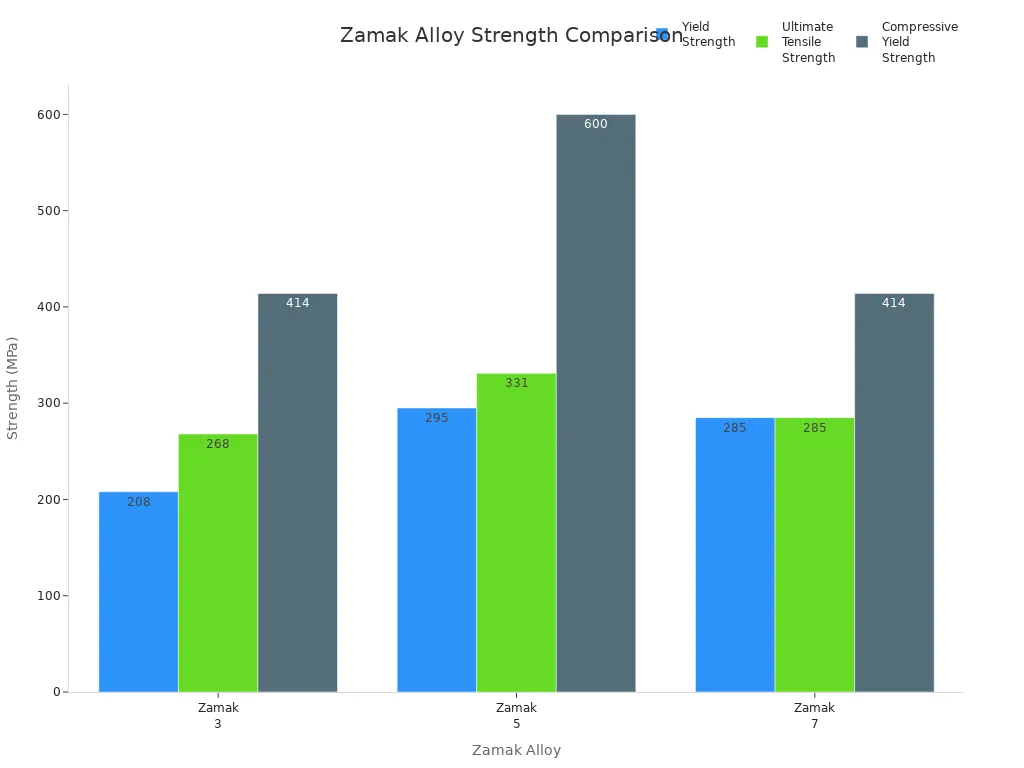
Zamak 5 has the best compressive yield strength. Zamak 3 works well for most jobs. Zamak 4 and Zamak 7 are used for special needs.
When air touches them, they make a zinc oxide layer. This layer keeps water and chemicals away from the metal. Zinc alloys last longer than aluminum and magnesium in hard places.
| Material | Durability | Corrosion Resistance |
|---|---|---|
| Zinc Alloys | Stronger than aluminum | Excellent due to protective zinc oxide layer |
| Aluminum | Less durable | Moderate |
| Magnesium | Variable | Moderate |
| Copper | High | Good |
| Lead | Pliable | Moderate |
- They make a zinc oxide layer that stops rust.
The protective zinc oxide layer improves corrosion resistance in harsh environments. Their oxide layer keeps the metal safe.
Note: Zinc alloys for die casting can be recycled. About 20% to 40% get recycled. In some places, like the European Union, over half are recycled.
Zamak alloys help companies make parts that last and do not rust. Their strength and toughness make them a great choice for die casting.
Zinc Alloy Die Casting Advantages
Energy Efficiency and Cost-Effectiveness
Zinc alloy die casting uses less energy. Zinc melts at a lower temperature than other metals. This saves money and helps the planet. Zinc is highly recyclable, reducing material waste. The parts made are strong and last a long time. Companies spend less because zinc alloy die casting makes tough parts easily. The process lets factories make many parts fast. This lowers the price for each part.
- Makes strong parts with tiny details.
- Saves money for companies.
- Can replace plastic or aluminum parts.
- Most leftover material is recycled at the factory.
- Uses less energy than aluminum casting.
Precision and Complex Designs
This creates thin parts and small details. The process gives steady quality and keeps sizes accurate. MORELUX uses a flash-free process. This removes extra material and saves time. It also makes the work more efficient. It cuts down on extra finishing steps.
| Feature Size Range | Typical Tolerance (As-Cast) |
|---|---|
| 0 – 25 mm | ±0.05 mm |
| 25 – 50 mm | ±0.08 mm |
| 50 – 150 mm | ±0.13 mm |
| >150 mm | ±0.2 mm |
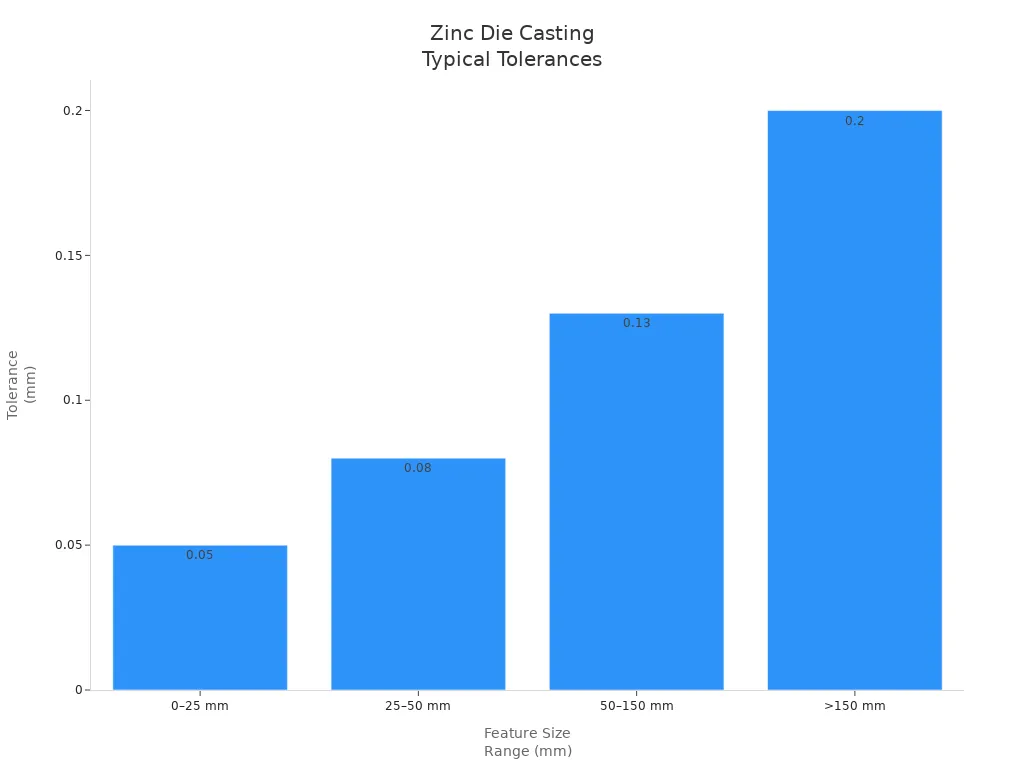
Designers can reach precision as low as 0.1% of the size. Zinc die casting lets parts come out of the mold ready to use. This cuts waste and makes the process better.
Surface Finishes and Customization
Zinc alloy die casting gives many surface finishes. These finishes make parts look good and work well. Powder coating, painting, and electroplating make parts stronger and fight rust. Sand blasting and tumbling smooth the surface and remove sharp edges. Passivation adds more protection to the metal. MORELUX’s flash-free process gives parts a neat finish and tight sizes. Zinc alloys are easy to shape and change. This helps different industries get what they need.
- Powder coating stops rust and protects parts.
- Painting makes parts look nice and stick well.
- Electroplating makes parts tougher and prettier.
- Sand blasting makes the surface even.
- Tumbling smooths and cleans parts.
High-pressure zinc alloy die casting uses fluid alloy and smart methods. It makes parts with great finishes and tricky shapes. These benefits make zinc die casting a top pick for companies wanting quality, speed, and custom parts.
Applications of Zinc Die Casting

Automotive and Aerospace
Zinc alloy die casting is also frequently used in the manufacture of automotive and aircraft castings. This method makes strong and exact pieces that follow strict rules. Engineers pick zinc die castings for things like electrical housings, carburetors, and door handles. They also use zinc for sunroof parts, chassis pieces, and inside the car. Transmission parts and air-conditioning systems use zinc too. Engine parts, brake hardware, and power steering systems need zinc’s toughness. Fuel intake parts last longer with zinc. Zinc alloy die casting helps make light and dependable parts fast. Airplane projects need tricky shapes and close sizes. Zinc die casting can do this easily.
Electronics and Medical Devices
Electronics makers use zinc alloy die casting for many items. They make outlet parts for extension cords and power supplies. Heat sinks are made from zinc too. Designers use zinc for the outside of smartwatches and remote controls. Inside frames for phones and camera brackets use zinc die castings. Port shields, button covers, and trim pieces need zinc’s accuracy and strength. Medical die-casting technology can also be used to manufacture defibrillators and blood pressure monitors. Stethoscopes, hospital beds, and infusion stands use zinc parts. Inhalers and portable oxygen supplies have zinc die cast pieces. These parts must be safe, strong, and easy to clean.
Consumer Products and Other Uses
Zinc alloy die casting shapes many things people use every day. Kitchen tools like hand mixers, food processors, and toasters use zinc for tough parts. Blenders and smart home devices use zinc too. Virtual reality gear, smartphones, tablets, and game consoles need zinc’s smooth finish and strength. Door handles, faucets, and locks use zinc because it does not scratch easily. Personal care devices and digital cameras have zinc die cast parts inside and outside.
- Zinc die cast parts are found in:
- Kitchen tools
- Smart home gadgets
- Wearable tech
- Door handles and locks
Zinc alloy die casting is very useful for many jobs. Companies in different fields pick zinc because it can make hard shapes with great detail. The process makes strong and long-lasting parts, so it is used all over the world.
Die cast zinc alloy is known for being strong and flexible. It lets makers build light parts that last a long time. These parts are made with exact sizes and smooth surfaces. Zinc melts at a lower temperature, so parts are made faster. This also helps molds stay good for longer. Car, electronics, and medical companies use zinc alloy die casting. They trust it because it works well and saves money. MORELUX gives custom zinc die casting services to help companies get great parts.
| Advantage | Benefit |
|---|---|
| Tool Longevity | Molds last longer, saving costs |
| Precision | Parts meet strict size requirements |
| Recyclability | Zinc is nearly 100% recyclable |
| Design Flexibility | Complex shapes are easy to produce |
Companies wanting new and fast ways to make things should look at custom zinc die casting from MORELUX.
FAQ
What is die cast zinc alloy used for?
Die cast zinc alloy makes parts for cars, electronics, medical devices, and home products. Many industries choose zinc alloys because they are strong, last long, and can form complex shapes.
Why do manufacturers prefer zinc die casting?
Manufacturers like zinc die casting because it creates detailed parts quickly. Zinc flows well in molds, so it forms thin walls and small features. The process also saves energy and reduces waste.
How does zinc die casting help the environment?
Zinc die casting uses less energy since zinc melts at a low temperature. Most leftover zinc gets recycled. This process helps reduce waste and supports a cleaner environment.
Can zinc die cast parts have different finishes?
Yes! Zinc die cast parts can have many finishes. Companies can polish, paint, or electroplate them. These finishes improve how the parts look and protect them from rust.