

Cold chamber die casting pushes hot liquid metal into a steel mold using high pressure. This method is important for making strong and exact parts for many businesses. Aluminum and magnesium are very good for this process. MORELUX gives trusted help to companies that need exact die-cast parts.
Key Takeaways
- Cold chamber die casting is a way to make parts. It uses high pressure to push hot metal into molds. This makes parts that are strong and exact.
- This process works best with metals like aluminum and magnesium. These metals melt at high heat. They are used in cars and electronics.
- Cold chamber die casting has many good points. It makes parts that are very strong and very accurate. It can also make parts with tricky shapes. This is great for special projects.
Cold chamber die casting process
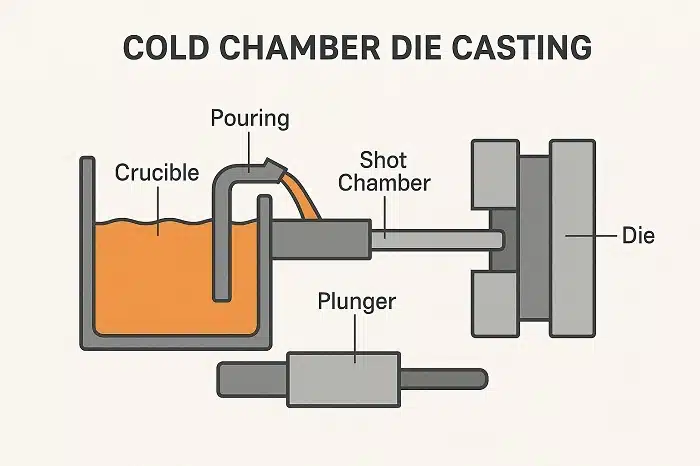
Machine components
Cold chamber die casting machines have many important parts. Each part does a special job. The process starts with a furnace and a ladle. The furnace melts the metal and keeps it hot. The ladle moves the melted metal to the shot sleeve. The shot sleeve holds the metal before it is injected. The plunger pushes the metal into the die cavity. The die and cooling channels shape the part and help remove heat. The clamping unit and ejection system keep the die halves together and let the finished part out.
| Component | Function |
|---|---|
| External Furnace & Ladle | Keeps the injection system away from molten metal, making sure the metal stays clean and good. |
| Shot Sleeve | Holds melted metal before injection; stops air from getting in and prevents cold slugs. |
| Plunger & Intensification | Pushes metal into the die cavity and uses pressure to stop holes from forming. |
| Die & Cooling Channels | Shapes the part and removes heat; keeps the temperature balanced to avoid problems. |
| Clamping Unit & Ejection | Holds die halves together during pressure; lets the finished part out without damage. |
The shot sleeve and plunger are very important. The shot sleeve must handle high heat and pressure. The plunger moves inside the shot sleeve and pushes the melted metal into the die cavity. The nozzle guides the metal into the mold. Pressure systems control how hard and fast the plunger moves. These systems help stop mistakes and keep the metal flowing well.
MORELUX uses modern machines for cold chamber die casting. The company uses vacuum copper die casting to make parts with fewer holes and better strength. This process makes the surface smoother and helps electricity flow better. MORELUX makes exact parts for cars, electronics, and machines.
Step-by-step operation
Cold chamber die casting follows steps to make strong and exact parts. First, the right metal is picked and melted. The metal is melted in a furnace outside the machine. The melted metal goes into the shot sleeve and stays hot. The die is made ready and closed tight. The die has two halves that form the mold.
A plunger pushes the melted metal into the die cavity. The plunger uses high pressure to fill every part of the mold. The metal cools and gets hard inside the die. Cooling channels help control how fast the metal cools and make sure the part is strong. After cooling, the die halves open. Ejector pins push out the hard part without breaking it.
- Metal Selection and Melting: The right metal is picked and melted in a furnace.
- Transfer to Shot Sleeve: The melted metal moves into the shot sleeve and stays hot.
- Die Preparation: The die is closed tight to form the mold.
- Injection of Molten Metal: The plunger pushes the metal into the die cavity with high pressure.
- Cooling and Solidification: The metal cools and gets hard inside the die.
- Ejection of Casting: The die opens, and ejector pins push out the finished part.
Cold chamber die casting works well for metals with high melting points like aluminum and magnesium. The process handles these metals easily. Hot chamber die casting cannot work with such high temperatures. Cold chamber die casting makes strong parts that are needed for cars and electronics.
MORELUX checks quality with advanced methods. The factory uses software and real-time checks to stop mistakes. The company makes the shape and heat flow better. These steps help stop cold flow and holes from forming. The supplier makes sure every part is made to strict rules.
Clamping force and cycle time
Clamping force is very important in cold chamber die casting. The force keeps the die halves together when metal is injected. For aluminum and magnesium, clamping force is usually between 720 tons and 6000 tons. The manufacturer figures out the force by looking at the pressure and the size of the part. Strong clamping stops leaks and makes sure the part forms right.
Cycle time is how long it takes to make each part. Cold chamber die casting takes longer than hot chamber die casting. Melting metal and moving it to the shot sleeve slows things down. This is even more true for big or complicated parts. But cold chamber die casting can use more types of metals. It is good for custom jobs.
MORELUX uses machines and robots to make work faster and better. Smart die design means less extra cutting is needed. Custom machines make the process easier and safer. The company uses sprays and robots to cover the die surface. These tools help keep quality high and production smooth.
Tip: Cold chamber die casting is best for making strong aluminum and magnesium parts. The process makes parts that last and are very exact. It is great for industries that need tough and precise parts.
Cold chamber die casting Advantages
Advantages of cold chamber die casting
Cold chamber die casting has many good points for factories and suppliers. This process is great for metals that melt at high heat, like aluminum and magnesium. These metals are needed for parts that are strong but not heavy. The melting furnace is not part of the casting unit. This helps the mold last longer and stops it from wearing out fast. Factories can make parts that are very exact, with small size changes of only ±0.1 mm. They can also make shapes that are hard to create in just one step. The parts come out smooth, so there is not much extra work needed. This saves both time and money.
| Advantage | Description |
|---|---|
| Scalability for medium- to high-volume production | Makes lots of parts for big or special orders, keeping quality and speed. |
| Compatibility with high-melting-point alloys | Works with aluminum, magnesium, and copper without hurting the metal. |
| High mechanical strength and internal density | High pressure stops shrinking, so parts are strong and last long. |
| Excellent dimensional accuracy and repeatability | Tight size limits mean less extra cutting is needed. |
| Capability to produce complex geometries | Can make tricky shapes, so fewer parts are needed and building is easier. |
Cold vs. hot chamber methods
Cold chamber die casting and hot chamber die casting are not the same. Hot chamber works faster and is good for metals like zinc that melt at low heat. Cold chamber is better for metals that need more heat to melt. It makes parts that are more exact and have smoother surfaces. This way, the mold lasts longer and does not get rusty as fast. Cold chamber is best when you need strong parts that can take heat and have special shapes.
Suitable materials
Cold chamber die casting works best with metals like aluminum, magnesium, and copper. These metals melt at high heat and are strong and tough. Car, electronics, and medical companies use this process to make parts they can trust. MORELUX is a trusted company that makes and sells cold chamber die casting parts for these jobs. Their new machines make sure every part is made well and can be used in many ways.
Cold chamber die casting applications

Cold chamber die casting is used in many fields. Many factories use this method to make strong and exact parts. It works well with metals like aluminum and magnesium. That is why it is common in cars, electronics, and machines.
Many companies make electronic parts with cold chamber die casting. These parts are housings, connectors, and heat sinks. The process makes each part strong and the right size. Factories use metals that melt at high heat. This makes electronic devices last longer and work better.
- Electronic housings keep circuits safe.
- Connectors help devices stay linked.
- Heat sinks keep equipment cool.
Car makers use cold chamber die casting for engine parts and frames. Airplane makers use it for light and strong parts. Machine makers use it for gears and brackets. Companies use it for home tools and appliances. New energy companies use it for battery cases and green energy systems.
| Industry |
|---|
| Automotive Industry |
| Aerospace |
| Industrial Machinery |
| Consumer Goods and Home Appliances |
| New Energy and Renewable Energy |
Cold chamber die casting is used more as technology grows. Factories and suppliers make strong and exact parts for many jobs. Companies like MORELUX help these fields with custom parts and careful checks.
Note: Cold chamber die casting helps companies meet world rules and make parts that last.
Cold chamber die casting makes strong parts from metals like aluminum. This process is picked because it works with many metals. It also makes parts that are tough and have smooth surfaces.
| Benefit | Description |
|---|---|
| Material Versatility | Can use metals that melt at high heat. |
| High Strength Components | Makes parts that last a long time. |
| Complex Geometries | Can create shapes that are hard to make. |
| Enhanced Surface Finish | Gives parts a smooth look and feel. |
| Corrosion Resistance | Parts do not wear out or rust easily. |
Companies look at what metals they need and how many parts to make. They also check the cost. MORELUX gives trusted help. Readers can reach out to the supplier for special projects.
FAQ
What metals work best for cold chamber die casting?
Aluminum, magnesium, and copper alloys are best for cold chamber die casting. Factories pick these metals because they are strong and last a long time. These metals also melt at high temperatures.
How does cold chamber die casting improve part quality?
Using high pressure helps stop mistakes. This makes parts smooth and the right shape. Factories check each part to make sure it works well for cars, electronics, and medical tools.
Why do suppliers prefer cold chamber die casting for custom projects?
- Cold chamber die casting can make tricky shapes.
- Factories make parts that fit very closely.
- Suppliers can match special needs for business clients.