
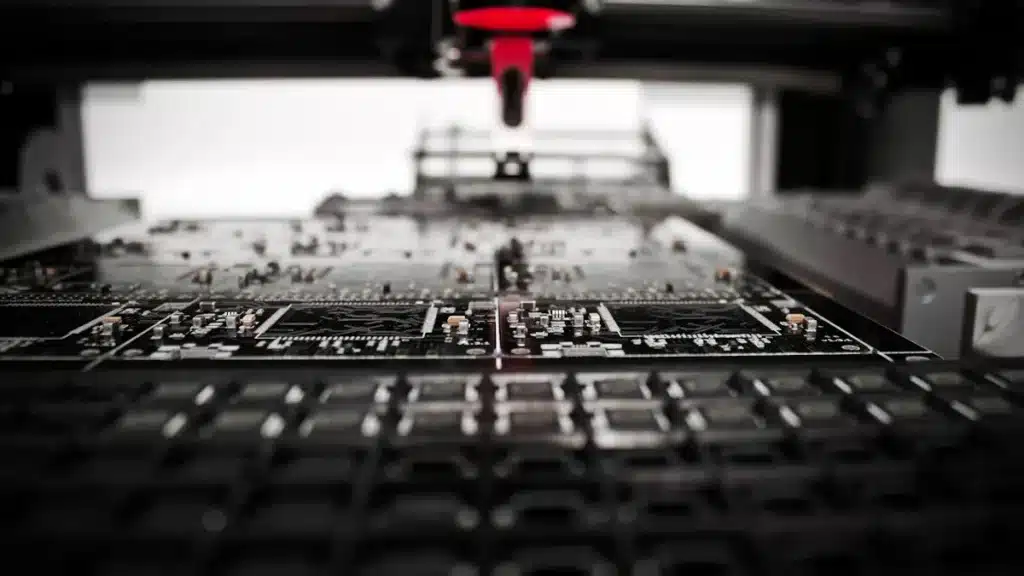
Aluminium gravity die casting is a manufacturing method that relies on gravity to pour molten aluminium into a metal mold, producing strong, lightweight parts with excellent dimensional accuracy; widely adopted by numerous enterprises to fabricate key components, the global aluminium gravity die casting market is set to expand steadily, growing from USD 7.88 billion in 2026 to USD 11.58 billion by 2034, with the automotive industry standing as its largest end-user. In addition, aluminium components made via this process feature long service life, great corrosion resistance and outstanding thermal conductivity, making them highly suitable for applications in electronics and medical equipment.
| Industry | Applications |
|---|---|
| Automotive | Engine blocks, transmission cases, suspension parts |
| Electronics | Durable enclosures, heat sinks, cooling components, connectors |
| Medical Equipment | Lightweight, corrosion-resistant parts for medical devices |
Key Takeaways
- Gravity die casting of aluminum is a low-cost method for manufacturing high-strength, lightweight parts. These parts are widely used in the automotive and electronics industries. The process uses a hot metal mold into which molten aluminum is poured, and after cooling, a smooth, precise part is formed. Commonly used aluminum alloys include A356 and A380, which ensure durability and good heat dissipation, making them versatile. Gravity die casting allows for the design of various shapes, and is particularly suitable for parts that are not too thin or have a relatively simple structure. Furthermore, the recycling of aluminum in this process saves energy, making it an environmentally friendly manufacturing method.
Aluminium gravity die casting process
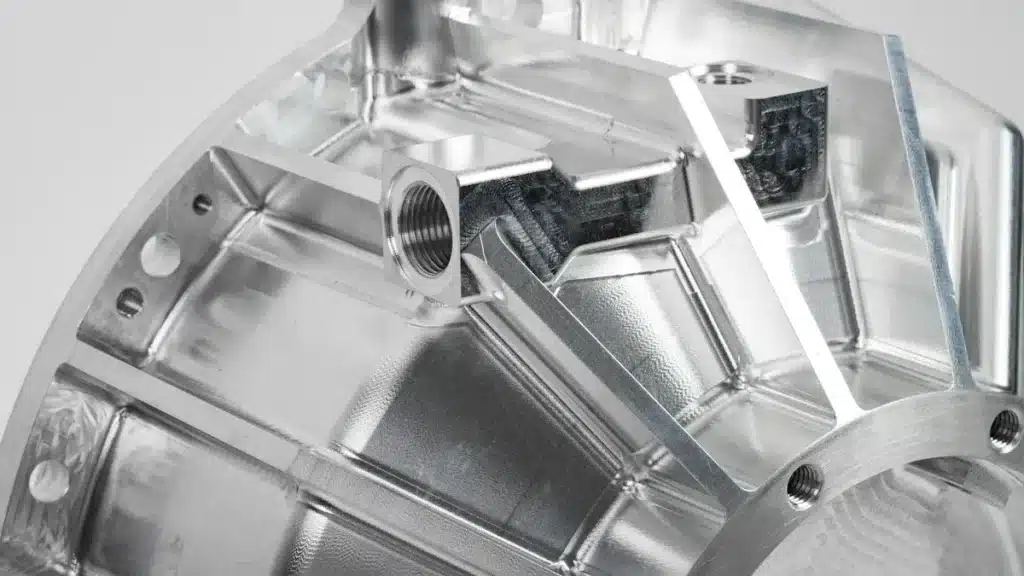
How Gravity Casting of Aluminum Works
Aluminum gravity casting uses reusable metal molds. Gravity helps molten aluminum fill the mold. First, workers heat the mold to approximately 200°C to 300°C. This helps the mold maintain its strength and prevents cracking due to the high temperature. Next, they apply a thin protective layer to the inner wall of the mold. This protective layer helps the molten metal flow better and protects the mold.
Gravity pulls the molten aluminum into the gaps in the mold. The metal begins to cool and harden from the mold walls. The steel mold cools the metal at a steady rate. This results in parts with high strength and a uniform surface. Gravity casting of aluminum is suitable for non-ferrous alloys such as aluminum. These metals melt easily and have good fluidity. The process produces parts with high strength and a smooth surface.
Note: Companies such as MORELUX use special mold designs and machines to make better parts. They check each part carefully to make sure it is good enough for use.
Key steps in the casting process
The aluminium gravity die casting process has several main steps. Each step helps make strong and exact parts.
- Preparing the Mold: Workers heat the mold and put on a special coating.
- Pouring the Molten Aluminum: They pour melted aluminium into the mold using gravity.
- Solidification and Cooling: The metal cools and becomes solid inside the mold.
- Removing the Casting: Workers open the mold, take out the part, and cut off extra bits.
- Finishing and Inspection: They finish the part and check it to make sure it is good.
Doing these steps in order helps every part meet the right strength and look. Good mold design is important for making parts that fit well and look nice.
Materials and equipment used
Aluminium gravity casting uses non-ferrous alloys, mostly aluminium, because they melt at lower temperatures and flow well. The most used aluminium alloys are A356, A380, and B319. These alloys flow easily, shrink a little, and are strong. They are used for car parts, heat sinks, and machine parts.
| Alloy Grade | Melting Range (°C) | Fluidity | Shrinkage | Applications |
|---|---|---|---|---|
| A356 | 600–650 | High | ~1.2% | Automotive housings, heat sinks, pump bodies |
| A380 | 600–650 | High | ~1.2% | Automotive parts, consumer electronics |
| B319 | 600–650 | High | ~1.2% | Industrial components |
Key tools include steel molds, melting furnaces, casting ladles, and machinery for moving the molds. New technologies such as real-time monitoring and specialized casting machines help companies like MORELUX produce more, higher-quality parts. This machinery also helps save costs and reduce waste. Maintaining the correct temperature helps avoid production errors.
Aluminum gravity casting is good for the planet. Aluminum can be repeatedly recycled. Recycling aluminum consumes far less energy than producing new metal. This makes the process efficient and more environmentally friendly.
Advantages of Aluminum Gravity Casting
Quality and Surface Finish
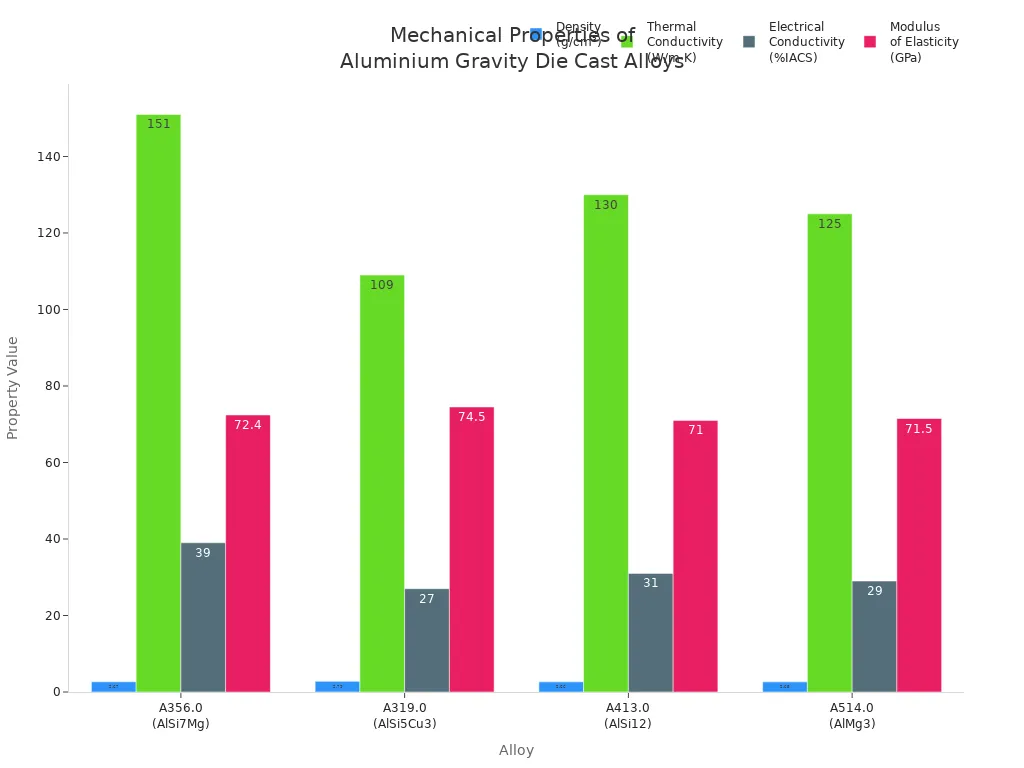
Parts produced by aluminum gravity casting have a beautiful appearance and excellent performance. The metal molds help parts achieve a smooth surface and a robust shape. Most commonly used aluminum alloys, such as A356.0 and A319.0, have high strength and toughness. The table below lists some commonly used parameters:
| Property | A356.0 (AlSi7Mg) | A319.0 (AlSi5Cu3) | A413.0 (AlSi12) | A514.0 (AlMg3) |
|---|---|---|---|---|
| Tensile Strength (MPa) | 230-280 | 180-240 | 170-200 | 170-220 |
| Yield Strength (MPa) | 160-220 | 120-170 | 80-120 | 90-130 |
| Elongation (%) | 2-5 | 1.5-3 | 2.5-4 | 3-8 |
| Hardness (Brinell) | 70-90 | 70-85 | 55-75 | 60-75 |
| Density (g/cm³) | 2.67 | 2.79 | 2.66 | 2.65 |
| Thermal Conductivity | 151 | 109 | 130 | 125 |
The type of mold affects the smoothness of the parts. Parts cast using permanent molds are smoother than those cast using sand casting, meaning less post-cast machining is required and the parts have a more aesthetically pleasing appearance. Gravity casting of aluminum can produce parts with extremely high precision and minimal error, which is especially important for parts requiring tight fits.
Efficiency and Cost-Effectiveness
This process helps businesses save time and costs. The same metal mold can be reused, thus spreading costs across multiple parts. Compared to sand casting, gravity casting is faster and ideal for producing large quantities of parts at once. Less scrap and less additional machining further reduce costs. Gravity casting slowly pours metal, resulting in stronger parts. Its mold costs are lower than those of high-pressure casting molds, making it ideal for small to medium batch production.
Tip: Companies can make more parts quickly with aluminium gravity die casting. This helps them fill big orders and keep prices low.
Design flexibility and limitations
Aluminium gravity die casting lets people design many kinds of parts. It works best for parts that are not too thin or too tricky. The process can make big parts that are strong and have few holes. But it is hard to make very thin or very detailed shapes. The table below shows the main points:
| Design Aspect | Description |
|---|---|
| Limitations | Hard to make thin walls (<3 mm) or very complex shapes. |
| Flexibilities | Good for thick-walled parts (3–50 mm) like pump casings and gearbox housings. |
Engineers choose this process to manufacture high-strength, high-precision parts, such as pump bodies, engine mounts, and other critical components.
Aluminum Gravity Die Casting vs. Sand Casting
Process and Mold Differences
Aluminum gravity die casting and sand casting differ in their metal forming methods. In aluminum gravity die casting, workers pour molten aluminum into a steel mold. Gravity helps the metal fill every corner of the mold. This method is suitable for metals such as aluminum, magnesium, and zinc. The steel mold can be reused multiple times, and more intricate shapes can be created.
Sand casting uses molds made of compacted sand. Workers compact the sand around the mold and then remove it. They pour molten metal into the voids. Sand casting is suitable for a wide variety of metals, even including iron and steel. However, sand casting cannot produce parts with a large number of fine details.
Key differences include:
- Gravity die casting uses steel molds again and again, but sand casting uses new sand molds each time.
- Gravity die casting can make more detailed parts.
- Sand casting works with more types of metals.
Surface finish and accuracy
The way a part looks and fits depends on the casting method. Gravity die casting makes parts with smoother surfaces and better accuracy. Sand casting leaves a rougher surface and is less exact.
| Casting Method | Surface Finish | Dimensional Accuracy |
|---|---|---|
| Sand Casting | Rougher | Tolerances of ±0.020″ to ±0.030″ |
| Gravity Die Casting | Smoother | Tolerances of ±0.002″ to ±0.005″ |
Parts from gravity die casting need less fixing after they are made. Sand casting parts often need to be ground or cut to the right size and smoothness.
Typical applications for each method
Different jobs use different casting methods for their needs. Gravity die casting is used in cars, airplanes, and electronics. It makes things like engine blocks, pistons, housings, brackets, and heat sinks. Sand casting is used for big parts in building, ships, and farm machines.
| Casting Method | Common Applications |
|---|---|
| Gravity Die Casting | Automotive (engine blocks, pistons), Aerospace (housings, brackets), Electronics (heat sinks, enclosures), Industrial (valve bodies, pump housings) |
| Sand Casting | Automotive (engine blocks), Construction, Marine, Agricultural Machinery |
Tip: Picking the best casting method depends on the part’s size, shape, and how smooth it needs to be. Gravity die casting is best for smooth, exact parts. Sand casting is better for big or simple parts.
Applications of aluminium casting

Automotive and electronics
Car makers use aluminium gravity die casting for many parts. This method makes strong and light pieces for cars. It helps cars work better and use less fuel. Some car parts made this way are:
- Engine blocks, cylinder heads, and crankcases. These need to be the right size for engines to work well.
- Wheels, doors, and frames. Casting these parts makes cars lighter and saves gas.
- Control arms, axles, and brake calipers. These help cars stay safe and drive smoothly.
In electronics, casting makes covers and cases for devices. It also makes heat sinks to keep things cool. The process makes parts that are light and strong for new gadgets. Aluminium gravity die casting lets companies make cool shapes. This helps electronics look nice and work well.
Medical and industrial uses
Aluminium casting is important in medical and industrial jobs. Many medical tools need parts that do not rust and last long. Casting makes these parts strong and safe for hospitals.
Some main products made by casting are:
- Strong parts for medical machines, like covers and brackets.
- Hydraulic parts and pump covers for big machines.
- Gearboxes and supports for factory tools.
- Tough cases for home appliances.
These parts must follow strict safety and quality rules. Aluminium gravity die casting helps companies meet these tough standards.
Custom solutions for various industries
Every industry needs different things. Companies like MORELUX make custom die-cast parts for many jobs. They work with customers to design parts for special uses. This means they can change the shape, size, or finish of each part.
Note: Custom parts are important. They help meet industry rules and make sure each part works well.
MORELUX uses new technology and careful checks to make good castings. Their team helps customers pick the best materials and designs. This way, each industry gets the right parts for its needs.
Quality and material selection in aluminium casting
Choosing the right aluminium alloy
Picking the best aluminium alloy is very important for each project. Engineers think about many things before they decide. They look at how strong and bendy the metal is. They check if it can fight rust. They see what temperatures it can handle. They also think about how easy it is to shape and cut. The cost matters too.
Different jobs use different alloys. Car parts often use ADC12 or A356. These alloys flow well and do not cost a lot. Planes need lighter and stronger alloys like A357 or 319. Things people use every day might use 443.0 or 360. These alloys look nice and do not rust easily. The most used alloy is A356.0. It makes strong parts that can handle a lot of force. If a part needs to be even stronger, A357.0 is a good pick.
The table below shows how some aluminium alloys are different:
| Alloy | Mechanical Properties | Corrosion Resistance |
|---|---|---|
| AlSi7Mg (A356) | Excellent corrosion resistance, high ductility | Suitable for harsh environments |
| AlSi9Mg | Good fluidity and mechanical properties | Medium-strength structural applications |
| AlSi12 | High wear resistance and fluidity | Commonly used for complex geometries |
| AlCu4TiMg (206) | High-strength, heat-treatable | Demanding aerospace and military parts |
Quality Control Steps
Quality control ensures that every part is robust and safe. The team inspects the shape and dimensions of each part and tests the hardness and strength of the metal. Good mold design prevents parts from bending or shrinking. The metal must be maintained at the appropriate temperature to prevent voids. The cooling process is strictly controlled to ensure uniform hardening of the metal. The team checks the metal proportions to ensure they are correct. They use specialized tools to measure parts and observe the internal structure of the metal. They also test the performance of the parts in practical applications.
Quality control in aluminum gravity die casting ensures the consistency and safety of every part. Good mold design and precise temperature control prevent problems such as voids, cracks, and weak points.
Impact on Product Performance
The metals selected and the inspections performed affect the performance of the parts. Higher strength alloys help extend the service life of parts and withstand greater pressure. Good rust resistance allows parts to function properly in harsh environments. Wear-resistant alloys, such as aluminum alloy 390, can further extend the service life of parts. When companies follow each step and select the appropriate alloys, they obtain high-quality parts with superior performance.
Tip: Picking the right metal and checking quality helps products last a long time and work great.
Aluminium gravity die casting helps companies make strong and exact parts. These parts have smooth surfaces. The process uses metal molds that can be used many times. This helps make high-quality parts. The table below shows the main good and bad points:
| Advantages | Limitations |
|---|---|
| Low gas porosity and fine grain sizes | Higher costs associated with metal moulds |
| Improved structural integrity and reduced defects | |
| Better surface finish and dimensional accuracy | |
| Less finishing and fettling required | |
| Ability to incorporate undercuts and cavities | |
| Higher casting rate suitable for mass production |
FAQ
What is aluminum gravity die casting used for?
Manufacturers use aluminum gravity die casting to create high-strength parts. These parts are lightweight and durable, and are widely used in automotive, electronics, and medical devices.
What is the difference between gravity die casting and sand casting?
Gravity die casting allows for the reuse of metal molds, while sand casting requires a new mold for each part. Gravity die casting produces smoother, more precise parts.
Why do companies choose aluminum for die casting?
Aluminum does not rust, is lighter than most metals, and has excellent thermal conductivity. These properties make aluminum ideal for many applications.
Can aluminum gravity die casting create custom parts?
Yes. Companies can customize molds to different shapes and sizes. This process allows them to create custom parts for automotive and electronics products.
How is quality control conducted in aluminum gravity die casting?
The team checks the dimensions, shape, and strength of each part. They use tools to test and measure the metal. Careful inspection ensures that each part meets quality standards.