

Alloy casting is the process of manufacturing metal parts by pouring molten alloy into a mold. This method can form a variety of metals, including aluminum, zinc, and magnesium, and has a wide range of applications. Alloy casting provides companies with robust and reliable parts. Precision die casting technology further enhances the quality of alloy casting by producing parts with smooth surfaces and precise dimensions. MORELUX is a leader in precision die casting, committed to providing high-quality solutions for today’s needs. Alloy casting is widely used in the manufacture of automotive, electronics, and medical devices. People trust alloy casting because of its high precision and superior performance.
Key Takeaways
- Alloy casting is a process for manufacturing robust metal parts. It is achieved by pouring molten alloy into a mold. This is crucial for industries such as automotive and electronics.
- The alloy casting process comprises six main steps: melting, degassing, pouring, cooling, solidification, and casting. Each step is essential for producing high-quality parts.
- High-pressure die casting can produce parts with precise dimensions and smooth surfaces. This makes it ideal for manufacturing complex shapes and enabling rapid mass production.
- There are various casting methods, such as sand casting and investment casting. These methods meet different needs, allowing for modifications to design and manufacturing processes.
- Choosing the right alloy, such as aluminum, zinc, or magnesium, can make the final product stronger, lighter, and more durable, thus meeting the needs of various industries.
Alloy casting process

Alloy casting transforms raw metal into usable parts. Workers use heat, molds, and delicate steps to shape the metal. Metal casting is crucial for manufacturing products such as automobiles, electronics, and medical devices. The process involves multiple steps that ultimately transform solid metal into finished parts.
Melting and Shaping
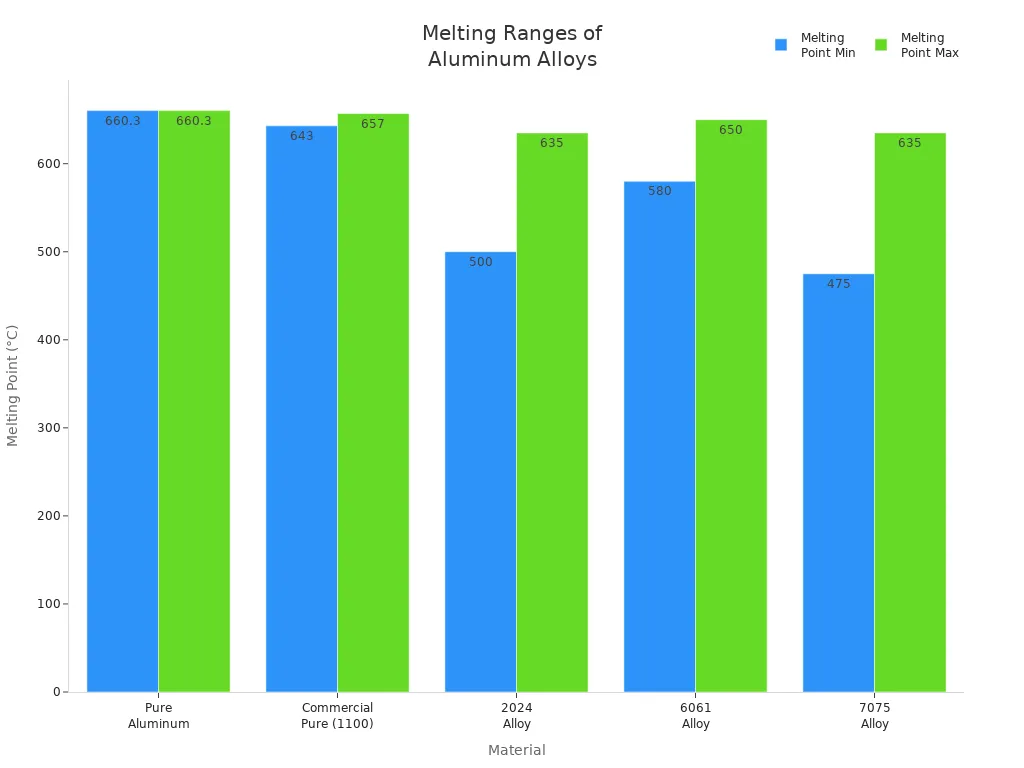
The first step is melting. Workers heat the metal alloy to a liquid state. Each alloy has a different melting point. For example, pure aluminum has a melting point of 660.3°C. Zinc-aluminum alloys have melting points between 426°C and 482°C. Magnesium-aluminum alloys have melting points between 621°C and 704°C. The appropriate temperature is key to achieving good casting results.
After melting, workers remove gases and improve the melt, which helps the casting maintain strength and high quality. Next, they pour the hot metal into a mold. The mold shapes the metal as it cools. The metal solidifies rapidly within the mold. As it cools, crystals form, and the metal gradually hardens. Finally, the worker removes the solidified casting from the mold.
The main steps of the alloy casting process are as follows:
- Melting: Heating the metal alloy until it melts.
- Degassing and Modification: Removing gases and improving the melt.
- Pouring: Pouring the molten metal into a mold.
- Solidification: Allowing the metal to cool rapidly within the mold.
- Solidification: As the metal hardens, crystals form.
- Casting: Removing the solidified casting from the mold.
Sometimes, problems arise during melting and shaping. These problems, known as defects, reduce the strength of the casting. The table below lists common defects, their causes, and solutions.
| Defect Type | Description | Causes | Prevention Methods |
|---|---|---|---|
| Porosity | Small holes or air pockets in the metal, weakening it. | Trapped gases, poor venting, contamination. | Ensure good venting, control pouring speed, and keep the environment clean. |
| Shrinkage | Decrease in metal volume as it cools, causing empty spaces. | Thick areas or uneven cooling. | Use risers, control cooling rate, and add insulation. |
| Cold Shuts | Weak seams where molten metal streams do not fuse. | Slow pouring or low temperature. | Ensure high pouring temperature and smooth metal flow. |
| Misruns | Incomplete castings where the mold is not fully filled. | Low pouring temperature or speed. | Increase pouring temperature and preheat the mold. |
| Inclusions | Impurities or particles trapped inside the casting. | Contamination or improper filtering. | Clean the mold, filter molten metal, and avoid contamination. |
| Hot Tears | Cracks formed due to uneven cooling. | Stress from uneven cooling. | Use flexible mold materials and control cooling rate. |
MORELUX employs specialized casting processes to reduce defect rates. The company rigorously inspects parts at every stage of production, utilizing X-rays and other detection methods to identify problems early. Their team meticulously controls temperatures and uses pure alloy materials to ensure the superior quality of every casting.
High-Pressure Die Casting
High-pressure die casting is a specialized metal casting process. This process injects high-temperature metal into a steel mold at extremely high speed and pressure. The metal fills every space in the mold, perfectly filling even the smallest corners and sharp edges. This method can create shapes that are impossible to achieve with other casting processes.
High-pressure die casting offers numerous advantages:
- It can produce dimensionally precise, smooth-surfaced parts.
- This process enables the rapid production of robust and highly detailed parts.
- Die casting molds can withstand high pressure, which is especially important for metals such as aluminum, zinc, and magnesium.
- Rapid filling results in a more refined and robust metal structure.
- This process reduces porosity and increases the strength of castings.
The table below shows the dimensional accuracy of different casting processes:
| Casting Process | Tolerances Achievable |
|---|---|
| High-Pressure Die Casting | ±0.05–0.3% (±0.05–0.3 mm per 100 mm) |
| Investment Casting | ±0.1–0.5% (±0.1–0.5 mm per 100 mm) |
| Sand Casting | ±0.5–2.0% (±0.5–2.0 mm per 100 mm) |
MORELUX uses high-pressure die casting technology to manufacture precision parts for a wide range of applications. Its process utilizes advanced equipment and rigorous quality control to ensure the accuracy and strength of each part. The company also utilizes CNC machining and surface treatment technologies for finishing the castings.
High-pressure die casting technology helps MORELUX produce robust and reliable metal parts. Its casting process meets the needs of numerous industries for lightweight, high-strength, and precision parts. With its superior casting process, MORELUX maintains a leading position in quality and innovation.
Types of Alloy Casting
Alloy casting uses different methods to form metal parts. These methods are widely used in various industries. Each method has its own steps and advantages. The main types include sand casting, die casting, and investment casting. These methods are used to manufacture parts made of aluminum, zinc, and magnesium alloys. The choice of casting method depends on the size, shape, and application of the part.
Sand casting
Sand casting is a long-established and widely used alloy casting method. Workers use templates to create molds in sand, then pour hot alloy into the sand mold. After the alloy cools, the sand is removed. This is the finished part. Sand casting is ideal for large or complex-shaped parts. It is commonly used to manufacture engine blocks, gearbox housings, pump bodies, and mechanical parts. Sand casting is also used to manufacture parts for bridges, gears, flywheels, fuel tanks, and electronic components.
Sand casting is suitable for a wide range of alloy types and sizes, making it ideal for custom machining.
| Application Type | Description |
|---|---|
| Engine Blocks | Used to make strong engine blocks and cylinder heads. |
| Transmission Housings | Makes complex shapes for transmission systems. |
| Machinery Parts | Casts big and tricky parts like gear housings and brackets. |
| Infrastructure Components | Custom castings for bridges and buildings with special designs. |
| Pump Bodies | Needed for making tough pump parts. |
Die casting
Die casting uses high pressure to press a high-temperature alloy into a steel mold. This method can produce parts with precise dimensions and smooth surfaces. Die casting is fast and ideal for mass production of parts. It is best suited for aluminum, zinc, and magnesium alloys. Die casting is widely used in the automotive, electronics, and medical device industries. This process can produce parts that are strong, detailed, and durable.
| Aspect | Die Casting | Sand Casting |
|---|---|---|
| Efficiency | Very fast and efficient | Slower cycles |
| Surface Finish | Very smooth surfaces | Rougher surfaces |
| Design Versatility | Can make tricky shapes | Not as flexible |
| Durability | Very strong | Not as strong |
MORELUX boasts exceptional capabilities in precision die casting. The company utilizes advanced equipment and rigorous quality control processes. Their team specializes in casting aluminum, zinc, and magnesium alloys, providing superior casting solutions.
Investment casting
Investment casting, also known as lost-wax casting, involves workers using a wax model and covering it with ceramic. The wax model is then melted, leaving a ceramic mold. Finally, hot alloy is poured into the mold to create the part. Investment casting produces parts with fine details and smooth surfaces. This method is particularly suitable for parts with complex shapes and thin walls, meaning fewer subsequent machining steps are required.
Alloy casting methods offer manufacturers a variety of options. Sand casting is suitable for large or custom parts. Die casting is best suited for mass production of high-precision alloy parts. Investment casting is suitable for complex designs. MORELUX is a leader in die casting, providing high-quality alloy parts to numerous industries.
Alloy casting materials
Alloy casting materials are crucial for manufacturing high-strength metal parts. Different casting alloys possess unique properties, making them suitable for numerous industries. Major casting alloys include aluminum alloys, zinc alloys, and magnesium alloys. Each metal has its unique mechanical properties, making it suitable for casting.
Aluminum alloys
Aluminum alloys are widely popular due to their lightweight and high strength. They are resistant to rust, have good thermal conductivity, and are easy to form. Aluminum alloys are widely used in the automotive, aerospace, and electronics industries. Many engine blocks and gearbox housings are made of aluminum alloys because they are both lightweight and strong.
| Alloy | Properties | Uses |
|---|---|---|
| A360 | Very bendy, strong, does not rust, flows well, holds pressure | Used for exact casting, cars, and planes |
| A383 | Moves heat well, light, resists rust and oxidation more | Used for tricky die-casting jobs |
| A413 | Strong for its weight, does not rust, easy to machine | Used for hydraulic parts and hard shapes |
| B390 | Wears down slowly, melts at lower heat, conducts well | Used for pistons, pumps, and brakes |
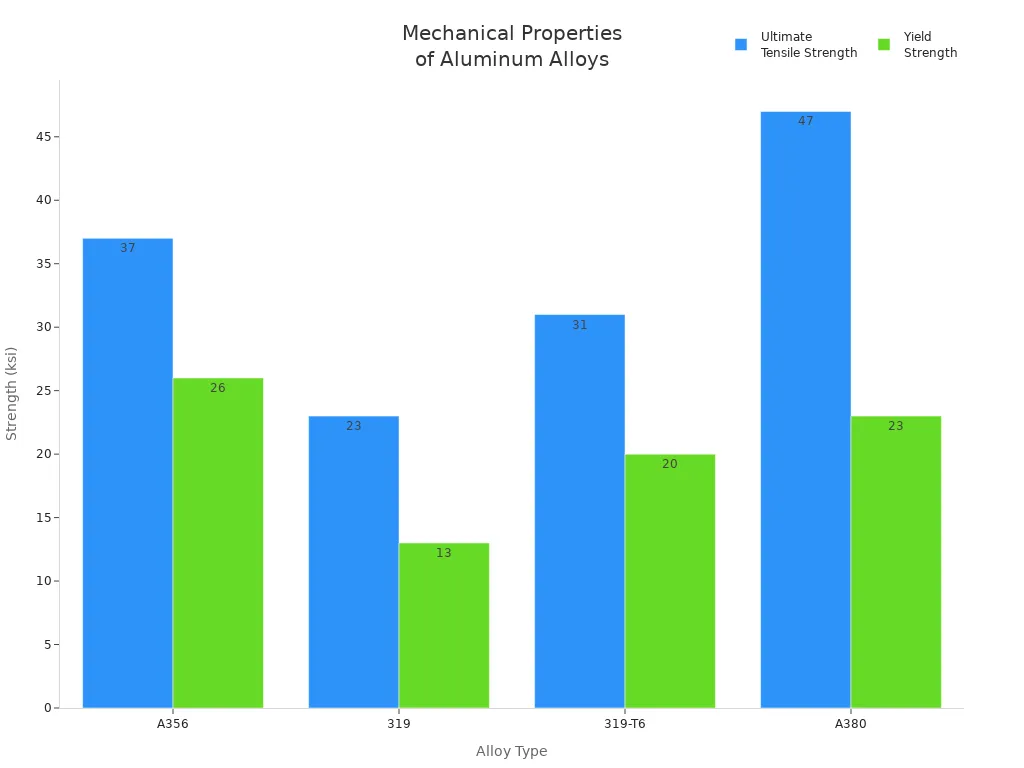
The table below shows how strong some common aluminum alloys are.
| Alloy Type | Casting Method | Ultimate Tensile Strength | Yield Strength |
|---|---|---|---|
| A356 | Permanent Mold Casting | 37 ksi (255 MPa) | 26 ksi (180 MPa) |
| 319 | Sand Casting | 23 ksi (160 MPa) | 13 ksi (90 MPa) |
| 319-T6 | Sand Casting | 31 ksi (215 MPa) | 20 ksi (140 MPa) |
| A380 | Die Casting | 47 ksi (324 MPa) | 23 ksi (160 MPa) |
Zinc alloys
Zinc alloys are important materials for manufacturing precision parts. These casting alloys are easy to bend, have good toughness, and a low melting point. The zinc alloy casting process is simple and can produce parts with smooth surfaces. They are widely used in the automotive, electronics, medical device, and construction industries. Zinc alloys also prevent steel in automobiles from rusting and can be used as water anodizing agents.
Magnesium alloys
Magnesium alloys are currently the lightest casting alloys. These casting alloys are lightweight, high-strength, and easy to cut and shape. Magnesium alloys are 70% lighter than steel and about one-third lighter than aluminum. Compared to other metals, magnesium alloys have better vibration resistance.
| Property | Description |
|---|---|
| Lightweight | Magnesium alloys are much lighter than aluminum and steel. Their density is 1.74 g/cm³. |
| Strength-to-weight ratio | Magnesium is stronger for its weight than aluminum and steel. |
| Corrosion resistance | Magnesium alloys do not rust in dry places, especially with surface coatings. |
| Ease of manufacturing | Magnesium alloys are easy to cut, which makes casting faster and tools last longer. |
Magnesium alloys are widely used in aerospace, sporting goods, defense, and automotive industries. These casting alloys help to manufacture lightweight yet high-strength parts.
Choosing the right casting alloy depends on your specific needs, such as strength, weight, or rust resistance. Each metal has unique casting properties suitable for different applications.
Applications and Advantages

Industry uses
Alloy casting is crucial in many industries. Companies utilize alloy casting to manufacture high-strength parts for a wide range of applications. The table below lists how alloy casting is applied in different industries.
| Industry | Applications |
|---|---|
| Automotive | Used to make car parts, lower weight, and boost performance. |
| Marine | Makes things like valves, propellers, and pumps with copper alloys. |
| Construction | Uses cast iron and steel for building and design materials. |
| Oil and Gas | Makes parts for getting and processing oil and gas. |
| Mining | Used for mining machines and their parts. |
| Military and Defense | Makes tough parts for defense equipment. |
| Aviation | Used to make airplane parts. |
| Agriculture | Makes parts for farm machines. |
MORELUX provides die-casting solutions for these industries. Their processes can be used to manufacture components for automobiles, electronics, mobile phones, and medical devices. The company uses new technologies to produce alloy parts that meet stringent standards. Each project can be customized to specific requirements. This makes alloy casting ideal for many applications.
Advantages of Alloy Casting
Alloy casting offers numerous advantages for manufacturers and engineers. These advantages help companies produce products with wider applications and better performance.
- Casting alloys are high in strength, rust-resistant, and heat-resistant.
- The process allows workers to create complex shapes and fine details.
- Alloy casting produces parts with smooth surfaces and high strength.
- Aluminum, zinc, and magnesium are lightweight and heat-resistant.
- The right alloy can extend the service life of parts and enable them to function properly in harsh environments.
- The casting process is suitable for both high-volume and low-volume production.
- Custom casting allows companies to choose alloy composition, dimensions, and surface treatments.
- Manufacturers can meet the precise requirements of each project.
- Quality inspection ensures that every part meets the required standards.
Alloy casting helps solve specific problems through customized solutions. The alloy casting process gives products flexibility, strength, and precision, making them suitable for a variety of applications. Companies like MORELUX utilize this technology to produce reliable parts for various industries.
FAQ
What are the uses of alloy casting?
Alloy casting processes can manufacture strong metal parts for a wide range of applications. It is widely used in fields such as automotive, electronics, medical devices, and machinery. Engineers choose this process to obtain parts with the appropriate shape and size.
What metals do companies use in alloy casting?
Companies use aluminum alloys, zinc alloys, and magnesium alloys. Each metal has its unique properties. Some are lightweight, some are strong, and some do not rust.
How does high-pressure die casting improve product quality?
High-pressure die casting rapidly injects high-temperature metal into a mold, creating parts with smooth surfaces and precise dimensions. It also helps prevent parts from having problems.
Why does industry prefer alloy casting?
Industry prefers alloy casting because it produces high-quality parts. The process allows them to customize part shapes and produce them quickly. These parts are durable and perform exceptionally well.
How does MORELUX ensure the quality of its alloy castings?
MORELUX uses advanced equipment and rigorous inspection processes. Their team inspects each part using X-rays and other inspection methods. They strictly adhere to international standards for every project.