
A380.0 is the most widely used aluminum die-casting alloy in the world, accounting for an estimated 80–85% of all aluminum die-cast parts by volume. Standardized under ASTM B85, it belongs to the Al-Si-Cu family—aluminum alloyed with 7.5–9.5% silicon for fluidity and 3.0–4.0% copper for strength. If you’re sourcing aluminum castings for automotive, electronics, or industrial equipment, A380 is almost certainly on your shortlist. Its combination of excellent castability (thin walls down to 1.5 mm), moderate mechanical strength (324 MPa tensile), reliable thermal conductivity (96 W/m·K), and global raw material availability makes it the cost-effective baseline against which all other die-casting alloys are measured. This guide covers the chemical composition, mechanical and physical properties, castability characteristics, key applications, and how A380 stacks up against ADC12, A383, A360, and 6061—so you can make an informed material selection decision.
A380 Aluminum Alloy Properties

Chemical Composition
A380.0 follows ASTM B26 US standards, with internationally equivalent grades including Japan ADC10, Germany GD-AlSi9Cu3 and ISO Al-Si8Cu3Fe. The table below lists standardized element mass fraction ranges for cross-industry reference:
| Alloy Standard Designation | Cu | Si | Mg | Zn | Fe | Mn | Ni | Sn | Pb | Ti | Remainder Al |
|---|---|---|---|---|---|---|---|---|---|---|---|
| A380.0 (ASTM US) | 3.0–4.0 | 7.5–9.5 | ≤0.10 | ≤3.0 | ≤2.0 | ≤0.50 | ≤0.50 | ≤0.35 | – | – | Balance |
| ADC10 (JIS Japan) | 2.0–4.0 | 7.5–9.5 | ≤0.3 | ≤1.0 | ≤1.3 | ≤0.5 | ≤0.5 | ≤0.2 | ≤0.2 | ≤0.30 | Balance |
| GD-AlSi9Cu3 (DIN Germany) | 2.0–3.5 | 8.0–11.0 | 0.1–0.5 | ≤1.2 | ≤1.2 | 0.1–0.5 | ≤0.3 | ≤0.1 | ≤0.2 | ≤0.15 | Balance |
| Al-Si8Cu3Fe (ISO Standard) | 2.5–4.0 | 7.5–9.5 | ≤0.3 | ≤1.2 | ≤1.3 | ≤0.6 | ≤0.5 | ≤0.2 | ≤0.3 | ≤0.2 | Balance |
Silicon guarantees high fluidity for thin-wall filling; copper elevates room-temperature tensile strength and hardness; controlled iron content mitigates hot tearing during solidification. Strict impurity limits ensure consistent batch-to-batch casting quality.
Mechanical & Physical Fixed Benchmark Properties
Physical Properties (ASTM B85, as-cast, room temperature)
| Property | Value | Unit |
|---|---|---|
| Density | 2.71 | g/cm³ |
| Thermal Conductivity | 96 | W/m·K |
| Electrical Conductivity | ~31 | % IACS |
| Thermal Expansion | 21.1 | µm/m·°C |
| Melting Range | 538–593 | °C |
Mechanical Properties (ASTM B85, as-cast)
| Property | Value | Unit |
|---|---|---|
| Tensile Strength (UTS) | ~324 (47,000 psi) | MPa |
| Yield Strength (0.2% offset) | ~159 (23,000 psi) | MPa |
| Elongation | ~3.5 | % |
| Fatigue Strength (10⁸ cycles) | ~124 (18,000 psi) | MPa |
| Elastic Modulus | ~71 | GPa |
| Hardness | ~80 | HB (Brinell) |
All values sourced from ASTM B85 / NADCA Product Standards for Die Castings. Actual properties vary with casting process parameters, wall thickness, and post-casting treatment.
Castability & Machinability
| Alloy Grade | Castability | Ductility | Corrosion Resistance | Hot Cracking Resistance | Machinability |
|---|---|---|---|---|---|
| A380 | Excellent | Balanced moderate | Moderate | Good | Good |
| 6061 Wrought Aluminum | Good | Lower | Superior | N/A (forging/extrusion only) | Moderate |
| ADC12 | Good | Limited | Moderate | Average | Average |
| A360 Die-Cast Alloy | Moderate | Limited | Better than A380 | Average | Poor |
Die-Casting Alloy Applications
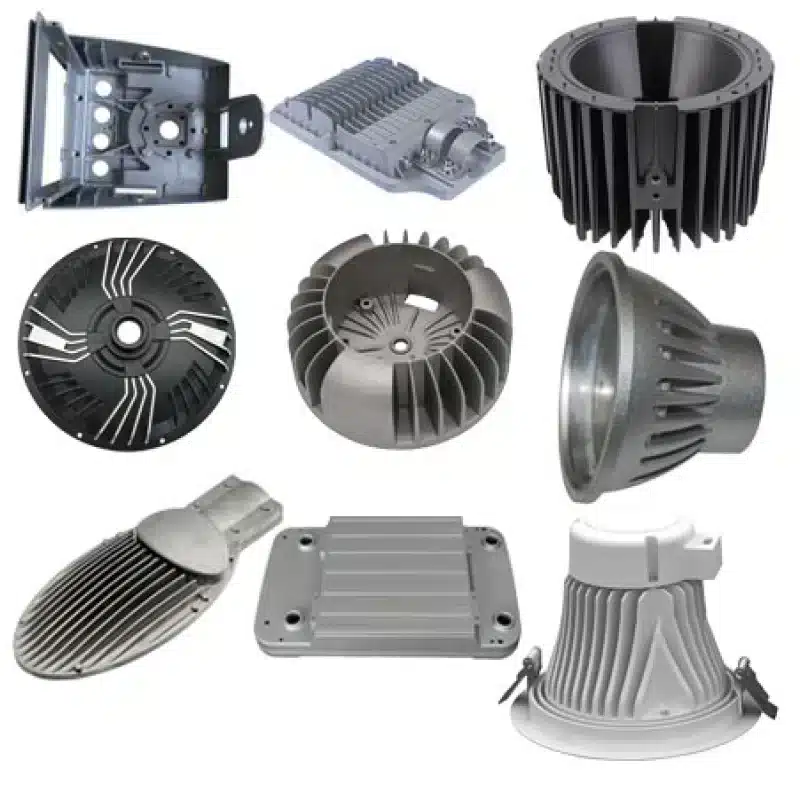
A380’s balanced casting, thermal and mechanical performance is widely adopted across six core manufacturing sectors for mass-produced aluminum die castings:
- Automotive (largest application field)Engine brackets, clutch housings, oil pans, valve bodies, transmission cases, wheel spacers, lightweight chassis auxiliary parts
- Consumer & Industrial ElectronicsHeat sinks, motor housings, LED structural frames, sealed electronic enclosures
- General Industrial MachineryPump housings, compressor casings, equipment mounting brackets, gearbox shells
- Aerospace Auxiliary HardwareNon-load-bearing interior brackets, avionics equipment housings, lightweight fitting casings
- Consumer Hardware & Power ToolsKitchen appliance frames, power tool housings, lighting structural parts, furniture support brackets
- HVAC & ConstructionHVAC blower housings, duct covers, architectural door/window auxiliary hardware
Applications by Industry
| Industry | Typical Components | Why A380 Is Selected |
|---|---|---|
| Automotive | Engine brackets, transmission cases, oil pans, valve bodies, clutch housings, wheel spacers | Lightweight (2.71 g/cm³), adequate strength for non-structural powertrain parts, high-volume cost efficiency |
| Electronics | Heat sinks, motor housings, LED frames, sealed enclosures | Thermal conductivity 96 W/m·K eliminates hotspots; thin-wall capability for compact designs |
| Industrial Machinery | Pump housings, compressor casings, gearbox shells, mounting brackets | Good machinability for secondary operations; moderate fatigue resistance for cyclic loads |
| Aerospace (non-structural) | Avionics housings, interior brackets, fitting casings | Established supply chain; meets non-critical aerospace auxiliary part standards |
| Consumer & Power Tools | Appliance frames, tool housings, lighting structural parts | Good surface finish as-cast; cost advantage over machined-from-billet alternatives |
| HVAC & Construction | Blower housings, duct covers, architectural hardware | Moderate corrosion resistance; dimensional stability under temperature cycling |
Operating limits to know: A380 retains dimensional stability and core strength up to ~150°C continuous service. For sustained operation above 180°C, consider dedicated high-temperature casting alloys (e.g., A242, A356 with T6 heat treatment).
A380 vs. Common Die-Casting Alloys: Comparison Table
| Property | A380 | A383 (ADC12) | A360 | A413 | ADC10 (JIS) |
|---|---|---|---|---|---|
| Si % | 7.5–9.5 | 9.5–11.5 | 9.0–10.0 | 11.0–13.0 | 7.5–9.5 |
| Cu % | 3.0–4.0 | 2.0–3.0 | ≤0.6 | ≤1.0 | 2.0–4.0 |
| Tensile Strength (MPa) | ~324 | ~310 | ~317 | ~290 | ~310 |
| Yield Strength (MPa) | ~159 | ~150 | ~165 | ~130 | ~150 |
| Castability | Excellent | Excellent | Good | Excellent | Excellent |
| Corrosion Resistance | Moderate | Moderate | Good | Moderate | Moderate |
| Machinability | Good | Very Good | Fair | Poor (high Si) | Good |
| Best For | General-purpose: auto, electronics, industrial | Ultra-thin-wall, complex geometry | Corrosion-critical, marine, outdoor | Thin-wall, pressure-tight | JIS-region equivalent of A380 |
When to choose A380: You need a cost-effective, globally available alloy with balanced mechanical and thermal properties for medium-to-high volume production. It’s the default choice unless specific requirements push you to a specialty grade.
When to go with an alternative:
- A383 (ADC12) — when your part has walls thinner than 1.2 mm or extreme rib density; the higher silicon improves cavity filling at the cost of slightly lower strength.
- A360 — when corrosion resistance is the priority (marine hardware, outdoor enclosures, chemical exposure). Lower copper content significantly improves atmospheric corrosion performance.
- A413 — when pressure-tightness is critical (hydraulic components, pump bodies). Highest silicon content for maximum fluidity, but poor machinability limits secondary operations.
- 6061 Wrought — when you don’t need casting at all. If your geometry can be machined from billet, 6061-T6 offers 310 MPa tensile with far superior corrosion resistance and weldability. But die casting is 3–10x cheaper per part at volume.
A380 Casting Process Considerations
What to Know When Specifying A380 for Your Project
If you’re designing a part for A380 die casting, a few practical considerations can save significant downstream cost and lead time:
- Wall thickness: A380 flows well in walls as thin as 1.2–1.5 mm, but designing uniform wall thickness throughout the part reduces warpage and internal porosity. Avoid sharp transitions thicker than 3:1 ratio.
- Draft angles: Standard draft of 1–3° on internal surfaces and 0.5–2° on external surfaces ensures clean ejection from the die. Textured surfaces require an additional 1° per 0.025 mm of texture depth.
- Recycled content: A380 tolerates up to 50–70% recycled aluminum content with minimal property degradation when proper melt treatment is applied, significantly reducing material cost and carbon footprint. Specify secondary A380 (A380.1 per NADCA) if sustainability targets are a priority.
- Post-casting operations: A380 accepts standard machining (milling, drilling, tapping), anodizing (limited to clear/light colors due to high Si), powder coating, and chromate conversion coating. Specify surface finish requirements upfront—as-cast surface roughness is typically 1.6–3.2 µm Ra.
- Tolerances: Standard NADCA linear tolerances are ±0.1 mm for the first 25 mm, +0.05 mm per additional 25 mm. Tighter tolerances require secondary machining and increase unit cost.
FAQ
Why is A380 the most popular alloy for high-pressure die casting?
Three factors drive A380’s dominance: (1) its chemical composition hits a “sweet spot” — enough silicon (7.5–9.5%) for excellent fluidity without making the alloy brittle, and enough copper (3.0–4.0%) for strength without sacrificing corrosion resistance; (2) it’s been standardized globally (ASTM, JIS, DIN, ISO, GB) for decades, meaning every foundry knows how to cast it and every engineer knows what to expect; (3) raw material is abundant and competitively priced, with high tolerance for recycled content keeping per-part costs low in volume production — typically 20–40% cheaper than specialty die-casting grades like A360 or A390.
Can custom precision cast components be manufactured using A380?
Yes — A380 is well-suited for custom tooling. Multi-cavity HPDC dies can be designed for tailored wall thickness, rib patterns, and mounting interfaces. The key limitation to know: minimum achievable wall thickness with A380 is approximately 1.2 mm in production; below that, consider A383 (ADC12) for its higher silicon fluidity. Custom A380 tooling typically requires a minimum order quantity of 5,000–10,000 units to amortize die costs, which can range from $10,000 to $80,000+ depending on part complexity and cavitation.
Is A380 suitable for continuous high-temperature operating environments?
A380 maintains stable dimensional rigidity and core mechanical strength under moderate sustained heat loads (≤150°C continuous operating temperature), making it suitable for automotive engine auxiliary housings and industrial pump components. It is not recommended for long-term service above 180°C where dedicated high-temperature aluminum casting alloys are required.
A380 vs 6061 Aluminum — Which should I choose?
The short answer: If your part can be die-cast, A380 is almost always cheaper at volume. If your part requires superior corrosion resistance, weldability, or higher strength, 6061-T6 is the better choice — but at a higher per-part cost.
Key differences: A380 is a casting alloy (designed to flow into a mold); 6061 is a wrought alloy (designed to be extruded, rolled, or forged, then machined). A380 offers 324 MPa tensile as-cast with no heat treatment; 6061-T6 reaches 310 MPa but requires solution heat treatment and aging. A380’s corrosion resistance is moderate; 6061 offers excellent atmospheric corrosion resistance. For die-cast parts at 10,000+ units, A380 is typically 3–10x cheaper than machining the same geometry from 6061 billet.