

Zinc die casting offers advantages such as high production speed, high precision, and low cost. Many industries choose zinc die casting because it can manufacture complex and delicate parts with consistent results every time. The micro-zinc die casting market is particularly unique due to its ability to provide fine detail and its greater economic efficiency compared to other metal casting methods. Companies like MORELUX are leaders in zinc alloy die casting. They utilize new technologies to manufacture robust, high-quality parts.
Key Takeaways
- Zinc die casting enables businesses to manufacture parts quickly, helping them complete projects on time. The process can produce complex shapes and thin-walled parts, reducing part weight and material usage. Zinc die casting delivers consistent high quality every time with extremely high precision, requiring less extra work and saving costs. Zinc alloys are strong, long-lasting, and rust-resistant, making them suitable for a wide range of applications. Zinc die casting is energy-efficient and recyclable, which benefits both the environment and reduces costs.
Advantages of Zinc Die Casting
Fast and Efficient
Zinc die casting is known for its speed and efficiency. This process enables companies to quickly complete the entire process from part design to production. Zinc is cast faster than many other metals. Each cycle of zinc die casting takes only about 15 minutes. This helps companies complete orders on time and meet delivery deadlines.
Zinc die casting also requires fewer additional steps after casting. Zinc can be machined to the required dimensions, thus requiring less machining. This allows factories to produce more parts in less time. When mass-producing parts, this saves time and keeps production stable. For example, automotive companies use zinc alloy die casting to quickly manufacture engine parts and housings.
MORELUX uses specialized tools and new technologies such as CAD and fluid simulation. These technologies help to further accelerate production speed. Their team can complete mold making within 3-5 weeks. They can complete part testing and inspection within 1-2 weeks. Then, they can begin mass production of parts. This helps customers obtain qualified parts quickly.
Thin Walls and Complex Shapes
A major advantage of zinc alloy die casting is its ability to manufacture parts with thin walls and complex shapes. Zinc alloys have good fluidity, allowing them to fill every small space in the mold. This allows designers to create parts with thin-walled areas and intricate features.
Zinc alloy die casting enables the production of thinner-walled parts, resulting in lighter components and less material usage. This is particularly important in the electronics and lighting industries, where space and weight are critical constraints. For example, electric vehicles use zinc alloy die casting to manufacture motor housings with complex shapes. In the electronics sector, zinc alloy die casting is also used to manufacture multi-functional inverter housings.
MORELUX specializes in helping customers design and manufacture complex zinc alloy die-cast parts. Its advanced processes ensure precision in every detail, enhancing the quality of each part.
Stable Quality and High Precision
Zinc alloy die casting offers consistent quality and high precision. The process maintains tight tolerances, typically ±0.05 mm. This is significantly higher than the precision of some other materials, such as cast iron.
The table below lists the advantages in terms of precision and cost:
| Metric | Zinc Die Casting | Other Materials (e.g., Cast Iron) |
|---|---|---|
| Dimensional Tolerance | ±0.05 mm | ±0.2 mm |
| Energy Consumption Reduction | 40-50% | N/A |
| Fluidity for Thin-Walled Parts | 0.5 mm | N/A |
| Reduction in Secondary Processing | 80% | N/A |
| Cost Reduction | 30-40% | N/A |
Zinc alloy die casting molds have a longer lifespan than aluminum die casting molds, up to five times longer. This translates to fewer mold replacements, reducing long-term costs. Furthermore, the process ensures high quality from the first part to the last.
MORELUX uses specialized inspection tools such as X-rays and measuring machines to inspect every zinc die casting. Their emphasis on quality control ensures that every part meets stringent standards. In the medical field, this high precision is crucial for equipment that must function properly. In the lighting and electronics industries, consistent quality translates to longer product lifespan and superior performance.
Zinc die casting is fast, enabling the production of thin and complex parts, and providing reliable, high-precision results. These advantages make zinc alloy die casting the preferred choice for industries requiring high-quality, efficient parts.
Performance of Zinc Die Casting

Strength and Durability
Zinc alloys are known for their high strength and long service life. Many companies use zinc alloys to manufacture components that require sustained performance over extended periods. The table below shows the maximum force that different zinc alloys can withstand before fracture or bending.
| Alloy | Ultimate Tensile Strength (MPa) | Yield Strength – 0.2% Offset (MPa) |
|---|---|---|
| ZP3 | 315 | 276 |
| ZP5 | 331 | 295 |
| ZP2 | 397 | 360 |
| ZP8 | 386.8 | 318.6 |
| GDSL | 387 | 315 |
| Acuzinc5 | 407.79 | 337.84 |
| EZAC | 414 | 393 |
| HF alloy | 276 | 234 |
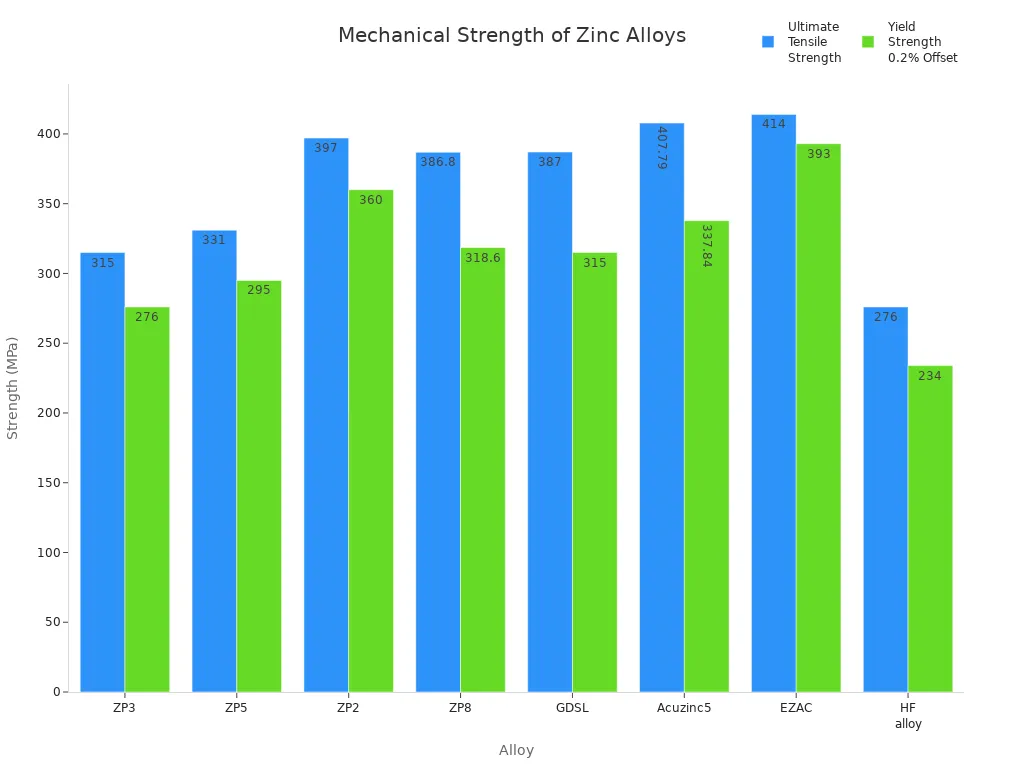
Zinc alloys can withstand heavy impacts without breaking and maintain their shape for a long time. This means that even after many years, zinc alloy parts remain strong, durable, and dimensionally accurate.
Corrosion Resistance
Zinc alloys are not prone to rust. When zinc comes into contact with air, a thin oxide layer forms, called the oxide layer. This oxide layer protects the metal from further corrosion. Some factories also add additional coatings, such as passivation and electroplating. These processes further enhance zinc’s rust resistance. Passivation treatment can allow parts to maintain their durability for up to 400 hours in a salt spray test.
Comparison with Other Alloys
In some aspects, zinc alloys are superior to aluminum and plastics. Zinc die-cast parts are stronger, more durable, and have a longer lifespan than aluminum parts. Aluminum parts are suitable for withstanding greater forces, but their precision is not as good as zinc. Plastics are lightweight and inexpensive, but their strength and toughness are not as good as zinc alloys.
| Property | Zinc Die Casting | Aluminum Die Casting | Magnesium Die Casting |
|---|---|---|---|
| Yield Strength | 2.5x higher | Lower | Lower |
| Toughness | Superior | Moderate | Moderate |
| Durability | High | Moderate | Moderate |
| Weight | Heavier | Lighter | Lighter |
Zinc Alloy Die Casting Performance
Zinc alloys are ideal for high-strength applications. Automotive and medical device manufacturers use zinc alloys to manufacture parts such as bearings, steering components, and brake pads. These alloys can be manufactured with great precision, resulting in less post-production repair work. Zinc alloys also have good thermal and electrical conductivity. They are resistant to rust and can be used for extended periods even in harsh environments.
Note: Zinc alloys harden rapidly upon cooling, allowing them to be machined into complex and intricate shapes.
Cost-Benefits of Zinc Die Casting
Reduced Production Costs
Manufacturers choose zinc alloys because they help save costs. The zinc die casting process allows them to produce parts quickly and easily. This process can create parts with complex shapes and thin walls. This means less material is needed per part. Many factories also reduce costs because zinc alloy parts require less finishing. The table below illustrates how zinc alloys reduce costs in several ways:
| Factor | Zinc Die Casting Benefits |
|---|---|
| Production Efficiency | Faster production times, leading to lower costs |
| Labor Costs | Reduced labor requirements due to fewer operations |
| Finishing Costs | Lower finishing costs compared to other methods |
| Complexity of Shapes | Ability to produce complex shapes with thinner walls |
| Assembly Time | Single cast parts can replace multiple stampings, reducing assembly time |
Zinc die casting offers numerous advantages. Companies can produce more parts faster and reduce labor and material costs.
Reduced Secondary Processing
Zinc die casting produces parts with smooth surfaces and extremely high precision. Factories do not need to spend extra time and money on repairs or polishing. The process is fast, efficient, and yields excellent surface finishes. Many companies have saved significant costs by eliminating these additional steps. For example:
- Shorter production cycle time
- Higher dimensional accuracy
- Better surface finish
- Reduced Secondary Processing Needs
Some companies have consolidated many parts and processes into a single zinc die casting. This has resulted in cost savings of up to 347%. Other companies have reduced costs by 34% by using zinc die casting for complex processes. These results demonstrate that zinc die casting can help companies save time and money.
Longer Mold Life
Zinc die casting molds have a longer lifespan than molds made of other metals. Zinc has a low melting point, making the molds less prone to damage. This means factories do not need to replace molds frequently, thus saving costs. Long tool life and high productivity ensure continuous operation and produce higher-quality parts. Manufacturers save costs by eliminating the need for significant expenditures on tool repair and purchases. Over time, these savings contribute to company growth.
Environmental Benefits

Energy Efficiency
Zinc die casting is more energy-efficient than other methods. Zinc has a low melting point, requiring less heat to melt it in the factory. This saves both energy and reduces costs. Hot-chamber die casting of zinc is more efficient than cold-chamber die casting of aluminum-magnesium alloys. Manufacturers can save up to 30% on energy costs.
| Material | Melting Point (°C) | Energy Consumption Efficiency |
|---|---|---|
| Zinc | 419-420 | High |
| Aluminium | 660 | Moderate |
| Magnesium | 650 | Moderate |
Zinc die casting is environmentally friendly. Reduced energy consumption means less burning of fossil fuels, thus reducing greenhouse gas emissions. Zinc molds are extremely precise, allowing factories to reduce material waste. These advantages help businesses achieve their sustainability goals.
Tip: Choosing zinc die casting helps manufacturers reduce emissions and save costs.
Recyclability
Zinc is easy to recycle. Many factories reuse zinc scrap during production. Up to 50% of zinc scrap can be melted down and reused. Approximately 30% of first-time zinc use comes from recycled materials. This means less new zinc needs to be mined, helping to protect natural resources.
Recycling zinc die castings supports the circular economy. Factories collect and process zinc scrap and use it in new products. This saves resources and reduces environmental impact.
The special feature of zinc die casting is its ability to produce parts with extremely high precision. It also helps businesses save costs and manufacture parts with various complex shapes for diverse applications. Zinc is known for its excellent fluidity, filling even the smallest spaces. This allows for the creation of thin-walled, finely designed parts. Due to the extremely high precision of the process, parts require almost no post-processing repairs. Companies like MORELUX use advanced equipment and meticulously inspect each part. These advantages make zinc die casting ideal for the automotive, electronics, and medical device industries.
FAQ
Which industries most commonly use zinc die casting?
Automotive, electronics, medical device, and lighting companies use zinc die casting extensively. They choose zinc because of its high precision and strength. Zinc also helps in the manufacture of complex-shaped parts.
How long is the lifespan of zinc die casting molds?
Zinc die casting molds have a much longer lifespan than aluminum die casting molds. They can last up to five times longer than aluminum die casting molds. This helps businesses reduce costs and maintain continuous parts production.
Can zinc die castings be recycled?
Yes, zinc die castings can be recycled multiple times. Factories typically melt down scrap zinc ingots for reuse. Recycling zinc reduces energy consumption and waste generation.
Why do manufacturers prefer zinc for making small, intricate parts?
Zinc is easily shaped and can fill every tiny space in a mold. This allows companies to create thin-walled parts and fine details that are impossible with other metals.
Is zinc die casting energy-efficient?
Zinc has a lower melting point than most metals. This means that factories need less energy to manufacture parts. Reducing energy consumption saves costs and protects the environment.