
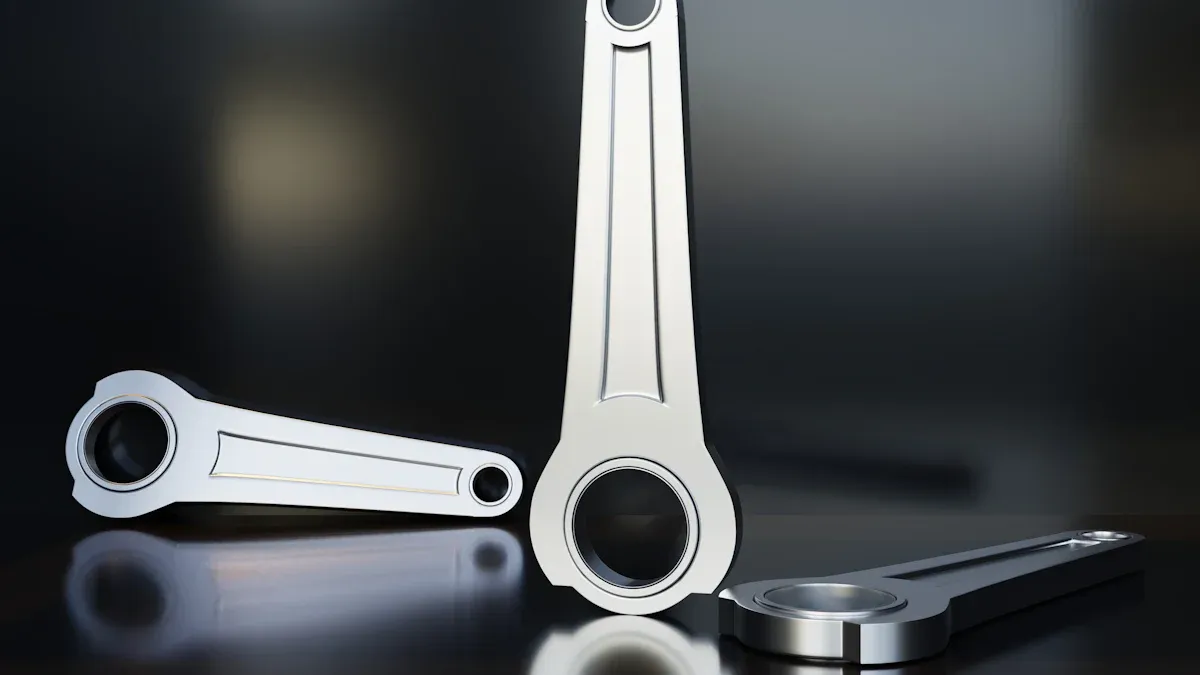
You can get better aluminum die-casting results by paying attention to material choice, part shape, and how easy it is to make. These steps help control quality, cost, and how fast you can make each die casting project. Key strategies for critical parts, such as automotive die-castings, include:
- Material choice changes how much the alloy costs, how strong it is, and how many mistakes happen.
- Picking shapes like even wall thickness helps stop mistakes and lowers tool costs, but things like undercuts or very tight fits (common in electronics die-castings) can make costs go up by as much as 40%.
- Making designs easy to build and using real-time process checks can lower mistakes and help you make more good parts.
Key Takeaways
- Pick the best aluminum alloy and make parts with walls that are the same thickness. This helps lower mistakes and saves money.
- Add draft angles and smooth fillets. These help take out parts easily and make them stronger.
- Use ribs and cores to make parts lighter and stronger. You do not need to use more material.
- Keep the die at the right temperature and pressure. This helps stop problems like porosity and shrinkage.
- Work with your supplier and use quality checks. This helps find problems early and makes parts work better.
Aluminum Die Casting Process

Essential Steps Involved in the Aluminum Die Casting Process
You can make strong aluminum parts by following each step carefully. Every step is important for making parts that are tough, correct, and not too expensive.
- Die Design & Tooling: You begin with careful die design. This shapes the part and controls how the hot metal moves. Good gating and venting help stop problems like porosity. Simulation software lets you find mistakes before you start making parts.
- Material Preparation: You pick the best aluminum alloy for your job. Some alloys, like A380, are strong. ADC12 is good for thin walls. You melt the alloy at 660–700°C. You take out gases to stop holes inside the part.
- Melting & Pouring: You melt aluminum ingots in a furnace. Then, you push the hot metal into the die using high pressure. This fills the mold fast and packs the metal tightly.
- Injection & Solidification: The hot metal fills most of the die very quickly. High pressure gets rid of air gaps. Fast cooling makes the part stronger.
- Ejection & Post-Processing: Ejection pins push the part out of the die. You cool the part fast so it does not bend. Trimming machines cut off extra metal.
- Finishing: You smooth sharp edges and drill holes if needed. Most parts do not need much finishing because the process makes them smooth.
Tip: Using multiple-cavity die casting tools can help save money, especially when you need to make many parts.
Applications of Aluminum Die Casting and Their Major Benefits
Aluminum die casting is used in many fields because it has special benefits.
- Automotive: Engine blocks and other parts help make cars lighter. If you make a car 10% lighter, it can use up to 8% less fuel.
- Electronics: Housings and heat sinks are strong and help get rid of heat. This process also cuts down on waste by up to 35%.
- Industrial Machinery: Machine parts and covers are tough and fit well.
- Healthcare: Medical tools and aids are light and do not rust.
- Construction: Hand tools and safety gear need strong, safe parts.
| Benefit | Description |
|---|---|
| Lightweight | Easier to move and helps save fuel |
| Complex Geometries | Makes tricky shapes and thin parts |
| High Volume Production | Fast cycles and saves money when making many parts |
| Superior Surface Finish | Needs little extra work |
| Tight Tolerances | Parts are always the same size |
| Corrosion Resistance | Stays strong in tough places |
You can make parts that are smooth and the right size. You do not need to finish them much. Aluminum die casting is fast and can make the same part over and over. It can also make shapes that other ways cannot. This process is great for making lots of parts for many different jobs.
Aluminum Die Casting Design Tips
If you want good aluminum die casting results, you must think about your design. These tips help you stop problems and make better parts. They also help you work faster. Here are the main things to remember when you design for die casting.
Best Practices for Maintaining Uniform Wall Thickness in Aluminum Die Cast Parts
Keeping wall thickness the same is very important. It helps stop mistakes and makes parts stronger. Thin walls make parts lighter. But if walls are too thin, you can get more holes or cracks. Thick walls can cause other problems like air bubbles and slow cooling.
Most parts should have walls between 1.5 mm and 3.5 mm. For very exact parts, use 2.0 mm to 2.5 mm. This works well with A380 or ADC12 alloys. Light parts that do not need to be strong can have walls as thin as 1 mm. Strong parts need at least 2.5 mm thick walls. Always pick the right wall thickness for your part and alloy.
| Aspect | Recommended Wall Thickness Range | Notes |
|---|---|---|
| Typical wall thickness | 1.5 mm to 3.5 mm | Good for electronics housings and general parts. |
| Nominal thickness for precision | 2.0 mm to 2.5 mm | Best for high-precision parts and common alloys. |
| Minimum design target | 1.5 mm | Use for mass production with high yield. |
| Localized minimum thickness | Down to 1.0 mm | Only with optimized tooling and high-fluidity alloys. |
Tip: Do not change wall thickness suddenly. Smooth changes help metal move and lower stress.
Studies show that changing wall thickness too much causes more mistakes. Thin walls with long paths can make weak parts. The best strength is at about 2 mm wall thickness. Always check your design with mold flow analysis before you start making parts.
Optimizing Draft Angles for Improved Aluminum Die Cast Part Ejection and Quality
Draft angles are very important in die casting. Draft means you add a small angle to straight walls. This helps you take the part out of the die. If you do not add draft, parts can get stuck or break.
You should use draft angles of 1° to 3° on all straight sides. For deep or tricky shapes, you may need up to 5° or 7°. The best draft angle depends on your material and part shape. Add draft angles early so you do not have to fix your design later.
- Draft angles help you:
- Remove parts easily and quickly.
- Lower damage to the part and the die.
- Make the surface smoother and stop mistakes.
Note: For walls up to 50 mm long, use at least 1° draft. Use bigger angles for longer or deeper walls.
Try to keep draft angles the same everywhere. Do not use undercuts. Test different angles to see what works best. Always talk to die casting experts to get the right draft angles for your part.
Designing Effective Fillets and Radii for Enhanced Aluminum Die Cast Part Performance
Fillets and radii are curved edges between surfaces. They are important for good die casting design. Sharp corners can cause cracks and other problems. Curved edges make parts stronger and last longer.
Here are some tips for fillets and radii:
- Use big fillets where wall thickness changes. This lowers stress and stops cracks.
- Make the outer radius equal to the inner radius plus wall thickness. The smallest inner radius should be 0.5 mm.
- Do not put fillets on parting lines. This makes the die easier to make and cheaper.
- For ribs and bosses, use fillets to stop thick spots that can cause dents.
- Use at least a 1 mm radius, and make it bigger in places with more stress.
Fillets are better than chamfers for lowering stress. They spread out force and help metal move during casting.
Research shows that smooth fillets and radii help parts last longer. They stop cracks from starting. Surface treatments can also help by making cracks less likely to grow.
Strategic Placement and Design Considerations for Parting Lines in Aluminum Die Cast Parts
Parting lines are where the two die halves meet. Where you put them is very important. Bad placement can cause extra metal, seams, or even broken parts.
Follow these tips for parting lines:
- Line up die halves well and make sure they close tight to stop extra metal.
- Put parting lines under rims or caps to hide them.
- Keep parting lines away from surfaces that must look good.
- Use straight, curved, or stepped parting lines based on your part’s shape.
- Add draft angles (1–2°) near parting lines to help remove parts and stop damage.
- Use textures or finishes to hide parting lines if needed.
Good parting line design makes parts work better and look nicer. It also helps your die last longer and saves time finishing parts.
If you focus on these things—wall thickness, draft angles, fillets and radii, and parting lines—you will get better die cast parts. These tips help you stop mistakes, save money, and make strong parts for any job. Remember, good design is the key to great results.
Structural Features Impact on Performance
Ribs and Bosses for Enhanced Strength and Functionality
You can make die casting parts stronger by adding ribs and bosses. Ribs stop flat parts from bending or breaking. They help spread out stress and make parts stiffer. You can use U-shaped ribs, diagonal ribs, or cross ribs to keep parts flat and strong. Ribs on bosses also help the molten metal move better. This lowers mistakes and makes parts stronger.
- Ribs help heat move away and help metal fill the mold.
- You use less material with ribs than with thick walls.
- Good rib shape and placement lower stress and casting problems.
| Design Parameter | Recommended Value | Purpose / Effect |
|---|---|---|
| Rib thickness | About 0.5 to 0.6 times wall thickness | Keeps strength, avoids sink marks |
| Rib height | Not over 2.5 times wall thickness | Prevents distortion |
| Rib spacing | At least 2–3 times rib thickness | Helps metal flow and cooling |
| Rib base transition radius | Minimum 0.5 mm fillet or radius | Reduces cracks and stress |
Tip: Ribs give you better strength for the weight than thick walls.
Coring and Pockets for Lightweight and Cost-Effective
Coring and pockets help make die casting parts lighter. Coring lets you make hollow spaces or thin walls. This uses less material. You can add things like cooling channels or oil passages in one part. This saves time and money. Pockets and holes take away extra material, so parts weigh less.
- 3D printed sand cores help make tricky hollow shapes.
- You can put cores and pockets where they save the most weight.
- This also lowers mistakes and saves on finishing work.
A real example shows an aluminum engine block made this way is over 60% lighter than a cast iron one. You get lighter parts that still work well.
Effective Strategies for Avoiding Undercuts
You should not use undercuts in your die casting design. Undercuts make it hard to take parts out of the die. They can cause mistakes. Try these ways to avoid problems:
| Strategy | Description | Outcome |
|---|---|---|
| Thicker, shorter core pins | Use strong pins so they do not bend or break. | Fewer mistakes and tools last longer |
| Stepped hole design | Make holes with different sizes to lower stress. | Parts last longer and have fewer mistakes |
| Include draft angles (1-3°) | Add draft to holes so parts come out easily. | Tools wear less and there are fewer undercut mistakes |
| Maintain minimum wall thickness | Keep walls at least 1.5 times the hole size or part thickness. | Stops cracks and keeps parts from warping |
| Align holes with parting line | Put holes along the mold split to keep pins lined up. | Holes are more accurate and need less extra work |
Note: Work with die casting experts and use computer tools to find undercut risks early.
If you focus on ribs, bosses, coring, and avoiding undercuts, you can make die casting parts that are strong, light, and work well.
Surface Finish and Tolerance Considerations
Surface Finish Requirements on Aluminum Die Cast Part Quality
It is important to watch the surface finish of die casting parts. The finish changes how parts work and how they look. Good die design helps you get a better finish. Picking the right aluminum alloy also helps. After casting, you can make parts smoother and stronger. You can use deburring or conversion coatings for this. If you want shiny or colored parts, you can use anodizing or powder coating.
How you set up the process matters too. Mold temperature and injection pressure must be right. If not, you might get flaws like porosity or flow marks. These flaws can make parts weak or look bad. You should always test your parts. Check the surface and size to make sure they are right.
Here is a simple guide to common die casting surface finishes:
| Surface Finish Type | Description | Impact on Performance | Impact on Appearance | Advantages | Disadvantages |
|---|---|---|---|---|---|
| Mechanical Finishing | Grinding, polishing, deburring, shot blasting | Makes parts more accurate and removes flaws | Smoother, shinier, better texture | Very precise, helps coatings stick | Takes time, can cause tiny cracks |
| Chemical Finishing | Anodizing, conversion coatings, passivation | Stops rust and corrosion | Gives color and even layers | Harder surface, looks nice | Needs care, not many color choices |
| Electroplating | Zinc, nickel, chromium | Protects and makes parts last longer | Shiny, metal look | Strong and looks good | Costs more, needs careful work |
| Surface Finish Grades | Utility to superior | Matches how tough the part needs to be | From plain to very shiny | Fits your needs, saves money | Better grades cost more |
You can pick anodizing for electronics. Powder coating is good for outdoor parts. Polishing gives a mirror look. Each finish changes how long your part lasts and how it looks.
Achieving the Right Balance Between Tight Tolerances and Manufacturability
You want your parts to fit and work well. This means you may need tight tolerances. Die casting can make shapes with very exact sizes. High-pressure injection and good tools help you do this. Tight tolerances can mean you do not need extra machining. This saves time and money.
But you must balance what you want and what is possible. Tighter tolerances need better tools and more control. This can make the first parts cost more. But if you make many parts, each one costs less. Industry rules like ANSI/ASME B46.1 help you pick the right surface roughness. Most aluminum die cast parts have a roughness between 0.4 μm and 1.6 μm. Smoother parts look better and last longer. But they cost more to make.
Tip: Talk to your die casting supplier early. This helps you pick the right tolerances and finishes. You get parts that work well and do not cost too much.
Secondary Operations for Enhanced Performance
Machining
Sometimes, you need to do more work on aluminum die cast parts. Die casting makes detailed shapes, but some features need extra steps. You might trim off extra metal like flash and runners. Precision machining lets you make holes, threads, or slots that casting cannot do. Finishing steps like polishing or deburring make the surface smoother and ready for coatings.
- Trimming cuts away extra metal and sharp edges.
- Precision machining makes holes and threads very exact.
- Finishing steps smooth the surface and make it look better.
These steps help you get tight tolerances so parts fit well. Machining also lets you check parts during production. This way, you can find problems early and keep quality high.
Coatings & Treatments
You can help aluminum die cast parts last longer with coatings and treatments. Each method gives special benefits for stopping rust, wear, and making parts look nice.
| Surface Treatment Method | Corrosion Resistance | Wear Resistance | Decorative Appearance | Typical Applications |
|---|---|---|---|---|
| Anodizing | High | Good | Yes | Consumer goods, marine parts |
| Powder Coating | High | Moderate | Yes (many colors) | Outdoor housings, tools |
| E-coating/Painting | Very high | Moderate | Yes (customizable) | Automotive, complex shapes |
| Passivation | Moderate | Fair | No | Precision parts |
| PVD Coating | High | Excellent | Yes (metallic finish) | Electronics, tools |
Anodizing makes a hard, stable layer on the part. Powder coating adds a thick, colorful cover that does not chip or fade easily. E-coating covers tricky shapes evenly. Passivation and PVD coatings give extra protection for special uses. You can also use heat treatment, shot blasting, or sealing to make parts even tougher.
Assembly Features
You can save time and money by adding assembly features to your die cast parts. For example, you can cast in studs, hinges, bosses, or drill holes. These features let you skip extra machining and make assembly faster.
- Add outside threads to round parts for easy fastening.
- Use glue to join parts and stop rust.
- Pick self-tapping screws or spring clips that fit right into the casting.
- Add inserts or tight fits for strong, safe connections.
If you plan these features early, you make assembly quicker and more reliable. You also need fewer steps after casting, so you get better parts for less money.
Defect Prevention Strategies for Aluminum Die Cast Parts
Common Defects
You can find many types of defects in aluminum die casting. These problems can change how your parts look and work. The table below lists the most common defects, how to spot them, and what causes them.
| Defect Type | Description / Visual Inspection | Primary Causes |
|---|---|---|
| Die Marks | Lines or steps on the surface from the mold | Worn or loose ejector pins, mold problems, or moving parts not tight |
| Soldering Marks | Small shiny or dark gray spots stuck to the die | Leftover material on the die, or dirty metal during casting |
| Lamination Defects | Layers of metal you can see on the part | Weak mold, plunger problems, or bad gating system |
| Metal Erosion | Rough spots on the part’s surface | Fast-moving metal, or not enough cooling in some areas |
| Cracking | Thin cracks you see after a special bath | Wrong alloy mix, short mold time, uneven walls, or too much force |
| Cold Shuts | Uneven lines or weak spots where metal did not join well | Metal did not fuse, low temperatures, bad gate spot, or slow filling |
| Shrinkage Defects (Sink Marks) | Smooth dents in thick areas | Walls not even, bad gating, not enough pressure, or poor cooling |
| Flow Marks | Lines or stripes that follow how the metal moved | Thin first metal layer, cold die, small or wrong ingate, not enough pressure |
| Cold Flow | Sunken lines with smooth edges | Metal streams did not mix, cold metal or die, bad alloy flow, or long path |
| Deformation | Part shape is off or bent | Bad design, opening mold too soon, uneven ejection, or dragging during ejection |
Other defects include porosity, warping, and flash. These happen from bad mold design, wrong injection speed, or poor temperature control.
Design Solutions
You can stop most defects by using smart design and good process control. Here are some ways to lower porosity, warping, and flash in aluminum die casting:
- Keep die temperature between 170°C and 240°C for good metal flow.
- Add vents in the right spots to let gas out and lower porosity.
- Use the biggest first stroke and longest fill time to cut gas bubbles.
- Try vacuum die casting to pull out gas and stop pores.
- Raise metal pressure and keep the gate thick to stop shrinkage.
- Use local cooling to stop hot spots that make pores.
- Add draft angles and skip undercuts to lower warping.
- Wait the right time before taking parts out to stop bending.
- Make sure the die closes tight and use enough force to stop flash.
- Keep the mold clean and oiled so metal flows well.
Tip: Squeeze casting can help you get strong, dense parts with fewer defects.
Quality Control
You need good quality control to find and stop defects in die casting. Use these ways to keep your aluminum die casting parts working well:
- Statistical Process Control (SPC): Watch things like pressure and cooling to catch problems early.
- Visual Inspection: Check for cracks, holes, or bad surfaces with a magnifier.
- Dimensional Measurement: Use calipers, micrometers, or CMMs to check size and shape.
- Non-Destructive Testing (NDT): Use X-rays or sound waves to find hidden cracks or holes.
- Destructive Testing: Break sample parts to test strength and hardness.
- Best Practices: Keep machines in good shape, train workers, and follow rules like ISO 9001.
Work closely with your die casting supplier. This helps you improve design, pick the right materials, and use better inspection tools. Good teamwork means better quality, fewer defects, and more reliable parts.
Using these tips helps you get good results every time. If you use smart design, check quality, and stop defects, your parts get stronger and you waste less. Many companies now make lighter and stronger parts that cost less by doing this. You can fix problems like holes or bad surfaces if you plan and test carefully. Try these ideas in your next project. Tell us what happens or ask for help if you need it!
FAQ
What is the best aluminum alloy for die casting?
You should choose A380 for most jobs. It gives you good strength, easy casting, and low cost. ADC12 works well for thin walls. Always match the alloy to your part’s needs.
How do you reduce porosity in die cast parts?
Tip: Use vacuum die casting, add vents, and keep the die at the right temperature. These steps help you lower gas bubbles and make stronger parts.
Can you add threads to aluminum die cast parts?
Yes, you can cast external threads directly. For internal threads, you should machine them after casting. This gives you better accuracy and strength.
Why do you need draft angles in die casting?
Draft angles help you remove parts from the die without damage. You should use at least 1° to 3° on straight walls. This step also makes the die last longer.
What is the typical surface finish for aluminum die cast parts?
| Finish Type | Roughness (Ra) |
|---|---|
| As-cast | 1.6–3.2 μm |
| Polished | 0.4–0.8 μm |
You can improve the finish with polishing or coatings.