

Die cast zinc is widely recognized for its high strength, toughness, and durability, making it a reliable material for demanding applications. Zinc die cast alloys typically offer tensile strengths ranging from 30,000 to 41,000 psi and yield strengths between 22,000 and 32,000 psi, along with excellent impact resistance and ductility. Compared with many aluminum alloys, zinc alloys provide higher strength and better performance under stress, making them one of the strongest non-ferrous metal options. These properties make die cast zinc ideal for precision components and heavy-duty industrial use. MORELUX specializes in advanced zinc die cast solutions, delivering high-quality and precision-manufactured parts for a wide range of applications.
Key Takeaways
- Zinc die-casting alloys are extremely strong non-ferrous metals, with tensile strengths reaching up to 54,000 psi. Zinc die-casting offers excellent impact and bending resistance, making it ideal for parts subjected to high stress. Choosing the appropriate zinc alloy, such as Zamak 3 or Zamak 5, helps parts achieve optimal performance in specific applications. Zinc die-casting can produce precisely shaped, tightly fitting parts, thus improving part performance and quality. Zinc die-cast parts are inexpensive, making them ideal for mass production and helping to save time and materials.
Zinc Die Cast Properties

Tensile Strength and Yield Strength
Zinc die-casting alloys are extremely strong. Zamak 3 and Zamak 5 are common zinc die-casting alloys with very high tensile strength.
The yield strength of zinc die-casting alloys is far higher than that of aluminum die-casting alloys, making them the non-ferrous alloys with the highest tensile strength, comparable to or even surpassing most cast irons. Some zinc die-casting alloys can achieve tensile strengths of up to 54,000 psi. This means that in many applications, zinc die-castings are stronger than aluminum die-castings. Their high strength-to-weight ratio allows engineers to manufacture smaller, lighter parts. These parts are robust, durable, and have a long service life.
MORELUX uses advanced pressure die-casting technology to inject molten zinc into a steel mold, producing parts with extremely high precision and consistency every time. The zinc alloy grade affects the performance of the parts. For example, ZA-8 has approximately 18% higher fatigue resistance than Zamak 3, making it suitable for high-intensity operations.
Impact Resistance and Ductility
Zinc die-castings have excellent impact resistance. This means that zinc die castings can withstand impacts without cracking. The table below shows how the impact resistance of different zinc alloys changes with temperature:
| Temperature (°C) | Alloy ZP3 | Alloy ZP5 | Alloy ZP2 |
|---|---|---|---|
| 80 | 112 | 103 | 116 |
| 40 | 106 | 111 | 104 |
| 20 | 116 | 131 | 96 |
| 0 | 44 | 130 | 55 |
| -20 | 11 | 13 | 13 |
| -40 | 6 | 6 | 5 |
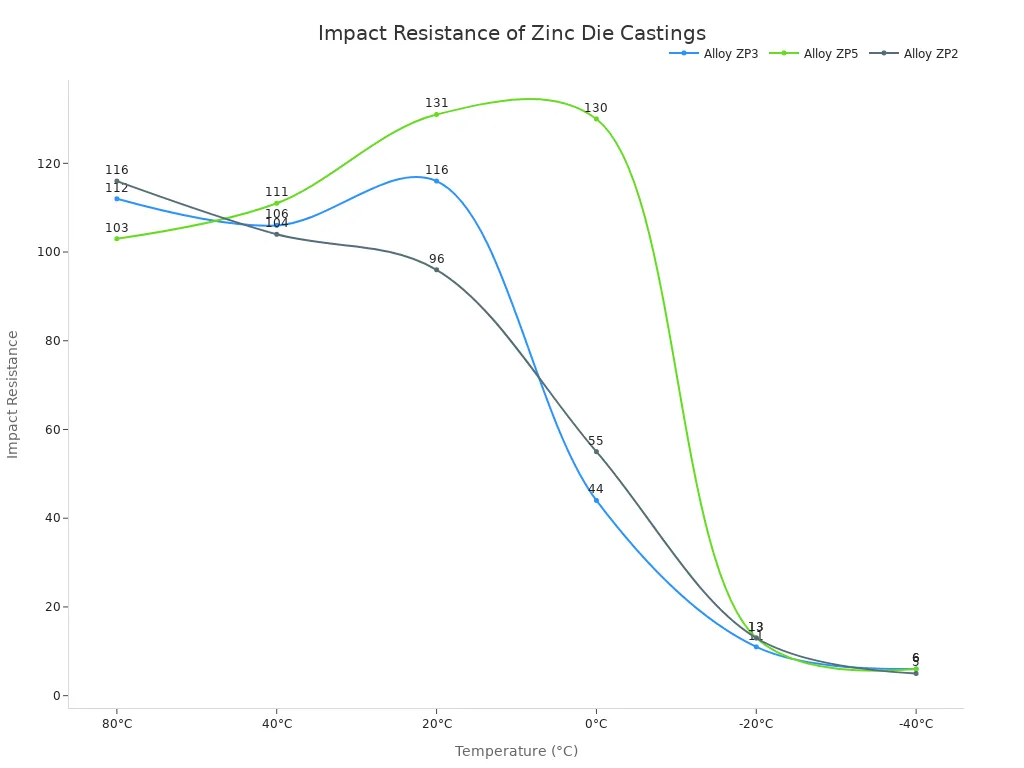
Zinc alloys also possess excellent ductility. This means they can be bent or stretched without breaking. High ductility helps zinc die castings absorb energy and withstand heavy loads. These properties are crucial for parts subjected to stress, such as gears or housings. Zinc die casting can also produce fine shapes and tight fits. This makes it ideal for parts requiring precision.
Density and Wear Resistance
Zinc die casting alloys have a high density. This contributes to their strength and service life. Higher density means better wear resistance and a longer service life. Zinc die casting alloys are well-suited for heavy-duty applications such as automotive parts and high-strength housings.
Zinc alloys can withstand greater stress than aluminum and magnesium alloys. This means they are less prone to bending. Zinc’s high strength allows for the use of less material per part. This saves space and reduces weight. Zinc die castings also offer superior precision and strength compared to aluminum parts.
MORELUX inspects the quality of every zinc die casting. Their advanced methods and rigorous inspections ensure that parts perform exceptionally well in demanding applications.
Comparison of Die Cast Zinc with Other Materials

Zinc Vs Aluminum
Zinc alloy die casting and aluminum alloy die casting are both widely used metal die castings, capable of producing high-strength parts for many applications. Engineers like to compare these two metals to determine which has superior performance. The table below compares the performance of zinc alloys and aluminum alloys in some important aspects:
| Alloy Designation | Type | Tensile Strength (UTS) | Yield Strength | Elongation (% in 50mm) | Hardness (Brinell) |
|---|---|---|---|---|---|
| Zamak 3 | Zinc | 283 MPa (41 ksi) | 221 MPa (32 ksi) | 10% | 82 HB |
| Zamak 5 | Zinc | 331 MPa (48 ksi) | 262 MPa (38 ksi) | 7% | 91 HB |
| A380 | Aluminum | 324 MPa (47 ksi) | 160 MPa (23 ksi) | 3.5% | 80 HB |
Zamak 5 is a common zinc die-casting alloy. Its strength is comparable to, or even higher than, some aluminum alloys. Zinc die-castings also have a higher elongation. For example, Zamak 3 has an elongation of up to 10%, while A380 aluminum alloy has only 3.5%. This means zinc die-castings can be bent and formed into more shapes without cracking. Zinc alloys also have higher yield strength. This helps parts resist excessive bending when bearing heavy loads.
Zinc die-casting technology allows for thinner wall thicknesses and more refined shapes. This provides designers with more options and helps reduce the weight of parts. In many cases, zinc alloys also have a higher strength-to-weight ratio. Manufacturing parts using zinc die-casting is faster and less expensive.
Zinc Vs Magnesium
Magnesium is very light. But zinc die-castings are stronger and have a longer lifespan. Zinc alloys are heavier, but this makes them more wear-resistant and longer-lasting. Magnesium parts are lighter but not as tough as zinc die-castings.
Zinc die-castings also have a lower melting point, meaning less energy is needed to manufacture parts. This process is safer and less expensive. Zinc alloys are also less prone to rusting than magnesium alloys, making them more suitable for use in harsh environments.
Comparison of Zinc, Steel, and Copper
Steel and copper are both high-strength metals. Steel is suitable for applications requiring high strength. Copper is excellent for conductivity. Zinc die casting is not as strong as steel, but it has other advantages.
Copper is heavier and more expensive than zinc. In many applications, zinc die casting can replace copper. If you need strength but want to reduce weight and cost, zinc die casting is a good choice. Zinc alloys also have good electrical conductivity, making them ideal for manufacturing electrical and electronic components.
Zinc Die Casting Applications
Automotive and Electronics Industries
Zinc die casting is widely used in the automotive and electronics industries. Many automotive parts need to be robust and durable, and zinc alloys help ensure the safety and reliability of these parts. Some automotive parts manufactured using the zinc die casting process include:
The zinc die casting process is also crucial for electronics. It helps manufacture parts that require high strength and precise shapes. The process’s extremely high precision allows for the design of complex parts. These robust components protect electronic equipment and extend its lifespan.
Industrial and Telecommunications Equipment
Many industrial and telecommunications products utilize zinc die casting. These products require excellent performance and durability. Zinc alloys offer a perfect balance between strength and precision. In the telecommunications sector, zinc die casting parts are used in housings, connectors, and internal hardware. These parts maintain their shape and dimensions, which is crucial for equipment requiring tight fits.
The table below illustrates how zinc die casting contributes to the development of telecommunications hardware:
| Benefit | Description |
|---|---|
| High Dimensional Accuracy and Stability | Makes parts with tight tolerances, so they fit well and need less extra work. |
| Excellent Surface Finish | Gives smooth surfaces that look good and can be coated easily. |
| High Strength and Hardness | Helps parts last longer, even in tough jobs. |
| Cost-Effectiveness for High-Volume Production | Makes many parts quickly, saving money on big projects. |
| Ease of Casting Intricate Details | Lets designers create complex shapes needed for modern devices. |
Surface Finishing and Machining
MORELUX employs advanced machining and surface finishing technologies to manufacture zinc die castings. Precision machining helps parts achieve extremely high tolerances, with an accuracy of +/- 0.001 inches. This precision is crucial for parts that must fit tightly and operate smoothly. Zinc alloys allow for extremely high tolerances, typically ±0.03 mm. Zinc die castings have good fluidity and low shrinkage, thus, in many cases, their strength is higher than that of aluminum parts.
Surface finishing further enhances the performance of zinc die castings. Electroplating and coatings protect parts and give them an aesthetically pleasing appearance. These surface finishes also help improve the wear resistance and corrosion resistance of parts. MORELUX’s superior machining and surface finishing technologies ensure that every zinc die casting is robust, durable, and aesthetically pleasing.
Factors Affecting the Strength of Zinc Die Castings
Alloy Selection and Composition
The strength of zinc die castings depends on the alloy used. Each zinc alloy has its unique properties. These properties affect the strength, hardness, and bending performance of the parts. Zamak 3 is a versatile and commonly used alloy. It combines strength and flexibility. Zamak 5 is stronger and stiffer than Zamak 3, making it ideal for components that need to withstand greater forces. Zinc 7 is very flexible, which helps components bend without breaking.
| Alloy | Tensile Strength | Ductility | Hardness | Creep Resistance | Fluidity | Application Use |
|---|---|---|---|---|---|---|
| Zinc 3 | Moderate | Moderate | Moderate | Moderate | Standard | General use |
| Zinc 5 | High | Low | High | High | Moderate | High strength |
| Zinc 7 | Moderate | High | Low | Moderate | High | High ductility |
Production Methods And Quality Control
How zinc die casting parts are made also changes their strength. High-pressure die casting pushes melted zinc into molds with a lot of force. This way makes parts that are smooth and fit together well. It also helps make parts that are strong and always the same.
- High-pressure die casting uses up to 20,000 psi to fill molds fast.
- This way makes thin and detailed parts that stay strong.
- Special zinc alloys in this process help the metal flow and stay strong.
Quality control is very important for zinc die casting. Companies like MORELUX use computers to design molds and check how metal will move. They look at each part to make sure it is the right shape and size. They also check the surface to make sure it is smooth. Keeping the alloy mix clean stops weak spots from forming. All these steps help make sure every zinc die casting part is strong and ready for hard work.
Die cast zinc is very strong and can bend without breaking. It also does not break easily when hit. The table below shows how zinc is different from other metals:
| Metric | Die Cast Zinc (Zamak) | Aluminum (A380) | Magnesium |
|---|---|---|---|
| Ultimate Strength | Highest | ~324-331 MPa | N/A |
| Ductility | Superior | N/A | N/A |
| Impact Resistance | Higher | N/A | N/A |
FAQ
What makes die-cast zinc so strong?
Die-cast zinc is strong because of its high tensile and yield strength. It also withstands impacts and is resistant to wear. These properties result in zinc parts with a longer lifespan and excellent performance under harsh conditions.
Can zinc die casting be used to manufacture small, precision castings?
Yes, zinc die casting can be used to manufacture small, intricate parts. This process allows for the addition of fine details while maintaining a tight fit. This is crucial for parts in electronics and equipment requiring precise fits.
How does zinc die casting compare to aluminum die casting?
Zinc die casting withstands impacts and bending better than aluminum die casting. Zinc parts can withstand greater stress and are less prone to breakage. Aluminum is lighter, but zinc offers better detail and strength in many applications.
Which industries use zinc die-cast parts?
Automotive, electronics, telecommunications, and industrial companies all use zinc die-cast parts. These parts are used to manufacture gears, housings, connectors, and safety components.
Does zinc die casting require special surface treatments?
Many zinc die-cast parts require coating or electroplating. These surface treatments prevent rust and improve the appearance of the parts. Surface treatments also help extend the service life of the parts in harsh environments.