
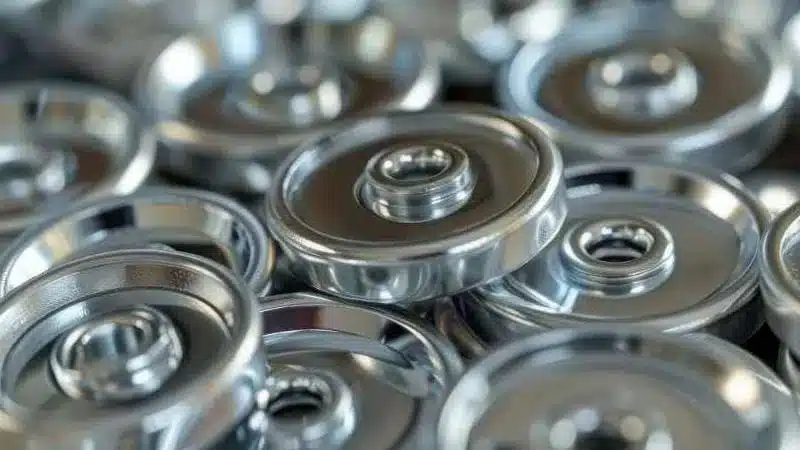
Zamak parts move through five production stages: tooling, die casting, machining, finishing, and assembly.
Zamak casting is a hot-chamber zinc die-casting process used to mass-produce small, complex, high-tolerance metal parts. The name Zamak comes from the German Zink (zinc), Aluminum, Magnesium, and Kupfer (copper) — the elements that make up this zinc alloy family, most commonly Zamak 2, 3, 5, and 7. Because Zamak melts at just 419 °C, a hot-chamber machine can inject it into a steel die in seconds, making it one of the most cost-efficient ways for a manufacturer to scale precision hardware. If you are evaluating our Zamak zinc die-casting service for a new program, understanding how the process runs on the shop floor will help you read supplier quotes with confidence.
Key takeaways
- Zamak is a zinc alloy poured at 419 °C in a hot-chamber die-casting machine — not a cold-chamber press.
- Buyers get thin walls, tight repeatable tolerances, and die life of 1,000,000+ shots at low unit cost.
- It is the default choice for plated, small, complex hardware in automotive, electronics, and lighting.
Why Zamak die casting beats other alloys for small parts
Zamak fills thin walls and fine detail better than almost any other castable metal. Its high fluidity and low pour temperature let it replicate features down to 0.5 mm wall thickness with an as-cast surface near 1 µm Ra, so secondary machining shrinks dramatically. Three points matter most to a wholesale buyer:
- Long die life. Zinc is gentle on tool steel. A well-maintained die runs 1,000,000+ shots before refurbishment, versus 100,000–150,000 for an aluminum die. The lower amortized tooling cost keeps unit price steady across a long program.
- Tight, repeatable tolerances. Zamak holds ±0.03 mm on small features — tighter than gravity casting and far cheaper than machined brass.
- Built-in corrosion and EMI shielding. The aluminum content forms a self-healing oxide layer, and the alloy’s conductivity blocks electromagnetic interference in connector shells and RF housings.
For decorative or hardware parts, Zamak also plates and powder-coats cleanly, which helps a retailer pass REACH and Prop 65 review without changing the alloy. Our precision die-casting capabilities cover tooling, casting, CNC machining, finishing, and assembly under one roof, shortening the path from prototype to production.
How Zamak die casting is done, step by step

A modern Zamak line is built around a hot-chamber die-casting machine. The gooseneck stays submerged in molten metal at roughly 410–430 °C, so the alloy never cools during injection — the same controlled process we apply to high-volume automotive die-casting programs that demand PPAP-level documentation and traceability.
Zamak is part of our zinc die-casting line; aluminum and copper share the same shop floor.
Step 1: Tooling and die preparation
Production starts with a multi-cavity steel die machined from H13 tool steel; lead time is typically 6–10 weeks. Waterlines are connected and the die is heated to 150–200 °C before the first shot, because a cold die causes cold-shut defects on the casting surface.
Step 2: Melting and alloy holding
Zamak ingots are held at 410–430 °C and dross is skimmed continuously. Iron is the enemy — even 0.05 % iron in a Zamak 3 bath can trigger intergranular corrosion after plating. The bath is checked with an optical emission spectrometer at every shift change to stay inside ASTM B240.
Step 3: Injection
A plunger pushes molten Zamak into the cavity at 8–30 m/s with 20–35 MPa intensification. Because the gooseneck keeps metal submerged, oxide inclusions rarely reach the part. Vacuum-assist can pull cavity pressure below 50 mbar for Class-A cosmetic surfaces.
Step 4: Cooling and ejection
The part solidifies in 1–5 seconds. Ejector pins push it out once it reaches ejection temperature; 0.5°–1° draft angles let it release without scuff marks.
Step 5: Trimming, machining, and finishing
A trim press strips the flash in one stroke. Parts needing bores or threads go to 3/4-axis CNC. Final options include vibratory tumbling, shot blasting, powder coat in any RAL color, and electroplating with nickel, chrome, tin, or antique brass. Every batch is verified with CMM and X-ray inspection before it ships.
Where Zamak castings are used across industries

Zamak castings ship into lighting, automotive, medical, telecom, and electronics programs.
Zamak shows up in more products than most buyers expect. The largest tonnage goes to:
- Automotive die-casting — seatbelt anchors, door-lock housings, mirror brackets, sensor mounts. Dimensional stability under vibration makes it the default for safety-critical sensor bodies.
- Electronics die-casting — RF shields, connector shells, LED heat sinks. Tight tolerances and conductivity suit high-frequency housings.
- Lighting die-casting — heat sinks, lamp housings, mounting rings. The smooth as-cast surface takes powder coat directly.
- Hardware and consumer goods — cabinet locks, door closers, zipper pulls, decorative trim.
- Medical and telecom — non-implantable instrument housings, base-station antenna brackets.
A wholesale buyer needing 10,000+ identical parts per month with walls under 2 mm almost always lands on Zamak. For a custom factory running a smaller engineering batch, the same alloy keeps tolerances tight without paying for full steel-die amortization.
Quick specs for sourcing
| Spec | Typical range at MORELUX |
| Alloys | Zamak 2 / 3 / 5 / 7, ZA-8 |
| Part weight | 5 g – 2.5 kg |
| Wall thickness | 0.5 – 4 mm |
| Tolerance | ±0.03 mm (critical) / ±0.05 mm (general) |
| Surface finish | As-cast 1.0–2.5 µm Ra |
| Die life | 1,000,000+ shots |
| Lead time | Tooling 6–10 wk; production 3–5 wk |
FAQ
What is the difference between Zamak and zinc?
Zamak is a defined family of zinc alloys with fixed aluminum, magnesium, and copper content. Generic ‘zinc’ castings may use ZA-8, ZA-12, or ZA-27 with more aluminum. Zamak 3 is the most common grade — it casts cleanly and is the grade most suppliers stock.
Can Zamak be used outdoors?
Yes, when plated or powder-coated. Bare Zamak forms a white oxide over time. Nickel or chrome plating plus a topcoat passes a 1,000-hour salt-spray test for outdoor hardware such as gate fittings and marine latches.
Why is hot-chamber die-casting used for Zamak?
Zamak’s low melting point lets the gooseneck stay submerged without erosion. Cold-chamber machines are reserved for aluminum and copper, which melt above 600 °C and would destroy a submerged gooseneck in days.
What is the smallest wall thickness Zamak can fill?
On a well-gated die, 0.5 mm walls fill cleanly. Below 0.4 mm the alloy tends to freeze before the cavity is full, so a thin-wall aluminum or magnesium die-cast is usually better.