
Selecting the best method for making electronic enclosures depends on the complexity of the design, required strength, and production quantity. Die casting for electronic enclosure is an excellent choice when engineers need durable electronics die-castings with intricate shapes and smooth finishes. Depending on the required strength and shielding, materials like zinc die-casting or copper die-casting may be selected. On the other hand, stamping is more suitable for simple, high-volume parts that don’t require complex geometries. The table below highlights the main reasons companies choose each process:
| Reason Category | Die Casting for Electronic Enclosure | Metal Stamping |
|---|---|---|
| Part Complexity | Handles tricky shapes with small details | Best for simple or flat parts |
| Production Volume | Good for making lots of hard parts | Works for both small and big amounts |
| Material Compatibility | Only works with nonferrous metals | Works with ferrous and nonferrous metals |
| Tooling Cost | High at first, cheaper for big orders | Low for easy parts, goes up if parts are harder |
| Surface Finish | Very smooth, often no extra work needed | Very exact, especially for flat parts |
Every project is unique. Designers should consider the application, cost, and required features before deciding between die casting for electronic enclosure and metal stamping.
Key Takeaways
- Die casting creates strong enclosures with smooth surfaces. It is good for detailed shapes and hard conditions.
- Stamping is best for simple, flat parts and big batches. It is fast and saves money when making many parts.
- Pick die casting if you need better impact resistance and heat control. It also seals tightly against dust and water.
- Think about your design, material, and how many you need. This helps you choose the right process for your project.
- Use the checklist to compare size, shape, strength, and cost. This helps you find the best way to make your enclosure.
Electronic Enclosures Mechanical and Performance Requirements
Impact Resistance
Electronic enclosures need to keep parts safe from bumps and drops. Die casting makes strong shapes that help stop the material from wearing out. This method gives enclosures better impact resistance, especially with aluminum. Stamped enclosures made from stainless steel are also good at handling impacts. Making them with fewer seams helps make them stronger. Still, die-cast aluminum enclosures usually protect better from shocks. That is why they are often picked for tough places.
Corrosion Resistance
Corrosion resistance helps enclosures last longer in tough places. Aluminum, used in both die casting and stamping, does not rust easily. Die-cast enclosures can be made with tight shapes that block water and chemicals. Stamped enclosures made from stainless steel also fight rust well. Both ways can meet rules for corrosion resistance. But die casting can make special shapes that give even more protection.
Thermal Management
Getting rid of heat is important for electronics. Die-cast enclosures can have built-in heat sinks to help with cooling. Stamped enclosures use thin aluminum sheets, so they are light but do not move heat as well.
| Heat Sink Type | Heat Transfer Efficiency Range (%) |
|---|---|
| Stamping & Flat Plates | 10 – 18 |
| Castings (including die cast) | Higher than stamping (implied) |
Die-cast enclosures are better at handling heat. This makes them good for hard jobs.
Sealing and Environmental Protection
Enclosures must keep out dust, water, and other things. Standards like NEMA and IEC IP tell what kind of sealing is needed. Both die casting and stamping can make enclosures that pass these tests by using gaskets, o-rings, and sealants.
Die-cast aluminum enclosures often seal tighter and last longer, so they meet IP65, IP68, and NEMA rules. Stamped enclosures can also meet these rules if they are put together carefully and have extra seals.
Strength and Rigidity
Strength and rigidity help enclosures keep their shape and protect the inside. Die casting makes tough, stiff enclosures with tricky shapes. Stamping makes strong, exact enclosures, especially with deep-drawn methods. Both ways make strong enclosures, but die casting is better for detailed, high-strength designs.
Picking die casting or stamping depends on what matters most for your project. Die casting is best for impact resistance, cooling, and sealing. Stamping is good for simple, strong, and low-cost designs.
Die Casting for Electronic Enclosure

The Die Casting Process for Electronic Enclosures
Die casting for electronic enclosure uses melted metal to make strong parts. These parts can have lots of small details. Makers often pick aluminum, magnesium, or zinc alloys for these enclosures. Aluminum alloys like 380 and 390 are light and strong. They also do not rust easily. Magnesium alloys are even lighter and are simple to shape. Zinc alloys are tough and good for adding a shiny layer. The cold chamber die casting method is used a lot for aluminum. In this way, workers put a special oil on the die. Then, they close the die tightly. Next, they push melted metal into the die with high pressure. The metal cools down and gets hard inside the die. A machine pushes out the finished part. Workers then cut off any extra metal.
Advantages of Using Die Casting for Electronic Enclosure Manufacturing
Die casting for electronic enclosure has many good points:
- It makes lots of parts quickly for big orders.
- The parts fit together well and keep electronics safe.
- Complicated shapes are made in one step, so less assembly is needed.
- High-pressure die casting is fast and keeps quality the same.
- Finished parts look smooth and have tiny details.
Die casting for electronic enclosure is great for projects needing special shapes, strong protection, and good sealing from water.
Limitations and Potential Challenges of Die Casting for Electronic Enclosures
| Limitation/Challenge | Description |
|---|---|
| High Initial Tooling Costs | Making the mold costs a lot at first, so small orders are expensive. |
| Porosity and Air Entrapment | Air can get trapped and make weak spots; good venting and pressure help stop this. |
| Design Limitations | It is hard to make thin walls or sharp corners; designs may need changes. |
| Shrinkage and Dimensional Accuracy | Cooling can make parts shrink and not fit right; molds must be very exact. |
| Tool Wear and Maintenance | High pressure wears out the die fast, so it needs more fixing and care. |
Die casting for electronic enclosure is best for making many parts. High mold costs and problems like air bubbles or shrinking can make it hard for small jobs.
Top Die Casting Applications for Electronic Enclosures
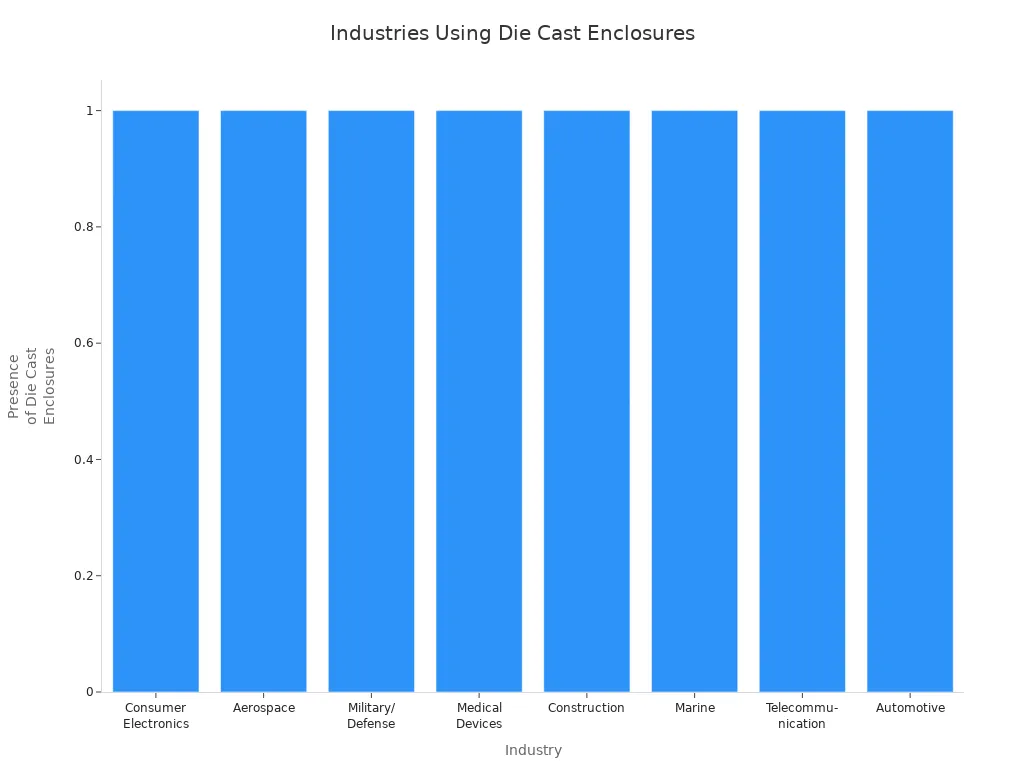
Many businesses use die casting for electronic enclosure because it makes strong and safe parts. Consumer electronics use die-cast cases for things like phones, speakers, and laptops. Aerospace and military need light, tough parts for gearboxes and control panels. Medical devices need enclosures that are always the same. Car and telecommunication companies use die casting for tough, cheap cases that protect electronics from rough places.
Stamping for Electronic Enclosures
Stamping Process Basics for Electronic Enclosures
Stamping changes flat metal sheets into enclosures by pressing them into shape. First, engineers pick metal sheets or coils. They choose based on how strong, bendy, or rust-proof the metal is. Next, they put the metal into a stamping press. The press uses dies to cut, bend, or punch the metal. This makes the shape they want. Some common stamping steps are blanking, bending, coining, and punching. After shaping, workers smooth rough edges and treat the surface. This helps the enclosure look better and last longer.
| Metal Type | Examples | Key Properties and Uses |
|---|---|---|
| Ferrous Metals | Steel (including stainless steel) | Strong and tough; stainless steel resists rust and fits special jobs. |
| Nonferrous Metals | Aluminum | Light, strong, and does not rust; easy to shape and good for enclosures. |
| Copper | Very easy to bend, does not rust, and carries electricity; used in parts and clean places. | |
| Brass (copper-zinc alloy) | Easy to form, resists rust, conducts well, and looks nice; used for both looks and use. |
Benefits of Using Stamping for Electronic Manufacturing
Stamping has many good points for making electronic enclosures:
- Stamping saves money on each part when making many at once.
- It can make hundreds or thousands of parts every hour.
- Machines and coil-fed systems help keep quality high and work fast.
- Stamping works for both big and small orders, so it is flexible.
Stamping is best for simple, flat, or shallow enclosures when cost and speed are most important.
Potential Drawbacks and Limitations of Using Stamping
Stamping also has some problems:
- The tools cost a lot, so it is not good for small jobs.
- Changing the design after making the die is hard and costs more.
- Thick metal can break the dies, and thin metal can wrinkle or tear.
- Scratches or rough spots can show up on the surface.
- Stamping cannot make very tricky 3D shapes.
Ideal Applications for Stamping in Electronic Enclosure Manufacturing
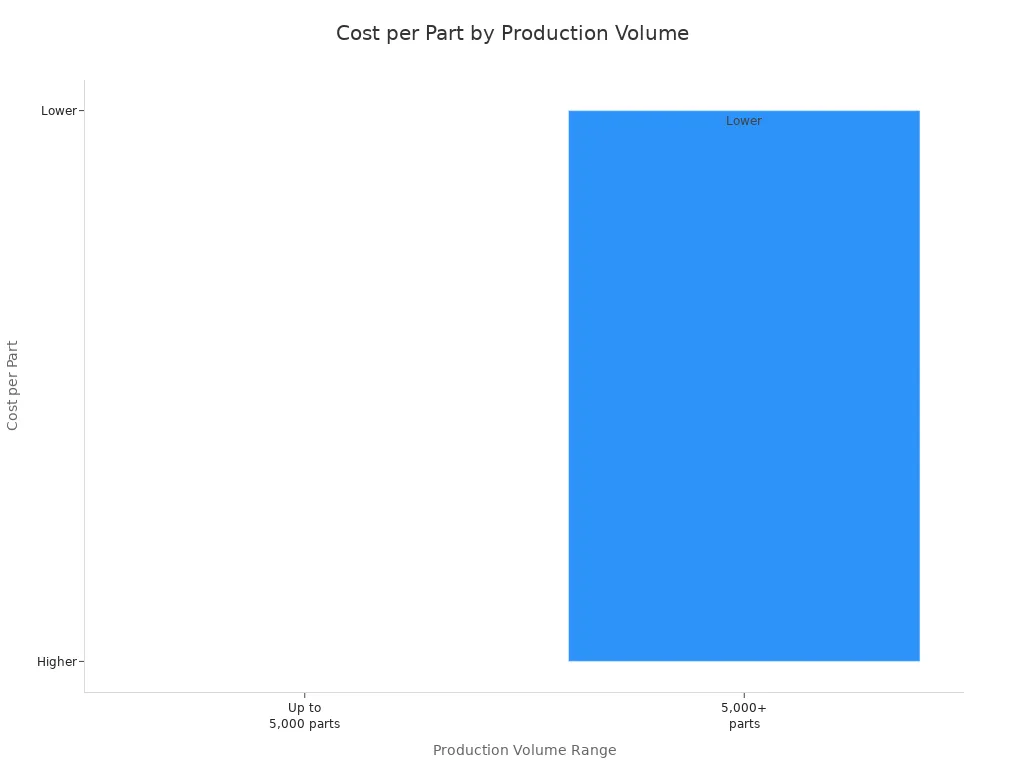
Stamping is used for enclosures with simple shapes and big orders. Progressive die stamping makes flat parts with bends for runs of 5,000 or more. Fourslide stamping makes clips and brackets with many bends. Deep draw stamping makes seamless, cup, or box-shaped enclosures. Compound die stamping is for simple, flat parts in smaller amounts.
| Stamping Method | Ideal Enclosure Type | Typical Production Volume | Production Speed | Tooling Cost |
|---|---|---|---|---|
| Progressive Die | Flat parts with bends | High volume (5,000+ parts) | Very fast | High |
| Fourslide | Parts with many bends (clips, brackets) | Medium to high volume | Fast | Medium |
| Deep Draw | Seamless, cup, or box-shaped enclosures | Medium volume | Medium | Medium-High |
| Compound Die | Simple, flat parts (washers, blanks) | Low volume | Slow | Low-Medium |
Stamping gives the best deal for simple, high-volume electronic enclosures when speed and saving money matter most.
Choosing the Right Method for Electronics
Material Requirements and Considerations for Electronic Enclosure Selection
Picking the right material is the first step. It helps you choose between stamping and die casting for electronic enclosures. Material strength, how easy it is to shape, and how it looks are important. Stamping works well for light, hollow enclosures. This method makes simple shapes fast and keeps tool costs low. Stamping can use both ferrous and nonferrous metals. This makes it good for many places.
Die casting for electronic enclosure often uses aluminum alloys like ADC12. These alloys are strong, resist rust, and cast well. They handle shaking and work for thin walls. When picking materials, engineers look at thickness, spring-back, hardness, ductility, and surface. These things change how the metal forms and how long tools last.
Tip: Always pick a material that fits where and how the enclosure will be used.
Evaluating Design Complexity Between Stamping and Die Casting
How complex the design is can help you choose the process. Die casting can make tricky 3D shapes and inside spaces. It gives smooth parts with exact sizes in one step. This is good for enclosures that need tight fits and small details.
Stamping is better for flat or shallow parts with even thickness. It makes parts fast and lets you change designs easily. But stamping cannot make deep holes or undercuts. The table below shows how both ways compare:
| Aspect | Die Casting | Metal Stamping |
|---|---|---|
| Geometry Complexity | Complex 3D shapes, internal features | Flat or shallow, uniform thickness |
| Dimensional Accuracy | High, in one cycle | Lower, best for simple shapes |
| Production Lead Time | Longer mold cycle, hard to modify | Shorter die cycle, easy to change |
| Production Speed | Slower per part, less assembly needed | Very fast, good for large runs |
| Application Suitability | Best for complex, tight-tolerance enclosures | Best for simple, flat, or shallow enclosures |
If you need to change designs a lot or have simple shapes, stamping is easier. For detailed and exact enclosures, die casting for electronic enclosure is better.
Production Volume and Cost Considerations
How many parts you need and the cost matter a lot. Stamping usually costs less for small batches because tools are cheaper. When you need more parts, die casting gets cheaper, especially for hard shapes. The table below shows how costs change:
| Production Volume | Die Casting Cost Characteristics | Stamping Cost Characteristics |
|---|---|---|
| Low Volume | High initial tooling cost; higher per-unit cost | Lower tooling investment; cost-effective |
| Medium Volume | Per-unit cost drops as tooling cost spreads out | Remains economical for simple shapes |
| High Volume | Lowest per-unit cost; best for complex designs | Very low per-unit cost; ideal for simple parts |
- Stamping is best for simple, high-volume parts.
- Die casting for electronic enclosure saves money at medium or high volumes, especially for hard shapes.
- If the part is tricky, stamping costs go up because of extra tools and steps.
Note: Always figure out how many parts you need before picking a process.
Durability, Surface Finish, and Long-Term Performance Considerations
How long the enclosure lasts and how it looks are important. Die casting makes smooth, strong parts right away. These parts often do not need much extra work. Special coatings like powder coating, anodizing, or chromate can help stop rust and make parts last longer. Anodizing makes a hard layer that does not peel or crack. Powder coating adds texture and hides marks.
Stamped enclosures may need more work, like smoothing edges or adding a coating, to look good. Tin or nickel plating can help stop rust and make them conduct electricity better. Bare metal does not protect as well and can wear out faster.
If you want strong, nice-looking parts, die casting for electronic enclosure is a great choice. Stamping can also work, but it may need more steps to get the same result.
Checklist: How to Match Your Project to the Best Process
- Write down the size, shape, ratings, and finish you need.
- Pick a material that fits the place and job.
- Look at the design: Does it need 3D shapes or just bends?
- Count how many parts you need: Is it a small, medium, or big batch?
- Add up all costs: tools, each part, and finishing.
- Decide how tough and nice the surface should be.
- Think about how easy it is to put together and reach inside.
- Test samples for fit, strength, and sealing.
By using this checklist, engineers can pick the best way to make their electronic enclosure.
Choosing how to make your enclosure depends on how hard the design is, how strong it needs to be, and how many you want to make.
- Die casting is good for designs with lots of details and that need to be strong.
- Stamping is better for simple shapes when you need to make a lot of them.
Look at the checklist above to help you pick. If your project is special, ask an expert for help.
Do you have questions or want to tell us what you think? Write a comment below! 👇
FAQ
What is the main difference between die casting and stamping for enclosures?
Die casting melts metal to make strong, detailed shapes. Stamping presses flat metal sheets into simple or shallow parts. Die casting is best for tough, complex enclosures. Stamping works well for easy shapes and big batches.
Which process offers better protection against water and dust?
Die-cast enclosures seal out water and dust very well. They often meet top IP and NEMA standards. Stamped enclosures can protect too, but may need extra gaskets or careful building.
Can both processes use the same metals?
No, they cannot. Die casting uses nonferrous metals like aluminum, zinc, or magnesium. Stamping can use ferrous and nonferrous metals, such as steel, stainless steel, aluminum, and copper.
Is die casting always more expensive than stamping?
Not every time. Die casting costs more at first because of the mold. For big orders with tricky parts, the price per part goes down. Stamping is cheaper for simple, flat parts and small amounts.
How do I choose the right process for my project?
- Write down your enclosure’s size, shape, and strength needs.
- Pick the material you want.
- Figure out how many you need.
- Think about cost and how the surface should look.
- Try out samples if you can.
Talking to a manufacturing expert can help you pick the best way.